Space-based solar power has long been treated as futuristic. China is now testing pieces of it.
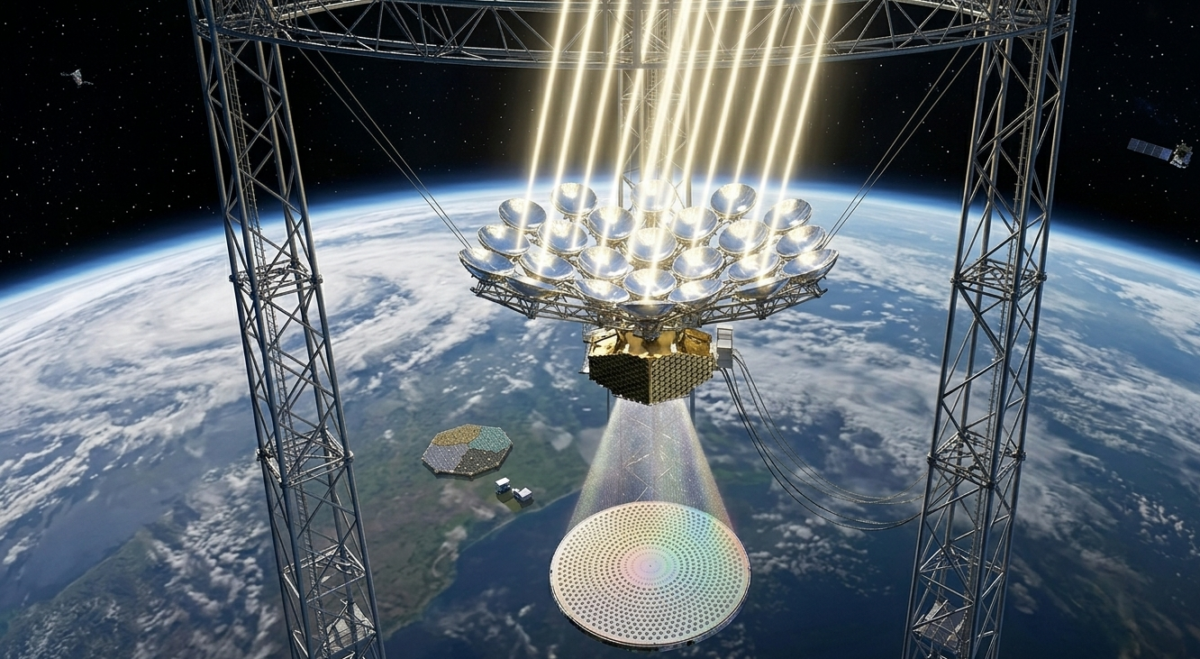
A research team at Xidian University has begun initial experiments under China’s Sun Chasing project, an effort aimed at developing large-scale space-based solar power systems capable of collecting energy in orbit and transmitting it wirelessly to Earth or to spacecraft.
The long-term concept is simple to describe and difficult to execute: capture uninterrupted solar energy in space, where there is no night, no weather, and no atmospheric filtering, then beam that power where it is needed. What makes the latest development notable is that China is now reporting early experimental progress on the transmission side of the problem.
According to the source material, the team demonstrated wireless power transmission over more than 100 meters to a stationary target and over more than 30 meters to a moving target. The project also reported microwave beaming experiments delivering as much as 1,180 watts with promising efficiency figures.
Why the concept matters
Space solar power has attracted interest for decades because it offers a theoretical way to generate continuous renewable electricity unconstrained by clouds, day-night cycles, or seasons. In principle, orbital systems could beam energy to ground stations or directly support spacecraft and remote operations in space.
That makes the idea appealing not only for terrestrial clean energy ambitions, but also for strategic and logistical uses in orbit. A functioning space power architecture could eventually support satellites, lunar infrastructure, or other long-duration missions without relying entirely on onboard generation and storage.
The challenge is that every stage is hard: collecting power at scale, converting it efficiently, transmitting it accurately across distance, and receiving it safely.

What China says it has demonstrated
The Sun Chasing project remains in an early experimental phase, but the reported tests suggest work is progressing beyond conceptual studies. Wireless transfer over more than 100 meters to a stationary target indicates the team is building and validating controlled beaming systems at meaningful laboratory or field scales.
The moving-target result is also important. Real-world power beaming is not only about line-of-sight transmission to fixed receivers. Tracking and maintaining delivery to a receiver that changes position is a more demanding problem, especially if future use cases include spacecraft or dynamic receiving platforms.
The reported 1,180-watt delivery figure does not imply grid-scale capability, but it does suggest the researchers are addressing practical power levels rather than only conducting low-energy demonstrations.
Microwave power beaming is central
The source text specifically references efficient microwave beaming. That is one of the classic proposed methods for space solar power because microwaves can be directed and received over long distances with the right antenna systems. In a complete orbital architecture, solar energy would likely be converted into a transmittable form and then sent to receiving stations using carefully controlled beams.
Efficiency matters at every step. A system that loses too much energy during conversion, transmission, or reception quickly becomes impractical, especially once launch costs and orbital infrastructure are added. That is why even modestly scaled experimental gains matter. They help answer whether the concept can move from visionary sketches toward engineering realism.
What this means for the global energy and space landscape
China’s reported progress does not mean space solar power is imminent as a commercial energy source. But it does indicate that at least one major national effort is taking the enabling technologies seriously enough to build and test them.
That has implications beyond renewable energy. Space-based solar power sits at the intersection of energy security, launch capability, wireless power transfer, space systems engineering, and strategic autonomy. A country that leads in this domain could influence future power architecture both on Earth and in orbit.
It also fits a broader pattern in which long-horizon energy technologies are increasingly tied to national industrial strategy rather than left solely to academic speculation.
The obstacles remain enormous
Even with successful early demonstrations, the distance between a 100-meter test and an orbital power station is vast. Large-scale systems would require lightweight but durable space structures, highly efficient solar collection, precise beam control, safe transmission protocols, and major advances in deployment and maintenance.
There are also policy and public acceptance questions. Any technology designed to beam significant power across long distances will face scrutiny over safety, regulation, and dual-use concerns. Orbital infrastructure at the scale envisioned would also require substantial investment and sustained political commitment.
In other words, the hardest parts are still ahead. But early-stage technical milestones matter because they separate pure aspiration from measurable progress.
A field worth watching again
For years, space solar power occupied an ambiguous place between visionary engineering and science-fiction rhetoric. The concept never disappeared, but it often lacked the kind of practical testing that would force serious evaluation.
China’s Sun Chasing experiments suggest that phase may be changing. Wireless power transfer to stationary and moving targets, combined with reported multi-hundred-watt to kilowatt-class beaming performance, gives the field new substance.
The right interpretation is not that orbital solar stations are suddenly around the corner. It is that one of the world’s largest space and energy actors is now producing experimental results that justify closer attention.
If space solar power ever becomes real at scale, it will emerge through exactly this kind of incremental engineering: first the beam, then the control, then the efficiency, then the larger system. China appears to be taking those first steps in public.
This article is based on reporting by PV Magazine. Read the original article.
Originally published on pv-magazine.com