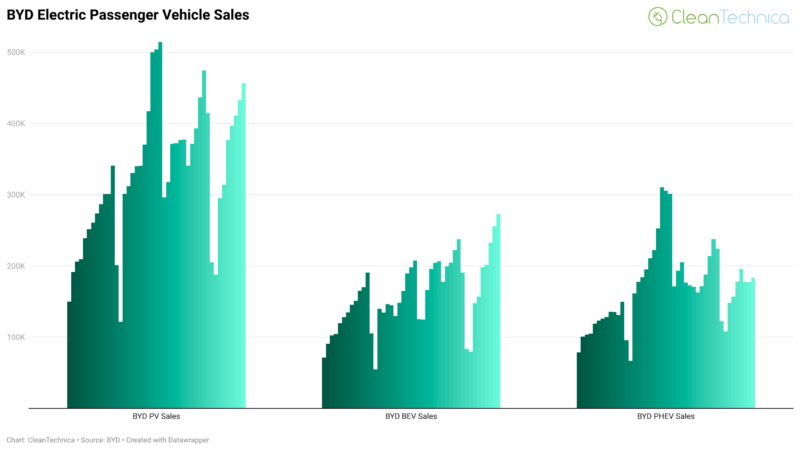
BYD's sales momentum kept building through September 2026, and the headline delivery number came with a notable twist: the growth was powered almost entirely by the company's fully electric models. The automaker reported 456,713 passenger vehicle deliveries for the month, a 5.4% increase over August 2026 and a 16.2% gain compared with September 2025.
On its own, that would be a respectable month. But the split between battery-electric vehicles (BEVs) and plug-in hybrids (PHEVs) reveals the more interesting story — a shift in buyer preference happening inside BYD's own lineup. After a slow start to the year, the company is now moving in the right direction, and its electric-only models are leading the way.
September by the numbers
Start with the monthly totals, which show a company clearly accelerating after a sluggish opening to 2026. The core figures for September 2026:
- Total passenger vehicle deliveries: 456,713, up 5.4% from August 2026 and 16.2% from September 2025
- BEV sales: 273,143, up 6.6% month over month and 33.2% year over year
- PHEV sales: 183,570, up 3.6% month over month but down 2.4% year over year
- Combined plugin passenger vehicle sales: 456,713 in September 2026, versus 393,060 in September 2025 — more than 63,000 additional deliveries
Because BYD's passenger lineup is built entirely around BEVs and PHEVs, those two categories add up to the total. That makes the monthly comparison unusually clean: whatever the company gained in September, it gained on the electric side.

Battery-electric models carry the month
The fully electric category is where September's real expansion happened. BEV deliveries rose from 205,050 units in September 2025 to 273,143 units in September 2026 — a jump of more than 68,000 vehicles and a 33.2% year-over-year increase. Month over month, electric sales grew 6.6%.
That 33.2% growth rate is more than double the 16.2% increase recorded across the passenger vehicle business as a whole. In practical terms, the electric side of the business is not just growing — it is growing substantially faster than the company's overall delivery pace, which means it is steadily taking a larger share of every vehicle BYD hands to a customer.
Why the split matters
When a single month's data shows total volume rising 16.2% while one product category climbs 33.2%, simple arithmetic does the rest: the other category must be lagging. Since BEVs and PHEVs are the only two options in BYD's passenger lineup, the strength in electrics came at the expense of the plug-in hybrid side of the mix.
The implication is that BYD's growth in September was not evenly distributed across its product range. It was concentrated in the models that run on batteries alone, suggesting that the gradual tilt toward full electrification that has been building in the broader market is showing up clearly in BYD's own order book.
Plug-in hybrids lose ground
The PHEV figures tell a different story. Plug-in hybrid sales came in at 183,570 units in September 2026, up 3.6% from August but down 2.4% compared with the 188,010 units delivered in September 2025.
The month-over-month gain is modest, and the year-over-year decline is the key detail. September 2025 was a strong comparison point for the company's hybrid lineup, and this year's result fell short of it. The result is that PHEVs are no longer contributing to BYD's year-over-year growth — they are subtracting from it. In a month when total deliveries rose by more than 63,000 vehicles versus the prior year, the hybrid category actually lost roughly 4,400 units of volume on an annual basis.
For a manufacturer whose rise was once closely associated with plug-in hybrids as a bridge technology, the September breakdown marks a meaningful reordering of priorities. The bridge, at least for this month, is not where the customers are heading.

The nine-month picture
Zoom out from a single month and the strategic value of the electric surge becomes clearer. Through the first three quarters of 2026, BYD delivered 3,078,544 passenger vehicles, down 4.4% from the 3,218,862 recorded over the same period in 2025. The company is still working to close that gap, but the trend is improving month by month.
The year-to-date split shows exactly where the pressure and the promise sit:
- BEVs: 1,629,957 units in the first three quarters of 2026, up 1.5% from 1,605,903 a year earlier
- PHEVs: 1,448,587 units, down 10.2% from 1,612,959 a year earlier
Fully electric is already in positive territory
The most striking takeaway from the nine-month data is that the electric business has already crossed back into growth while the overall company has not. Total passenger vehicle deliveries remain 4.4% below last year's pace, yet BEV volume is up 1.5% — a modest gain, but a directional one that September's 33.2% surge should reinforce.
The plug-in hybrid decline of 10.2% over the same period explains the drag. A shortfall of more than 164,000 hybrid units year to date is the single largest reason BYD's accumulated deliveries trail 2025's, and it is large enough that the company's electric growth has been partly offsetting it rather than fully compensating for it.
What the September data suggests
Three things stand out from the September result. First, BYD's monthly momentum is real: September built on August with a 5.4% sequential gain. Second, that momentum is increasingly electric — BEVs outpaced the company's overall growth rate by a wide margin. Third, the plug-in hybrid category remains a drag that has not yet reversed, both for the month and for the year.
If the September mix holds, the arithmetic is straightforward. Continued double-digit growth in electric sales, layered on even a flat hybrid performance, would put the company back on a path to closing its year-to-date shortfall. The gap is narrowing, and the electrified end of the lineup is doing the heavy lifting.

The bottom line
BYD's September 2026 numbers describe a company recovering from a slow start to the year and doing so on the strength of its fully electric models. Deliveries of 456,713 passenger vehicles represent a 16.2% year-over-year improvement, but the 33.2% jump in BEV sales is the figure that matters most for the company's direction.
The plug-in hybrid side of the business, down 2.4% for the month and 10.2% for the year, is the counterweight — a reminder that not every part of BYD's lineup is participating in the rebound. For now, at least, the electric share of the mix is rising, and September offered the clearest evidence yet that BYD's near-term growth story runs on batteries alone.
This article is based on reporting by CleanTechnica. Read the original article.
Originally published on cleantechnica.com