Why Bennu Looked Different Than Scientists Expected
Asteroid Bennu surprised researchers when NASA’s OSIRIS-REx spacecraft arrived in 2018. Earlier Earth-based observations had suggested a surface dominated by smaller rock fragments, but the spacecraft instead found a rugged world covered in large boulders with widely varying physical characteristics.
Now, a new study offers a possible explanation for that mismatch. According to a report on the research, Bennu’s low thermal inertia appears to come from cracks within the asteroid’s rocks rather than from a blanket of small debris. The finding helps reconcile remote observations with what OSIRIS-REx actually saw on the surface.
That matters because thermal inertia, the degree to which a material retains heat, was one of the main clues used to infer Bennu’s physical nature before the spacecraft arrived.
Returned Samples Provide the Missing Ground Truth
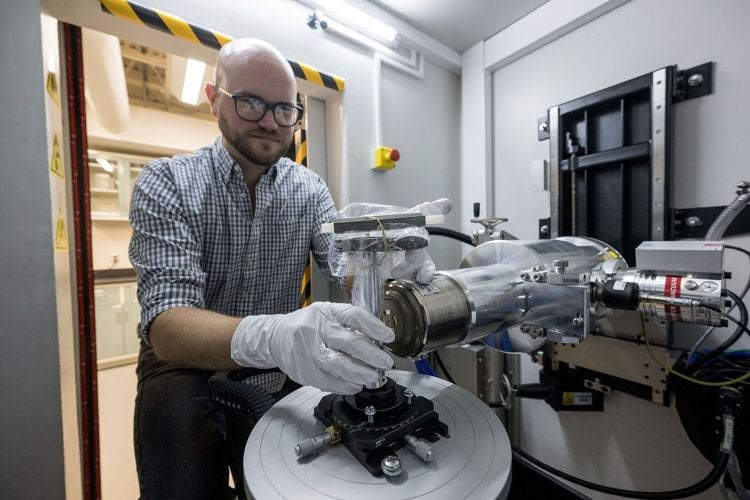
The study drew on Bennu samples returned by OSIRIS-REx and applied laboratory techniques previously used on samples from asteroid Ryugu. Researchers tested the physical properties and thermal inertia of the material to understand how they related to the boulders seen on Bennu.
Initially, Bennu’s low thermal inertia had led to the idea that its surface was covered in small rock fragments. Another possibility was that the asteroid’s large boulders contained substantial empty space, or porosity, which would make them poor heat retainers. Hollow objects, after all, tend to hold heat differently than solid ones.
But after analysis, the researchers found something else: internal cracking appears to be the key. The report says Bennu’s low thermal inertia results from cracks within its surface rocks, a conclusion similar to findings for Ryugu.

Why Cracks Matter
At first glance, the distinction may sound technical. In reality, it changes how scientists interpret asteroid surfaces from afar. If a heavily cracked boulder can mimic the thermal signature that researchers once associated with smaller fragments, then remote sensing can produce misleading impressions about what is physically present on the ground.
That is one reason the study is important. It suggests Bennu did not simply defy expectations in a random way. Instead, the asteroid may have exposed a blind spot in how thermal data is translated into surface models when direct sampling is not available.
The study therefore does more than solve a Bennu-specific puzzle. It also strengthens the case for sample-return missions as a way to calibrate and correct remote observations.
A Lesson for Future Asteroid Science
The researchers explicitly note that the analysis of Bennu and Ryugu samples allows scientists to “ground-truth” findings from remote-sensing data. That phrase captures the broader scientific value. Spacecraft can observe, orbit, and measure from a distance, but returned material provides the final check on what those measurements really mean.
For planetary science, this is a significant lesson. Asteroids are often treated as time capsules from the early solar system, and their physical properties matter for everything from formation theories to mission design. Misreading the structure of their surfaces can therefore ripple into larger interpretations.
Bennu’s cracked rocks also show that surface appearance alone may not tell the full story. A boulder-dominated asteroid can still behave thermally in a way that looks, from far away, like a field of smaller fragments.

Why Bennu Still Matters
Bennu remains one of the most scientifically valuable small bodies ever studied, not least because it has now been observed both remotely and directly. That combination lets researchers test assumptions that would otherwise remain speculative.
The new work shows how a discrepancy that once looked like a simple observational error can become a deeper insight into asteroid geology. Bennu’s rugged rocks are not just rugged. They are internally fractured in ways that affect how the asteroid absorbs and releases heat.
That makes the findings useful not only for understanding Bennu, but also for interpreting other dark, rocky asteroids that may be studied from a distance before spacecraft ever arrive. What seemed like a mismatch between telescope data and reality may instead be a reminder that reality is structurally more complicated than the models assumed.
This article is based on reporting by Universe Today. Read the original article.
Originally published on universetoday.com