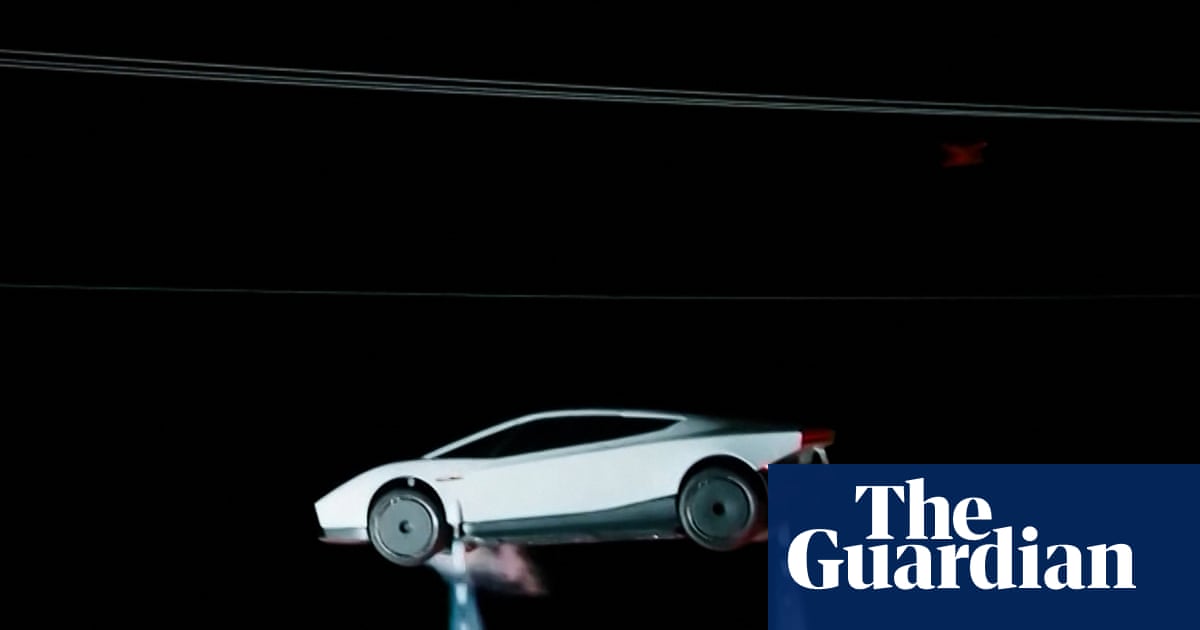
Tesla has demonstrated a redesigned Roadster 2 prototype that used rocket thrusters to perform ramp-assisted aerial maneuvers, including a flip and landing. At an event at SpaceX’s rocket development and testing facility in Texas, Elon Musk described the vehicle as a “flying car” and said it was controlled remotely during the demonstration.
The display placed Tesla’s long-promised next-generation Roadster at the intersection of electric performance cars and aerospace-inspired propulsion. It also underscored the distance between a striking prototype demonstration and a vehicle that could be legally and safely operated as an aircraft or on public roads.
A remote-controlled demonstration
Video from the event showed the Roadster driving up a curved ramp, using suction to maintain grip while inverted, then using thrusters to flip, fly and land. In another sequence, the vehicle appeared to use jets to leap over a line of existing Tesla models before accelerating.
Musk said the prototype was operated remotely “to make sure we don’t kill anyone.” He described the car as having altitude controls, thrusters and main rear thrusters, and said it could perform rolls and other aerial maneuvers.
Those remarks make clear that the event was a controlled prototype display rather than a conventional vehicle launch. The Roadster was not presented as a consumer car approved for public-road driving or as a certified personal aircraft. Musk himself acknowledged uncertainty about whether its capabilities would be legal in all jurisdictions.
SpaceX technology enters the Tesla narrative
The Roadster 2 demonstration drew on technology associated with Musk’s aerospace company, SpaceX. Musk said the vehicle could “basically fly like a rocket,” and the reported use of rocket thrusters is the defining feature of the prototype’s public showing.
That connection is important because the phrase “flying car” can suggest a vehicle designed for sustained, point-to-point aerial transportation. The demonstration instead centered on short, dramatic maneuvers enabled by thrusters: a ramp-assisted jump, a flip, a landing and an apparent leap over other cars. The available information does not establish how the vehicle would be regulated, what operational limits would apply or whether any customer version would reproduce the prototype’s full capabilities.
It does show Tesla using aerospace-style hardware as a performance and design proposition for a high-end sports car. For the company, that creates an unusually direct overlap between the public identities of Tesla and SpaceX.

Performance claims and a 2028 production target
Musk said the Roadster 2 could accelerate from zero to 60 mph in less than one second, which he characterized as a record. The company has said the vehicle is planned to enter production in 2028 and would be priced above $200,000.
The vehicle’s reservation page indicates several proposed versions. A performance version requires a £50,000 deposit, while a thrust version requires a $250,000 deposit. A one-seat “rocket” variant with a “full flight system” is described as invitation-only. Tesla also states that flying the car is not permitted on public roads.
Those terms point to a product positioned well beyond the mass-market vehicles that have driven most of Tesla’s sales. The Roadster 2 is being framed as an ultra-premium, limited-access technology showcase, with different deposit levels and a highly exclusive version for selected customers.

Prototype spectacle versus practical transport
The event’s most attention-grabbing claim is also the one that requires the greatest care in interpretation. A prototype that can use thrusters in a controlled demonstration is not necessarily a broadly usable flying car. Public use would raise questions about safety, licensing, insurance, operational airspace, maintenance, noise and local rules. The information released with the demonstration does not answer those questions.
There is also a practical distinction between a car that can briefly leave the ground and a vehicle designed to replace ordinary road or air travel. The Roadster’s displayed maneuvers were theatrical and short, built around acceleration, vertical movement and acrobatics rather than a described transport mission. Tesla’s own notice that flying is not permitted on public roads reinforces that boundary.
Still, the reveal is culturally notable because it turns a familiar future-tech idea into a public product demonstration. Musk had expressed skepticism about flying vehicles in 2014, according to the report, before announcing Roadster 2 development three years later. The Texas event is the clearest public expression yet of his current claim that the future can include cars with rocket-like flight capability.
What Tesla has actually shown
Tesla has shown a Roadster 2 prototype capable of dramatic, remotely controlled, thruster-assisted demonstrations. Musk says the vehicle has altitude controls and separate thruster systems, and Tesla is taking reservations for proposed versions of the two-seat sports car. Production is targeted for 2028.
What remains unresolved is how closely a production vehicle would match the prototype, what regulations would govern any flight-related capability and what practical uses would remain once the event setting is removed. For now, the Roadster 2 is best understood as a high-performance concept demonstrated with aerospace-inspired hardware—not evidence that personal flying cars are ready for ordinary public use.
This article is based on reporting by The Guardian. Read the original article.

Originally published on theguardian.com