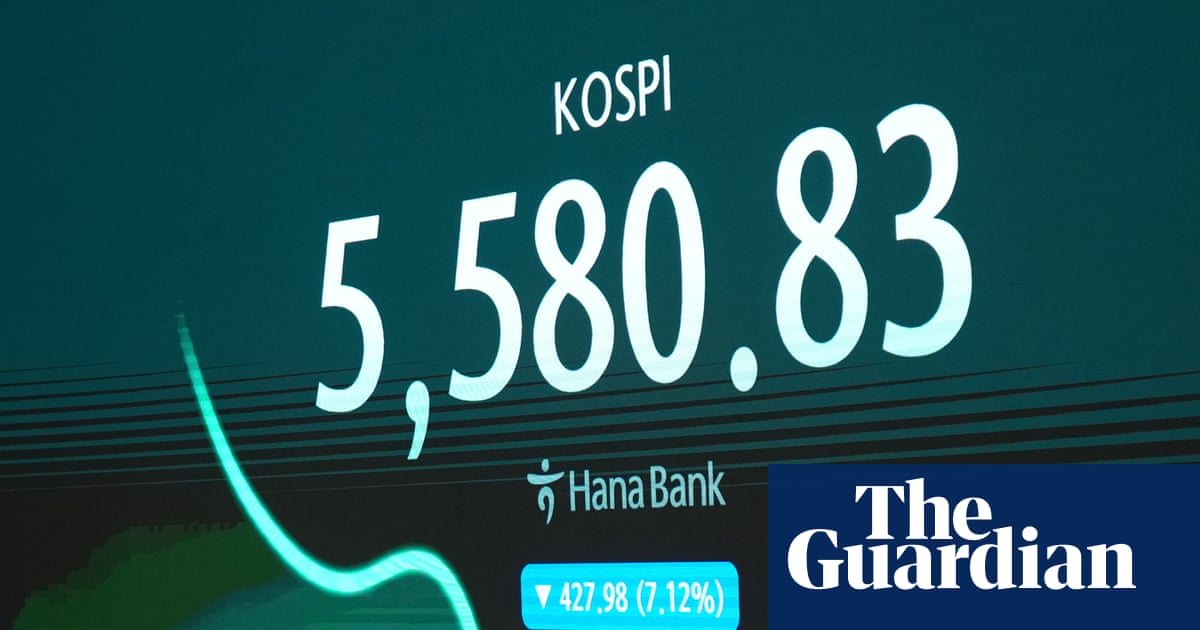
AI-linked technology shares came under heavy pressure in global trading on Thursday as investors reassessed the outlook for inflation, interest rates and debt across a sector that has drawn enormous capital. The selling began in the United States and spread through Asian markets, hitting chipmakers and companies closely associated with the AI investment boom.
South Korea’s Kospi 200, an index with substantial exposure to memory-chip producers, fell more than 8% overnight and reached a six-month closing low. The decline was severe enough to trigger circuit breakers and temporarily halt trading at points during the session. SK Hynix and Samsung Electronics were among the companies hit hardest, falling nearly 11% and 9.5%, respectively.
Japan also saw a sharp retreat. The Nikkei 225 dropped 4.9%, while memory-chip maker Kioxia fell 11% and SoftBank declined 10%. SoftBank is a major investor in OpenAI, placing it among the companies that investors have viewed as exposed to the fast-growing market for AI infrastructure and services.
Inflation changes the calculation
The immediate catalyst was new U.S. inflation data. Consumer prices rose 3.7% in September, above expectations and the fastest increase since the consumer price index reached 4.2% in May. The result unsettled markets already debating whether the costs of the AI buildout can be supported by near-term revenue and profits.
Higher inflation can matter especially sharply for growth-oriented technology companies. When investors expect higher interest rates, future earnings are discounted more heavily, reducing the present value that markets assign to companies whose strongest cash flows are expected years from now. That sensitivity helps explain why a shift in rate expectations can produce outsized moves in technology shares.
Deutsche Bank analysts, led by Jim Reid, described the period as a tumultuous 24 hours for markets, with a strong U.S. consumer-price reading followed by mounting concern around the AI trade. The inflation data also raised expectations that the U.S. Federal Reserve could increase rates again, with some market participants pricing in a move as soon as the end of the month.

Chipmakers sit at the center of the AI trade
Semiconductor companies have been central beneficiaries of demand for artificial-intelligence computing. Memory chips, processors, networking equipment and data-center capacity are all needed to train and run large AI systems. That has made companies in the supply chain a focal point for investors seeking exposure to the technology’s expansion.
It also makes the group vulnerable when confidence shifts. The fall in South Korean and Japanese chip-related shares showed how quickly concern about financing conditions can travel through a market that has become tightly connected across hardware makers, cloud providers, investors and AI developers.
The market move was not limited to Asia. In the previous U.S. session, the Nasdaq Composite fell 1.9% and the S&P 500 lost 1.1%, their worst performances since July. The sequence underlined the global reach of the technology trade: a change in expectations in U.S. markets can affect companies making memory chips in Korea, investors in Japan and technology valuations elsewhere.
Debt concerns add pressure
Investors are not only weighing the pace of AI demand. They are also examining how the sector’s vast spending requirements will be financed. Building data centers and acquiring advanced computing equipment requires substantial capital, while returns may arrive over a longer period. In a lower-rate environment, markets may be more willing to fund ambitious projects. When rates are expected to rise, borrowing costs and debt burdens become more prominent risks.
That concern has amplified the impact of the inflation surprise. The sell-off reflects a reassessment of both sides of the AI investment equation: the promise of continued demand for computing infrastructure and the financial conditions needed to sustain investment in it.
The episode does not by itself settle the longer-term outlook for AI or semiconductor demand. It does, however, show that the sector’s market performance remains closely tied to broader economic data. A technology story that has often been framed around innovation is also a story about capital costs, inflation and the willingness of investors to finance expansion.

A test for a crowded market theme
The breadth of the decline suggests that investors are treating AI exposure as a shared risk across several linked markets rather than as an isolated issue for one company or country. Memory-chip makers, technology investors and major equity benchmarks all moved lower as the same concerns spread.
For companies tied to the AI supply chain, the next phase will depend on whether inflation pressures ease and whether spending on AI infrastructure continues to justify the scale of investment. For markets, the sell-off is a reminder that even a powerful technology theme can be repriced quickly when the economic assumptions supporting it change.
This article is based on reporting by The Guardian. Read the original article.
Originally published on theguardian.com