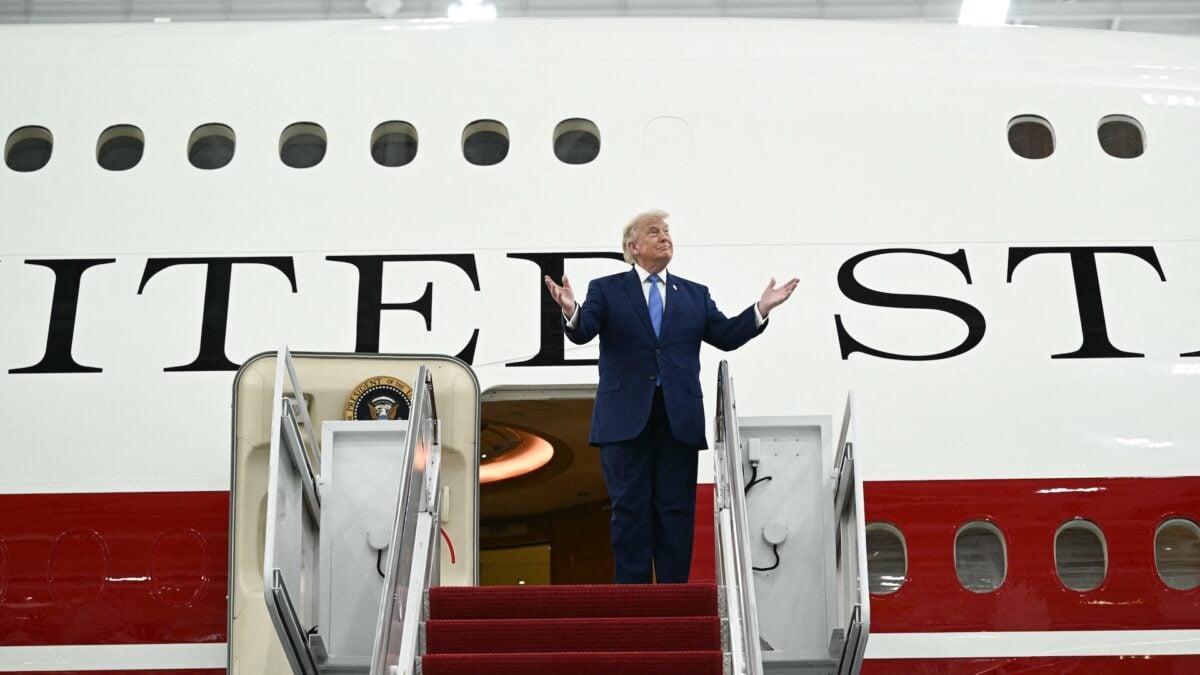
A replacement arrives under unusual circumstances
The latest Air Force One to enter the political spotlight is not simply another aircraft modernization story. It is a case study in how procurement delays, presidential priorities, symbolism, and constitutional concerns can collide around a single piece of machinery. The aircraft unveiled Friday and described in coverage as a Qatar-linked replacement has immediately become part of a broader debate over whether the United States found a practical shortcut around a stalled modernization effort or stepped into a controversy that will shadow the plane for as long as it is flown.
At the center of the dispute is a basic claim from President Donald Trump: the United States needed a newer and better aircraft for presidential transport. That argument draws force from the long-running problems surrounding Boeing’s effort to deliver the next-generation VC-25B fleet, the program intended to replace the older VC-25A aircraft that have served as the best-known Air Force One platforms. But while the desire for a newer aircraft can be explained in technical and operational terms, the path by which this plane entered the conversation is what has made it a flashpoint.
The Boeing backdrop
The current controversy only makes sense in light of the delays that have plagued Boeing’s Air Force One replacement work. The VC-25B concept has been public for years, and the plan was straightforward in broad form: adapt the Boeing 747-8i into a heavily modified military aircraft capable of serving as the president’s primary long-range transport. In 2018, Trump renegotiated the contract with Boeing, with delivery then scheduled for 2024 and a quoted price of $3.9 billion.
That timeline did not hold. As described in the source material, Boeing remained slow in modifying and delivering the aircraft even after the renegotiation. Those delays and rising frustration created the political opening for an alternative. In that sense, the Qatar-linked aircraft is not replacing the Boeing program so much as becoming a highly visible response to its failure to deliver on schedule.
For the White House, the message is simple: if the standard procurement route could not move fast enough, another option had to be found. For critics, that same reasoning looks like an attempt to bypass the normal political and institutional constraints that surround presidential assets.

Why this aircraft is controversial
The aircraft’s features matter, but the argument around it begins with how it changed hands. The reporting summarized in the supplied source text says experts have repeatedly argued the transfer may run into the U.S. Constitution’s emoluments clause. The concern is that a luxury aircraft tied to a foreign government creates the appearance, if not the legal reality, of an improper benefit reaching the president.
Trump’s defense, as reflected in the source text, is that the Pentagon can accept a gifted aircraft from Qatar without the president personally receiving an impermissible benefit. That distinction is central to the administration’s position. If the aircraft is treated as a defense asset handled through government channels, supporters argue the constitutional objection weakens.
But the politics do not disappear even if litigation never materializes. The source text notes that many observers do not expect a serious legal effort to punish or reverse the transfer. That does not mean the matter is settled. It means the practical political outcome may be that the aircraft flies under a permanent cloud of controversy without ever receiving a definitive court ruling.
Another detail sharpens the criticism: according to the summarized CNN reporting referenced in the source text, the aircraft was portrayed not as an unsolicited diplomatic gesture but more as something actively sought. That framing matters because it changes the optics from passive acceptance to direct pursuit of a foreign-linked presidential platform.
What “better” is supposed to mean
The public argument in favor of the aircraft depends on the word “better,” but that word can mean several things at once. It can mean newer in age, more luxurious in cabin design, more available in the near term, or more politically useful as a demonstration that the administration acted while Boeing did not. Those are not the same standard.
From the supplied source material, the clearest practical advantage is immediacy. A delayed program offers little value to a president focused on visible readiness. A plane that can be unveiled and integrated more quickly carries political and symbolic benefits even before its technical merit is fully debated in public.
Luxury, meanwhile, is a secondary and more delicate selling point. Presidential transport is not judged mainly by opulence. It is judged by reliability, communications capability, survivability, supportability, and how well it integrates into a hardened military mission set. A luxurious commercial or state aircraft may impress visually, but that does not automatically make it a superior Air Force One platform.
This distinction is important because the administration’s public rhetoric risks blending prestige with capability. In presidential aviation, those categories overlap in public imagination but not in mission planning.

A symbol of statecraft and procurement failure
Air Force One has always been more than transportation. It is a flying command platform, a diplomatic stage, and a global symbol of American executive power. Any attempt to replace or supplement it therefore becomes a statement about institutional competence. The Qatar-linked aircraft sends two different messages at once.
One message is that the administration is unwilling to wait indefinitely for a marquee U.S. aerospace contractor to finish a long-promised job. That can be read as impatience, but also as an indictment of how difficult major defense-adjacent procurement has become. The second message is less comfortable: the United States, despite its aerospace depth, became entangled in a situation where a foreign-linked aircraft could be presented as the faster route to presidential modernization.
That combination is why the story has traveled beyond aviation enthusiasts. It touches procurement, foreign relations, executive ethics, industrial performance, and national image all at once.
What comes next
The immediate future of the aircraft will likely be shaped less by a single legal verdict than by continued scrutiny. Questions will persist over how the aircraft compares operationally with the still-undelivered VC-25B, what modifications are required for presidential use, and whether the transfer sets an uncomfortable precedent. Boeing’s delays remain part of the story too. Every further setback on the VC-25B program makes the administration’s workaround look more understandable, even if not more defensible.
That leaves the new aircraft in a paradoxical position. It may be politically useful because it exists now, and controversial for precisely the same reason. It is a solution born from delay, but one that creates its own long tail of institutional and constitutional questions.
In that respect, the new Air Force One debate is not really about whether one plane is shinier than another. It is about what a presidential aircraft represents, who gets to provide it, and what standards the United States is willing to bend when legacy systems fail to arrive on time.
This article is based on reporting by Gizmodo. Read the original article.

Originally published on gizmodo.com