An old jawbone is reopening questions about medieval dental skill
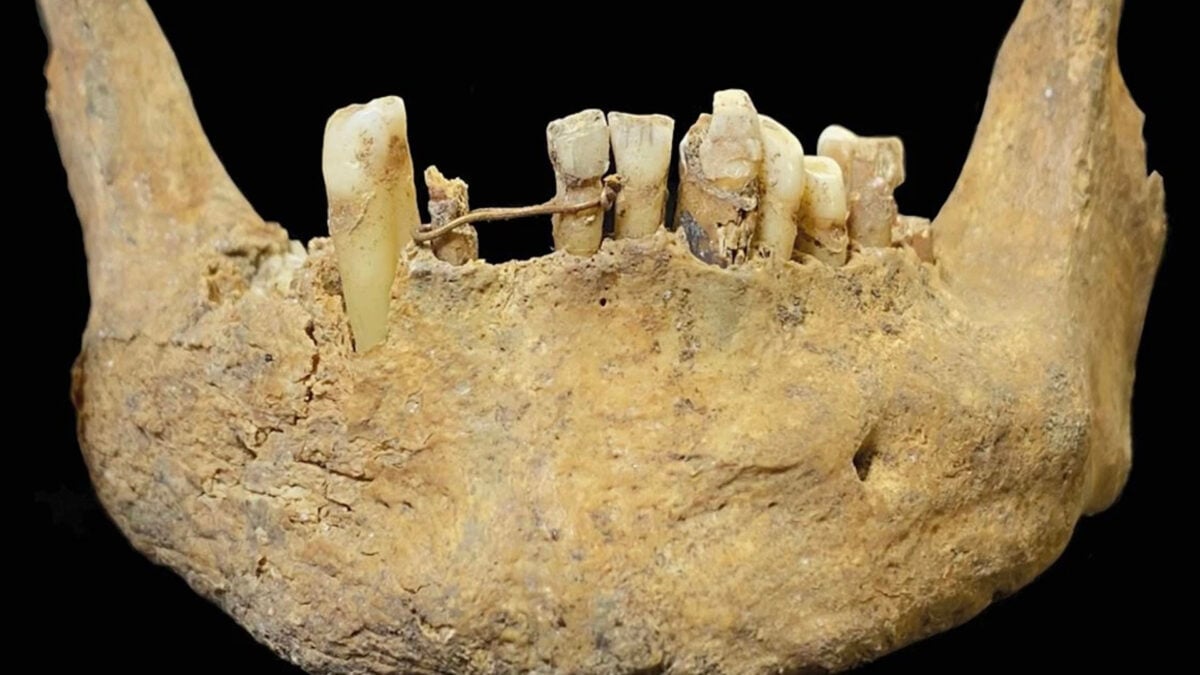
An archaeological dig at the site of a 12th-century church in Aberdeen, Scotland, has revealed a striking piece of dental work: a thin gold ligature wrapped around two teeth and extending across the healed socket of a missing tooth. According to the researchers cited in Gizmodo, the object most likely functioned either to retain a damaged incisor or to support a prosthetic replacement.
The find stands out not just because it is made mostly of gold, but because of what it suggests about technical competence long before modern dentistry became formalized. The metal wire was reported as 82.4 percent gold, 9.8 percent silver, and 2.5 percent copper, roughly equivalent to 20-carat gold today. More important than composition, however, is the evidence of intent. This was not ornamental debris near a skeleton. It was a carefully placed intervention in a human mouth.
A sign of advanced care before modern dentistry
The jawbone was found at the East Kirk of St. Nicholas Kirk in Aberdeen. Researchers dated the individual to a broad range between 1460 and 1670 using radiocarbon analysis, while noting that the bone had been found apart from its original context. Even with that uncertainty, the team concluded that the person was likely a relatively wealthy member of the community, in part because of the burial location and in part because nearly solid gold dental work would have been out of reach for most people.
The significance of the discovery is twofold. First, it reinforces the idea that sophisticated dental treatment existed centuries before dentistry was officially credentialed in the United Kingdom in 1860. Second, it highlights the uneven social distribution of such care. Techniques may have existed, but access to them was almost certainly restricted by wealth and status.
That combination feels familiar even now. Medical innovation often appears first at the edges of privilege before spreading, if it spreads at all. This medieval case appears to fit that pattern.
What the find says about historical practice
The researchers describe the ligature as comparable in concept to a modern dental bridge. That does not mean medieval practitioners had modern materials science, pain control, sterilization, or standardized training. It does mean they were experimenting with methods of retention and replacement that involved delicate handling, material selection, and a practical understanding of oral mechanics.
Gizmodo’s summary of the study notes that pre-modern dental treatment in Britain could come from a wide range of practitioners, including barber-surgeons, local healers, tooth-drawers, and traveling specialists. The article also points to the existence in Scotland of more trained “dentatores,” practitioners who may have drawn on advanced techniques associated with Arabic medical traditions.
That context matters because it complicates the common assumption that pre-modern care was uniformly crude. It was often inconsistent and risky, but not necessarily unsophisticated in every case. Skilled individuals could develop real expertise even in the absence of modern institutions.
A small object with a large cultural signal
Archaeological medicine often advances through fragments rather than complete stories. In this case, a single jawbone cannot tell researchers everything about the patient’s life, symptoms, or the exact success of the procedure. But it does show that someone invested substantial effort and valuable material in preserving dental structure or appearance.
That opens several possibilities. The procedure may have been functional, cosmetic, or both. Teeth affect speech, eating, appearance, and social standing. In an affluent parish setting, those factors may all have mattered. The ligature therefore offers a window not only into technical craft, but into how people of the late Middle Ages understood bodily repair and social presentation.
There is also something revealing in the material choice. Gold is soft, workable, and resistant to corrosion, which makes it plausible for oral use. But it is also a status metal. Even if the procedure had a practical goal, the use of gold would have carried social meaning.
Why the discovery resonates now
The modern appeal of finds like this lies in their ability to unsettle easy stories about progress. Dentistry did not suddenly appear out of nowhere when licensing systems arrived. Formalization matters, but it often organizes and standardizes practices that have much deeper roots.
This Aberdeen ligature suggests that late medieval practitioners, at least in some circles, were already grappling with problems of tooth retention and replacement in recognizably technical ways. The procedure may not have been common, and it certainly was not egalitarian. Yet it was real.
- Researchers found a thin gold dental ligature in a medieval Scottish grave context.
- The wire was reported as mostly gold and likely functioned as retention or bridging support.
- The remains were dated broadly to between 1460 and 1670.
- The find suggests advanced dental intervention existed well before modern credentialed dentistry.
This article is based on reporting by Gizmodo. Read the original article.
Originally published on gizmodo.com