A small shutdown with a long cultural shadow
Ask.com was never the biggest force on the web, and by the end it was hardly central to anyone’s daily internet life. But its closure still matters because some brands outlive their market power as cultural artifacts. Ask.com, formerly Ask Jeeves, was one of those brands. With its search business now discontinued by parent company IAC, a recognizable piece of the early consumer internet has formally dropped out of service.
That is more significant than the fate of a single aging search property. It marks the continued disappearance of an internet built around named destinations, quirky interfaces, and the idea that simply phrasing a question into a box could feel novel. Ask Jeeves helped package search not just as retrieval, but as an interaction. The mechanics often fell short, but the premise stuck in memory.
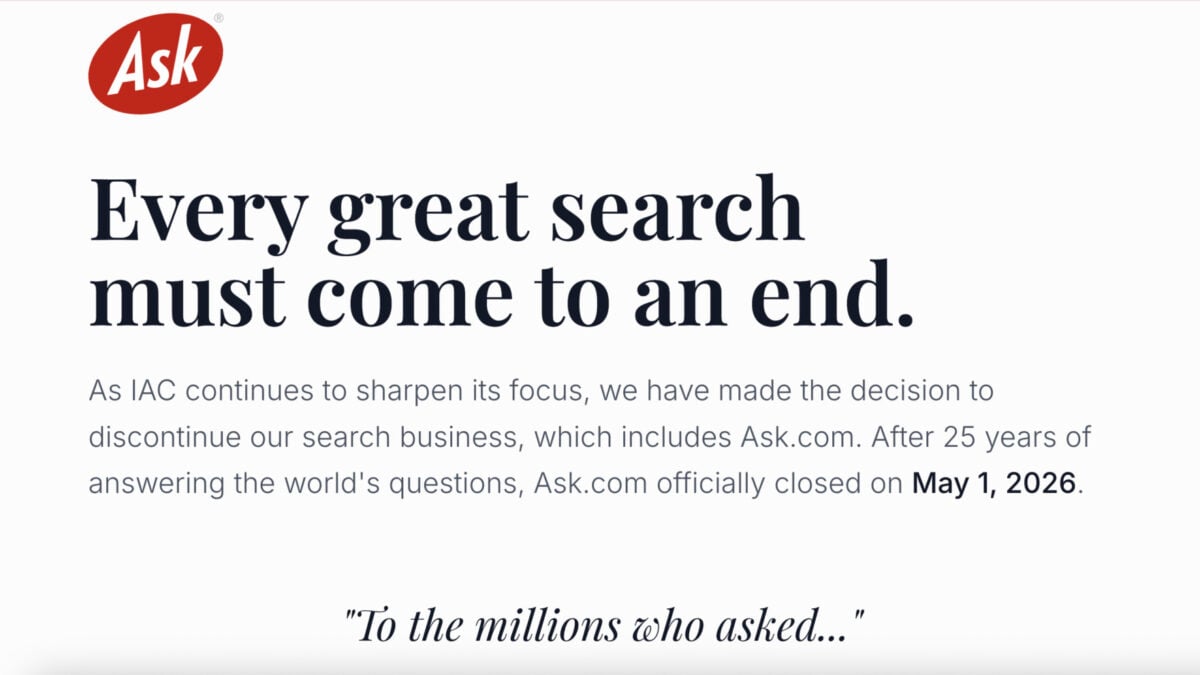
As of May 1, 2026, the site displays a message from IAC explaining that the company has decided to discontinue its search business, including Ask.com, as it sharpens its focus. The official language is terse, but the closure lands as a coda for a very specific phase of online history.
Why Ask Jeeves was memorable even when it was limited
Ask Jeeves stood out because it wrapped search in a humanized metaphor. Instead of presenting itself as a neutral index, it suggested that a butler-like figure might answer your question. That made it easy to demonstrate, easy to joke about, and easy to remember. For many users of the late 1990s and early 2000s, that distinctiveness mattered in a web environment that still felt messy and experimental.
The concept also hinted at an ambition that has returned in a much more powerful form: natural-language interaction. Ask Jeeves invited people to type questions in ordinary language rather than forcing them into keyword strings. The experience often resolved into ordinary search results, but the interface implied a future where computing systems might respond conversationally. At the time, that promise exceeded the underlying technology. Today, it looks more like an early sketch of a now-dominant computing pattern.
That is why the shutdown resonates beyond nostalgia. Ask.com did not merely fail to keep up with modern search economics. It belonged to a lineage of attempts to make information retrieval feel more intuitive, personalized, and dialogue-based.
The internet that supported brands like Ask is mostly gone
The web environment in which Ask Jeeves mattered was defined by portals, directories, standalone search brands, and a relatively high tolerance for whimsical interface identity. In that world, users routinely bounced among destinations that felt distinct from one another not just in content, but in personality. Search was one destination among many, not yet an invisible utility embedded everywhere.
That model eroded as search consolidated, mobile computing changed traffic patterns, and a handful of giant platforms absorbed more of the web’s navigation function. Google turned search into infrastructure. Social platforms redirected discovery. Apps weakened the centrality of the browser. As those shifts accumulated, there was less room for a mid-tier search brand sustained mainly by recognition and legacy habit.
Ask.com’s decline was therefore not an isolated failure. It was part of a larger compression of the internet’s middle layer, where once-familiar services either specialized, were acquired, or faded as users reorganized their behavior around a smaller set of gateways.
Why the AI angle hangs over the story
The most intriguing detail in the source material is not a product announcement, but a phrase in IAC’s shutdown notice: “Jeeves’ spirit endures.” That line invites interpretation because the original Ask Jeeves concept maps so neatly onto current chatbot culture. An interface built around asking a named entity a question is no longer an awkward novelty. It is one of the defining consumer software patterns of the moment.
That does not mean a revival is imminent, and the supplied reporting offers no evidence that one is planned. But the conceptual overlap is obvious. Ask Jeeves framed computation as conversational assistance long before the systems behind that framing could make good on it. Modern AI systems can do far more, but they also inherit some of the same tensions between charm, trust, and usefulness.
The closure of Ask.com therefore lands at an odd historical moment. The brand exits just as its original interaction model has become mainstream in more advanced form. It is a reminder that being early to an interface idea is not the same as being positioned to benefit when the technology finally catches up.

What the shutdown says about legacy internet brands
When old web properties disappear, they often do so quietly because their active user bases are limited. But the symbolic value can be larger than the traffic numbers suggest. Legacy brands serve as anchors for how people remember technological change. They compress entire eras into a name, a mascot, or a home page design.
Ask Jeeves did that for a formative stage of consumer search. It represented an internet still experimenting with tone, guidance, and metaphor. It also represented the limits of those experiments in an era when search quality and scale would soon matter more than brand theater.
Seen from that angle, the shutdown is not merely about one company ending a business line. It is about the continued thinning of the web’s historical layers. The living museum of old internet brands gets smaller each year, and each disappearance makes the surviving network feel a bit more standardized, a bit less textured, and a bit further removed from its transitional phases.
The larger lesson
Ask.com’s end underscores a broader truth about technology markets: even memorable interface ideas do not guarantee durable power. Timing, execution, infrastructure, and economic model matter more than concept alone. Ask Jeeves anticipated conversational computing in style, but not in technical capability or strategic position.
That should make the story interesting even to readers with no sentimental attachment to the brand. The internet’s history is full of products that sketched the future without being able to own it. Their afterlife is often cultural rather than commercial.
Ask.com now joins that category completely. What remains is not a platform, but a reference point: a reminder that the web once imagined question-answering as a polite exchange with a fictional helper, and that decades later the industry built something closer to that fantasy under entirely different names. The site is gone. The interaction model it popularized, in a limited early form, is not.
This article is based on reporting by Gizmodo. Read the original article.
.jpg)
Originally published on gizmodo.com