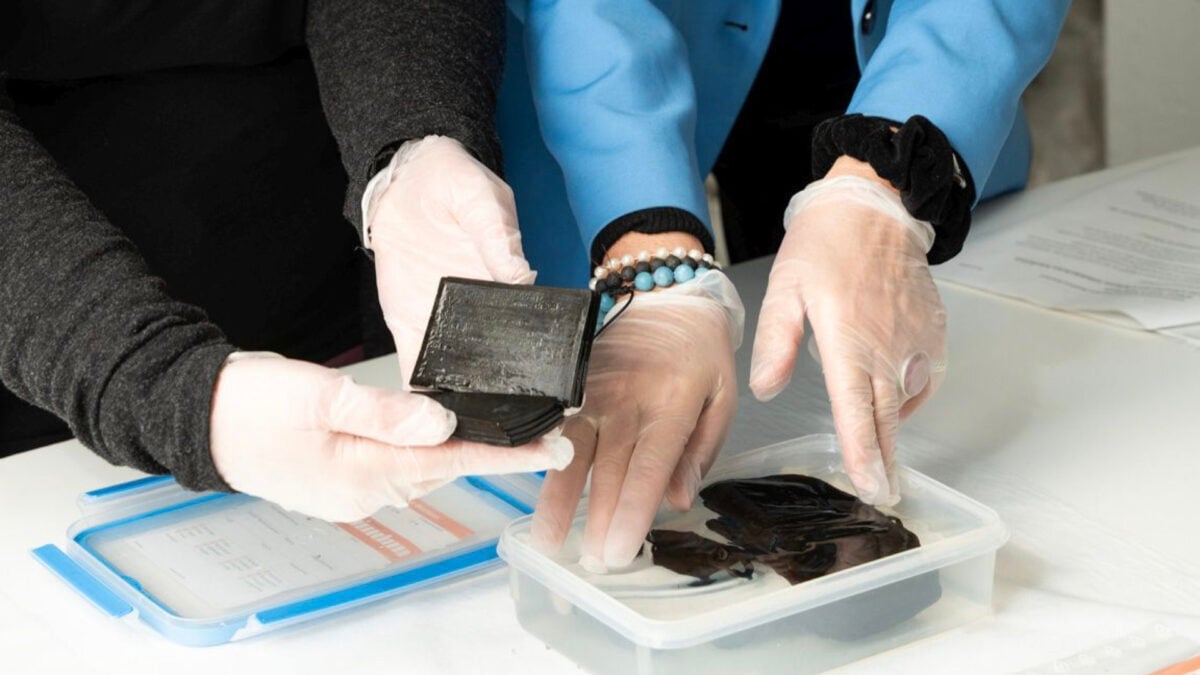
An archaeological dig in Paderborn, Germany, has turned up one of those finds that collapses the distance between centuries. From a late medieval latrine, researchers recovered a tiny notebook that is still legible after roughly 700 to 800 years underground. The object is small, pungent, and oddly familiar: a personal writing tool apparently dropped into a toilet during the late Middle Ages and preserved by the very conditions that should have destroyed it.
A rare survival from everyday life
The notebook measures about 4 by 3 inches, with a leather binding and a wooden backing. Inside are ten pages, and 18 sides of those double-sided pages were coated in wax. Rather than ink on parchment, the owner wrote by scratching marks into the wax, then smoothing it flat when the page needed to be reused. It was, in effect, a medieval reusable notebook.
That material form alone makes the discovery remarkable. Many written artifacts that survive from the Middle Ages are formal documents, religious texts, or elite manuscripts. This object belongs to a different category: practical daily use. Archaeologists said the notebook appears to have been used spontaneously, with layers of text written in two directions but apparently by the same hand. That makes it look less like a ceremonial or display object and more like a working pad for notes or record-keeping.

Why the toilet preserved it
The same damp, airtight conditions that have preserved other famous organic finds also protected this one. According to conservator Susanne Bretzel, the outside of the book needed cleaning, but the inner pages were so tightly bound that dirt did not penetrate them. The wood had not warped, the wax remained intact, and the writing itself was still easily legible. The latrine environment sealed the notebook off from the cycles of weathering and decomposition that would normally erase such a fragile object.
Preservation extended beyond the text-bearing surface. The find reportedly retained an unpleasant odor even after centuries in the ground, an earthy reminder that archaeology often recovers the past in its least romantic forms. Yet that unpleasant context is precisely what makes the object so valuable. Organic materials and everyday possessions often vanish from the historical record. Latrines and wells sometimes rescue them.
What the notebook can tell us
The writing appears in Latin script etched into wax, and researchers believe the same person likely used the tablet repeatedly. The source text does not provide a full translation, but the physical evidence already says a great deal. First, it points to practical literacy. Someone had a portable tool for temporary writing, suggesting a need to jot things down, revise them, and possibly erase them after use. Second, it gives a material snapshot of record-keeping before paper notebooks became ordinary objects.
The stylus used to write in the wax has not yet been found, but archaeologists say it would likely have resembled a modern stylus in function. One end would scratch letters into the surface; the other, flat or spatula-shaped, would smooth the wax for reuse. The comparison is not exact, but it is close enough to make the object feel strikingly contemporary. The owner was not creating a permanent manuscript. They were managing information on the fly.

Luxury, hygiene, and urban life
The notebook was found alongside rectangular silk scraps that researchers believe may have been used as toilet paper. If that interpretation holds, it suggests a wealthy urban context. Even without stretching beyond the available evidence, the combination of a reusable writing tablet and silk scraps hints at status, consumption, and the small routines of city life that written history often overlooks.
The discovery also arrived during preparatory construction work for a new administrative building, a reminder that major historical finds still emerge in active urban landscapes. Medieval Paderborn is not a distant ruin untouched by modernity. It lies beneath a living city, and its artifacts continue to surface when infrastructure and heritage collide.
What makes this notebook culturally important is not grandeur but intimacy. It captures a human scale of the past: someone writing notes, reusing pages, carrying a practical object through daily life, and then losing it in a profoundly embarrassing place. That accidental drop created a rare archive of ordinary behavior. In a field often dominated by kings, cathedrals, and monumental objects, a tiny book from a toilet offers something different and arguably more revealing: evidence that medieval people organized, forgot, improvised, and made use of their tools in ways that still feel immediately recognizable.
This article is based on reporting by Gizmodo. Read the original article.
Originally published on gizmodo.com