A Spaceship Touches Down in Exposition Park
After nearly a decade of construction and repeated delays, the Lucas Museum of Narrative Art is finally ready for the public. The roughly $1 billion complex occupies a site in Exposition Park in Los Angeles and opens on September 22, marking the end of a build-out that stretched across years of planning and anticipation.
The museum carries the name of George Lucas, the filmmaker behind "Star Wars," and essentially all of what fills its galleries comes from the personal collections of Lucas and his wife, Mellody Hobson, described in coverage of the project as one of the most accomplished businesswomen in the world. Their holdings form the foundation of an institution devoted to narrative art in all its forms.
More Than 40,000 Works, Roughly 1,200 on Display
The scale of the underlying collection is enormous. More than 40,000 works of art and pieces of pop culture history are held by the museum, yet only about 1,200 of them are on view at any one time, distributed across more than thirty galleries.
That gap between storage and exhibition hall is central to how the museum works. The galleries bring together widely different genres, artists and mediums, but every one of them is organized around a single shared idea: visual storytelling. A comic panel, an illustration, a painting or a film prop all count as narrative tools here, valued for what they communicate rather than for stylistic experiment alone.

Built From a Personal Collection
Almost nothing in the building arrived through a conventional institutional acquisition program. The works trace back to Lucas and Hobson themselves, which gives the museum an unusually personal character: it reflects the taste of two collectors rather than the consensus of a curatorial committee.
That provenance also explains the collection's breadth. Instead of narrowing to a single movement, period or medium, the museum ranges freely across paintings, illustrations, photographs, prints and comic book proofs — with the connection between them being how they tell stories rather than when or where they were made.
The Strongest Vehicular Art Collection Around
For visitors who care about cars, planes, trains, boats or spacecraft, the most striking thread running through the building may be the way it treats vehicles. After attending a member preview day, Jalopnik's Daniel Golson argued that the Lucas Museum holds by far the best collection of vehicular art he has ever encountered, measuring it specifically against the experience of visiting more conventional art museums.
That comparison is worth unpacking. Traditional car museums do display vehicle-related artworks, but those pieces tend to be marketing artwork or design sketches in which the car is the absolute focus. The Lucas Museum takes a different route, using vehicles as instruments of story rather than as subjects of promotion.
Not Just Design Sketches
Across the galleries, visitors find paintings, illustrations, comic book proofs, photographs and prints in which vehicles do narrative work. A car can establish a character's status, a boat can carry a plot forward, a rocket can stand in for ambition or escape. The range of material is broad enough to cover all of that and more.
The subject matter spans cars and motorcycles, planes and trains, all sorts of boats and — for many visitors the highlight — science fiction art filled with spaceships and rockets.
- Cars and motorcycles in illustration, painting and photography
- Aircraft and trains used as storytelling devices across multiple galleries
- Boats of every description, from working vessels to storybook craft
- Science fiction art featuring spaceships, rockets and other spacecraft
- Comic book proofs, prints and photographs shown alongside original paintings

"Star Wars" Is Under 10 Percent of the Museum — and Still Owns the Room
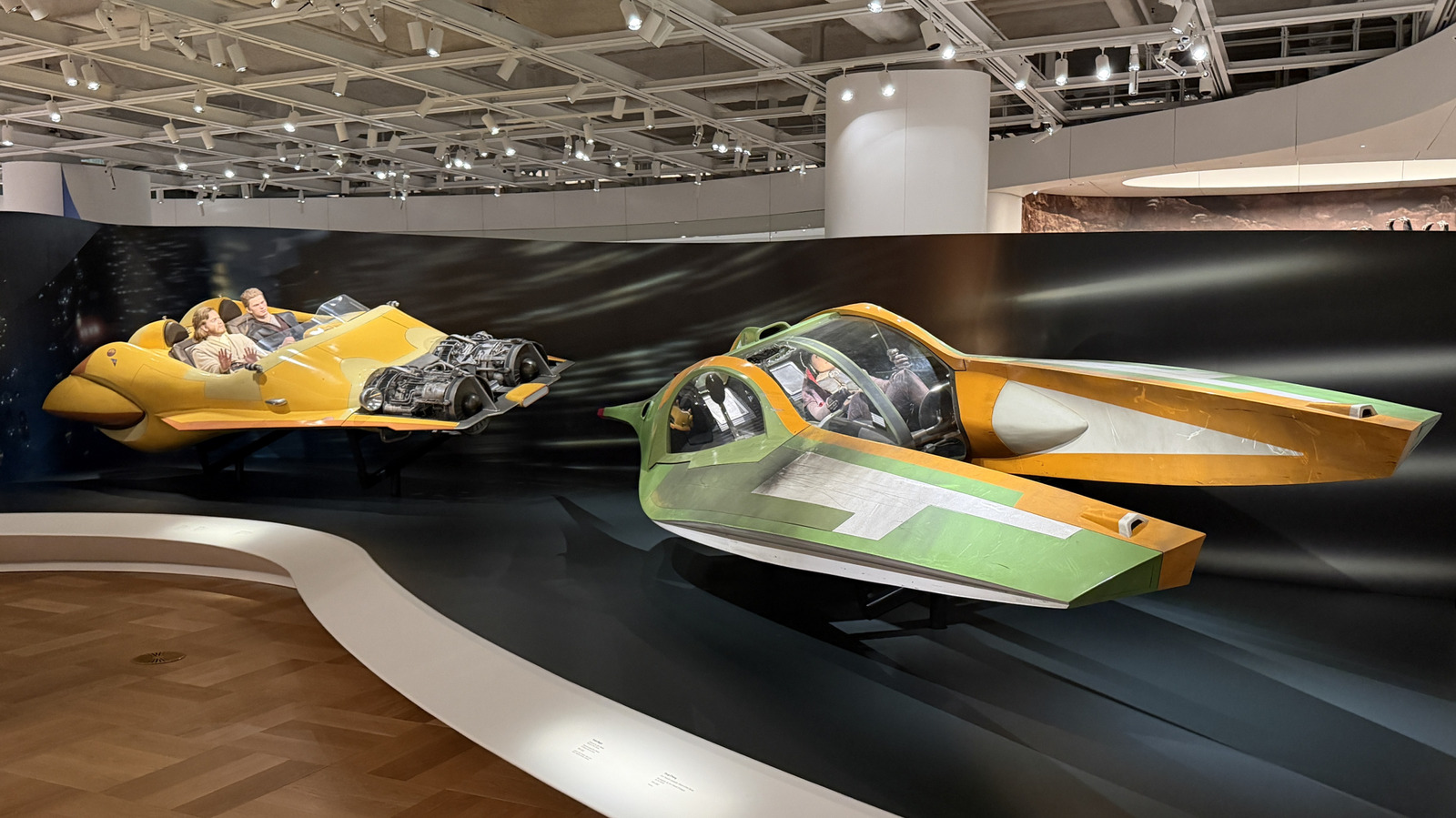
Despite the museum's name and its founder's fame, material from the "Star Wars" franchise accounts for less than 10 percent of the whole institution. Even so, the "Star Wars" gallery is the most prominently featured space in the building, and it holds some of the most memorable objects on view.
Podracers and Speeder Models
Walk into the room and the first thing that greets you is Anakin's full-scale podracer from "The Phantom Menace" — a machine that reads very differently at full size than it does on screen. Across the way sit the full-scale fiberglass speeder models built for the chase scene in "Attack of the Clones." Both displays make the case that physical props are their own category of narrative art: engineered objects built to sell a story.
Why Vehicles Work So Well as Storytelling Tools
What ties the museum together is the conviction that images exist to tell stories, and vehicles are among the most efficient storytelling devices an illustrator or filmmaker can use. They establish setting and period, signal speed and danger, and give audiences an immediate physical object to follow through a sequence.
Seen through that lens, a gallery filled with paintings of boats and prints of trains is not a detour from the museum's mission but an expression of it. The same logic applies to the science fiction art on the walls: rockets and spaceships are vehicles first and metaphors second, and the museum treats them as both.
It also explains why the collection lands differently than a car museum or a design archive. Where those institutions often stop at the object, the Lucas Museum keeps asking what the object is doing in the story — who is driving, where they are going and what is at stake.

What to Know Before You Go
- The museum opens to the public on September 22 in Exposition Park, Los Angeles
- The project cost roughly $1 billion and took nearly a decade to build
- More than thirty galleries display only about 1,200 of the museum's 40,000-plus works
- "Star Wars" material makes up less than 10 percent of the collection but anchors the most prominent gallery
- Vehicular art runs across genres: cars, motorcycles, planes, trains, boats and spacecraft
Worth a Visit, Even If You Don't Like Art Museums
The practical takeaway for travelers is straightforward. If you find yourself in Los Angeles, the Lucas Museum of Narrative Art is worth a stop, even if you consider yourself art museum-averse — and yes, there is podracing.
With more than thirty galleries, roughly 1,200 objects on display and a deeper reserve of more than 40,000 works behind them, the museum offers plenty of reasons to return. For anyone drawn to vehicles and the stories built around them, it may be the most rewarding collection of its kind anywhere. As Golson put it, few things are more useful in visual storytelling than vehicles — and this museum has gathered an extraordinary number of them.
This article is based on reporting by Jalopnik. Read the original article.
Originally published on jalopnik.com