Tactile sensing remains one of robotics’ harder practical problems
Industrial and service robots have become much better at seeing the world, but touch is still where many systems fall short. That gap is especially obvious when a robot has to handle thin, fragile, reflective, or irregular objects that vision alone cannot characterize well enough in real time. XELA Robotics is positioning its latest tactile sensing updates as a direct response to that limitation.
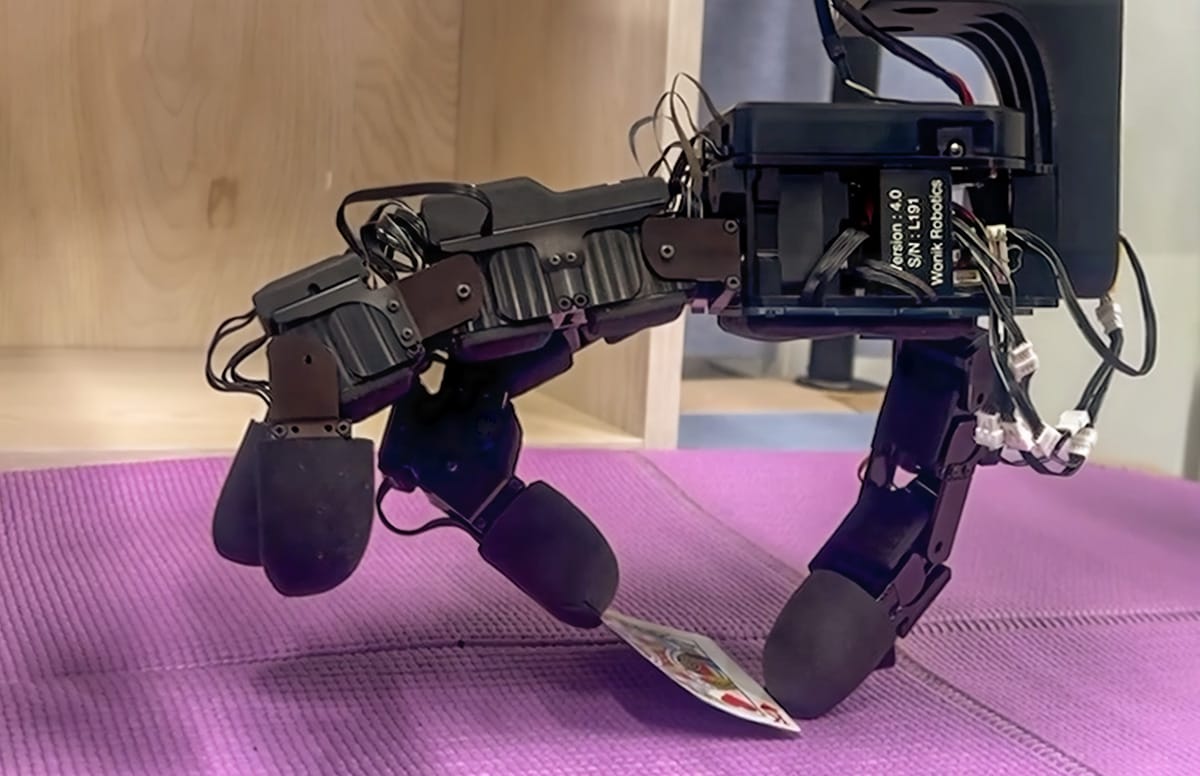
According to the source report, the company plans to demonstrate several new capabilities at the 2026 Robotics Summit & Expo in Boston, spanning sensor hardware, magnetic interference compensation, and software improvements tied to delicate grasping tasks. The list includes a robotic fingertip with a six-axis force-sensitive nail and 30 tri-axial force sensing points in the pulp, integration of its uSkin sensors into the open-source Universal Manipulation Interface, and new compensation techniques meant to remove complex magnetic interference from nearby magnets or ferromagnetic materials.
On paper, that package may sound incremental. In robotics, it is not. Handling edge cases often determines whether a system remains a research demo or becomes operationally useful.
Why a force-sensitive robotic nail matters
The source text describes XELA’s robotic fingertip with a force-sensitive nail as an industry first. The practical pitch is simple: objects such as cards, keys, or tape are difficult because their most useful graspable features can be thin, shallow, or partially embedded in surfaces. A fingertip that can sense forces through both a soft contact area and a nail-like structure gives the robot more options for controlled interaction.
That design begins to resemble the way humans use fingernails for precision manipulation. People do not just pinch objects with skin. They wedge, scrape, lift edges, and use hard structures to create leverage. Robotics has long struggled to replicate that kind of small-scale dexterity because standard grippers are usually optimized for gross grasping rather than fine object release or retrieval.
If XELA’s implementation performs as advertised, it would matter less as a single clever component than as a signal that robotic touch is becoming more anatomically and functionally layered.

Interference compensation addresses a factory-grade constraint
The magnetic interference update may be even more consequential for real deployments. The source report says the new system can remove complex magnetic interference from nearby magnets or ferromagnetic materials, expanding beyond a prior add-on that handled most interference except for strong, small magnets nearly touching the sensors.
This is a highly practical problem. Factories and specialized assembly environments do not offer clean laboratory conditions. If a tactile sensing system becomes unreliable around metal parts, magnetic clips, or tooling, its value drops sharply in exactly the places where precise robotic handling would be most useful.
By targeting interference directly, XELA is acknowledging a recurring truth in robotics: sensing breakthroughs only matter if they survive industrial noise. A sensor that works on a benchtop but drifts in a production line is not a platform advantage. It is a demo artifact.
Skill transfer and manipulation data are converging
XELA is also linking its tactile system to the Universal Manipulation Interface, an open-source gripper platform intended to support AI-driven human-to-robot skill transfer. The source text says uSkin adds distributed force-vector measurements to the data collection process, supplementing demonstrations where humans perform everyday actions and robots later learn to reproduce them.
This is where tactile sensing becomes strategically interesting for AI robotics. Vision can show what happened. Touch can help explain why a manipulation succeeded. A robot learning to pour, pick, or reposition objects benefits from knowing not only trajectories and object locations, but also the contact forces that kept the action stable. Tactile data can close part of the gap between observed behavior and executable skill.
That does not guarantee general-purpose dexterity. But it does suggest a path toward richer training data for manipulation systems that still struggle outside narrowly tuned settings.
The real test is whether the improvements reduce task fragility
The company’s planned demonstrations involve a paper origami crane and a quail egg, both chosen to emphasize fragile-object handling. The source report also mentions new software that uses machine vision, improved robot arm control, and a third-party graphical interface to support rapid development of advanced tasks.
Those elements point to an important industry shift. Dexterous robotics is increasingly less about a single breakthrough component and more about integration across sensing, perception, control, and task tooling. Better fingertip hardware alone is not enough. It has to work with vision, controllers, and development software in ways that reduce the engineering burden of each new manipulation problem.
XELA’s announcements remain company claims at the demonstration stage, so caution is warranted. But the direction is credible and useful. Robotics does not need more evidence that grasping a box is possible. It needs better systems for the objects that fail today’s robots: the delicate, thin, slippery, or noisy ones that break assumptions and expose the weakness of touch. That is the gap XELA is trying to narrow.
This article is based on reporting by The Robot Report. Read the original article.
Originally published on therobotreport.com