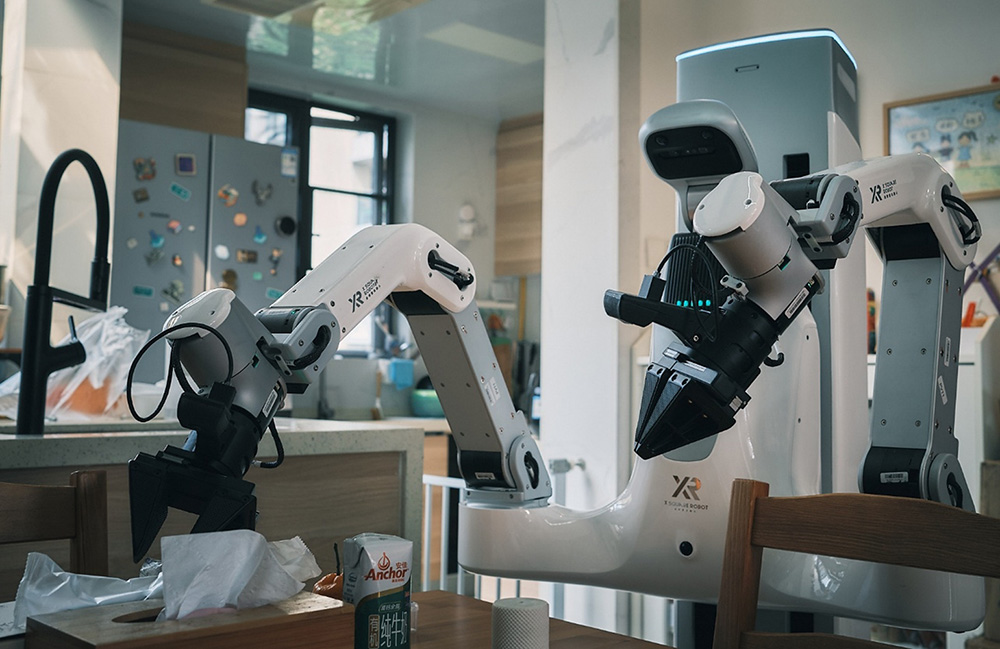
Embodied AI startup says its latest financing will fund full-stack robotics development
X Square Robot, a Shenzhen-based developer of embodied AI systems, says it has completed four consecutive financing rounds culminating in a Series C, bringing its valuation to more than $2.8 billion. The company says the new capital will be used to expand foundational research and core technologies as it pushes toward what it describes as general-purpose embodied AI.
The funding announcement stands out in a robotics market where investors are increasingly looking beyond software-only artificial intelligence and toward systems that can act in the physical world. X Square Robot is positioning itself as a company building both the intelligence layer and the hardware-and-data stack needed to deploy robots in real environments rather than controlled demonstrations.
That positioning matters because embodied AI has become one of the most closely watched areas in the broader AI market. The core bet is that progress in perception, reasoning, and action will accelerate when models are trained not only on text and images, but also on sensor data, motion, and repeated real-world interaction.
A full-stack approach is central to the company’s pitch
According to the source, X Square Robot develops what it calls end-to-end embodied AI systems. Rather than relying on traditional rule-based automation, the company says its platform is designed to let robots adapt to changing environments and generalize across a wider range of tasks.
The company’s stated architecture combines four major pieces: foundation models, robotics hardware, a proprietary data-pipeline system, and real-world deployments. That full-stack framing is increasingly common among robotics firms that want to distinguish themselves from labs building models in isolation. The argument is straightforward: robotics performance depends not just on model quality, but also on the quality of the physical platform, the training pipeline, and the feedback loop created by deployment.
X Square Robot founder and chief executive Wang Qian said the company has focused on in-house development of foundation models from the beginning and described that decision as difficult but necessary. He said investments in embodied AI models, a scalable data pipeline, and real-world deployment are beginning to produce results.
Even without independent performance validation in the supplied source, the structure of that message is important. Investors are rewarding companies that can show a plausible route from model research to operational systems, and X Square Robot is making the case that it has built that route internally.

WALL-B reflects the company’s push toward unified robot intelligence
One of the company’s key technical claims centers on WALL-B, a foundation model introduced in April 2026 and built on what X Square Robot calls its World Unified Model architecture. The source says WALL-B differs from modular vision-language-action approaches by training perception, language, action, and physical prediction within a unified network.
If that approach works as intended, the benefit would be tighter integration across capabilities that are often handled separately. In robotics, that matters because many failures happen at the boundaries between modules: a system may perceive correctly but choose the wrong action, or understand a command but fail to model the physical consequences of movement. A unified model aims to reduce those handoff problems by learning a shared internal representation across tasks.
X Square Robot says the result is stronger multimodal understanding, better spatial reasoning, and improved continual learning from real-world interactions. Those are ambitious claims, but they align with the broader direction of embodied AI research, where the challenge is not simply recognizing the world but acting effectively within it.
Open-source releases are part of the company’s strategy
The company has also open-sourced WALL-OSS-0.5 and WALL-WM, extending its unified approach into robot manipulation and world modeling. That is notable because open releases can serve multiple purposes at once. They can attract researchers, increase visibility, create benchmarks for talent recruitment, and signal confidence in a technical approach without disclosing every commercial advantage.
According to the source, WALL-OSS-0.5 achieved more than 80% autonomous completion on four of 17 real-robot tasks without post-training. WALL-WM, meanwhile, is described as introducing event-level prediction by aligning language, vision, and action data around meaningful events, with the goal of strengthening cross-modal learning and physical-world reasoning.
Those details suggest the company is trying to move beyond a narrow manipulation benchmark and toward a broader systems view of intelligence. In embodied AI, world models and event prediction are increasingly seen as important because robots need more than reactive control. They need a way to anticipate outcomes, sequence actions, and update plans as a scene changes.

Why investors are paying attention to embodied AI now
X Square Robot’s funding run lands at a moment when embodied AI is attracting serious capital worldwide. Investors see a potential next wave in AI: not just systems that generate content or answer questions, but systems that can perform labor, navigate homes or workplaces, and operate machinery with growing autonomy.
That opportunity is large, but so are the technical and commercial risks. Robotics companies must solve hardware reliability, data collection, safety, deployment economics, and model robustness at the same time. They also need enough real-world usage to improve systems continuously, which makes scaling difficult.
X Square Robot’s financing syndicate reflects that mix of promise and risk. The source says the rounds included both strategic and financial investors, including major technology companies, industrial partners, and venture capital firms. It also says IDG participated in the Series C round, while HongShan and Xiaomi backed the company in earlier rounds. That pattern suggests investors are not treating the company purely as a research bet; they appear to see possible industrial relevance as well.
The real test will be deployment, not valuation
A valuation above $2.8 billion is a strong signal of market interest, but it is not proof of durable technical leadership. In robotics, the hard part is moving from promising demos and benchmarks to repeated performance in uncontrolled environments. X Square Robot’s own framing acknowledges that challenge by emphasizing real-world deployment as one of the pillars of its strategy.
That may be the most important detail in the entire announcement. Embodied AI will be judged by how well systems perform in homes, factories, logistics settings, and other live environments where conditions shift constantly. Companies that can link model development to a reliable deployment loop are more likely to shape the sector than those that remain confined to lab-style progress.
For now, X Square Robot has secured the capital and attention to keep pursuing that path. The next question is whether its unified model strategy can translate into robots that work consistently enough, cheaply enough, and broadly enough to justify the scale of investor expectations now surrounding embodied AI.
This article is based on reporting by The Robot Report. Read the original article.

Originally published on therobotreport.com


