Google pushes deeper into agentic marketing tools
Google says it is rolling out a new set of AI features across Google Ads and Google Analytics, extending its push to make campaign analysis and optimization more conversational, automated, and embedded into daily marketing workflows. The update centers on a familiar promise in enterprise AI: reduce the time it takes to understand performance changes, generate reports, and decide what to do next.
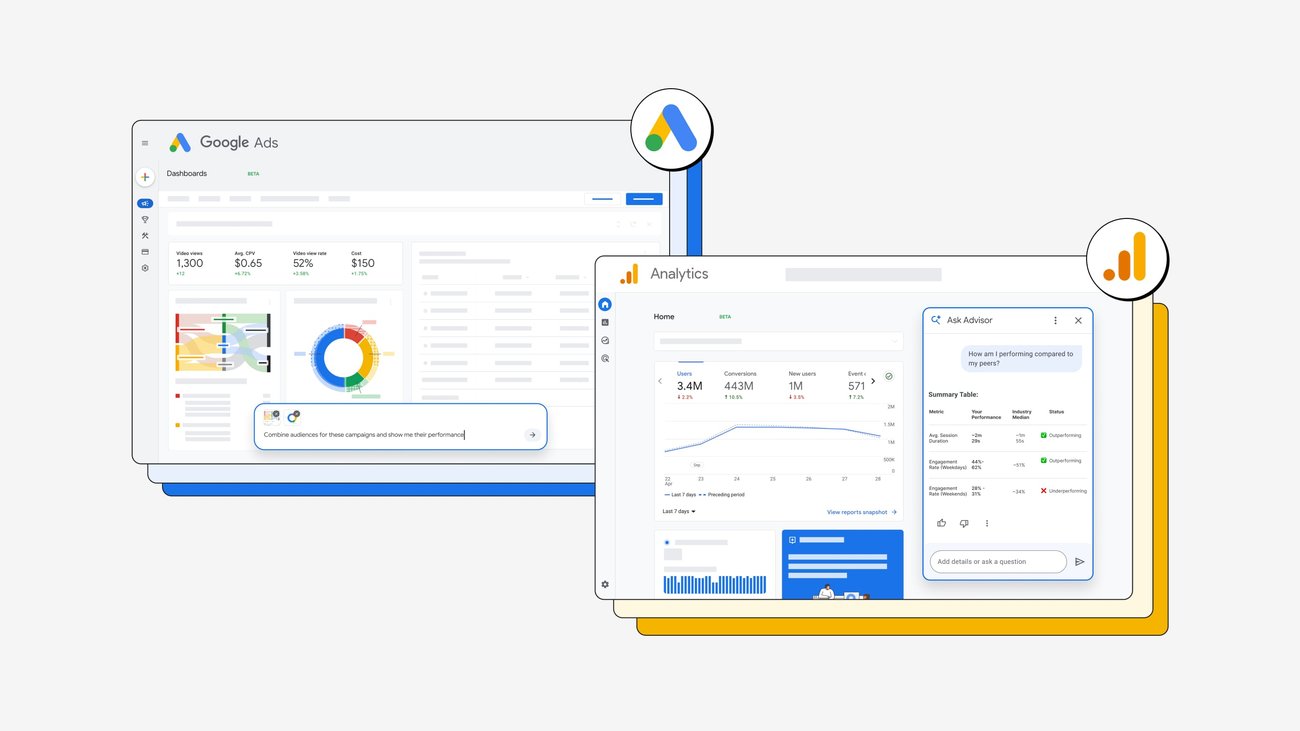
According to Google, the latest release builds on its in-product AI agent, Ask Advisor, and adds new capabilities designed to help marketers uncover insights more quickly while still keeping control over decisions and execution. The company frames the move as a way to pair machine-generated analysis with human judgment rather than replace strategic oversight.
The announcement focuses on three practical use cases. First, Google says new homepage summaries in Google Analytics can surface major performance shifts and notable data trends without requiring users to manually inspect multiple reports. Second, it is adding prompt-based visual reporting so users can create charts and reports using plain-language text requests. Third, it is introducing benchmarking features that let businesses compare their performance against similar companies.
What Google says is changing
Google’s description suggests a steady evolution from dashboards toward guided analysis. In traditional analytics products, teams typically need to monitor changes, identify anomalies, determine likely causes, and then prepare findings for internal stakeholders. Google is trying to compress that chain by turning AI into both a summarization layer and a reporting assistant.
The company says the new homepage insights are meant to highlight important changes as they happen. That matters because analytics tools often contain too much data for small teams to monitor efficiently. A summary view can help marketers spot traffic shifts, campaign movement, or conversion changes without searching for them first.
The prompt-based reporting feature points to another important shift: analytics interfaces are becoming less dependent on menu-driven exploration. If users can describe the report they want in natural language, then report generation becomes faster and more accessible to non-specialists. That may be particularly useful for small businesses or cross-functional teams that do not have dedicated analysts.
Benchmarking adds a different kind of value. Comparing campaign or business performance against peers can help teams decide whether a weak metric is a company-specific problem or a broader market pattern. Google says these comparisons are intended to help users find new ways to improve results.

Why this matters beyond advertising
While the announcement is framed around marketing, the larger significance is structural. Google is embedding AI deeper into products that already sit inside routine business operations. That is different from treating generative AI as a standalone chatbot or novelty feature. In this model, AI becomes part of the operational surface of software people already use to spend money, measure returns, and present results internally.
That integration strategy also reflects the current competitive phase in enterprise AI. Software companies are racing to turn AI into a default layer for summarization, recommendation, and action. For Google, Ads and Analytics are especially consequential products because they sit close to revenue decisions. If AI can help advertisers interpret complex performance signals faster, Google strengthens both the stickiness of its tools and its claim that automation can improve marketing efficiency.
The company is also careful in how it describes the role of the user. Google says the tools are meant to amplify expertise and help users stay in the driver’s seat. That language acknowledges a central tension in business AI: customers want speed and simplification, but many remain cautious about handing over too much control in areas tied directly to budget allocation and commercial performance.
Where the practical gains may appear first
The most immediate beneficiaries are likely to be teams that already have access to large amounts of campaign and site data but limited time to interpret them. Automated summaries can reduce monitoring overhead. Prompt-driven reports can make it easier for managers, executives, or clients to request tailored views without requiring a specialist to manually build each one. Benchmarking can give performance conversations more context, especially in periods when external conditions are shifting.
These features may also narrow the gap between expert and non-expert users. Analytics platforms often create dependence on a small number of technically fluent team members. If plain-language tools work reliably, more people inside an organization can participate in understanding performance data directly.
That said, the utility of these systems will depend on execution quality. Summaries need to surface genuinely meaningful changes rather than generic observations. Prompt-based reporting needs to interpret intent accurately. Benchmarking must provide comparisons that are relevant enough to guide action. Google’s announcement outlines the direction of travel, but the real test will be whether users trust the outputs in high-stakes campaign decisions.

A broader industry signal
Google’s update is also a signal about where AI product design is moving in mature software categories. Instead of asking users to visit a separate AI experience, companies increasingly want AI to sit on top of existing workflows, translating data into faster comprehension and shortening the distance between insight and action.
For marketing software, that approach is especially attractive because the underlying problem is not a lack of data. It is the burden of interpreting too much of it, too often, under time pressure. Google is betting that AI can serve as the first pass on that work: summarize the change, generate the view, add context, and let the human decide what to do next.
If that model works, the effect may be less about spectacular new capabilities and more about a steady redesign of everyday business interfaces. The marketing stack would become less about digging through reports and more about responding to synthesized recommendations. Google’s latest Ads and Analytics update suggests that shift is no longer theoretical. It is becoming a product strategy.
This article is based on reporting by Google AI Blog. Read the original article.
Originally published on blog.google