Google adds a dedicated image tool to Workspace
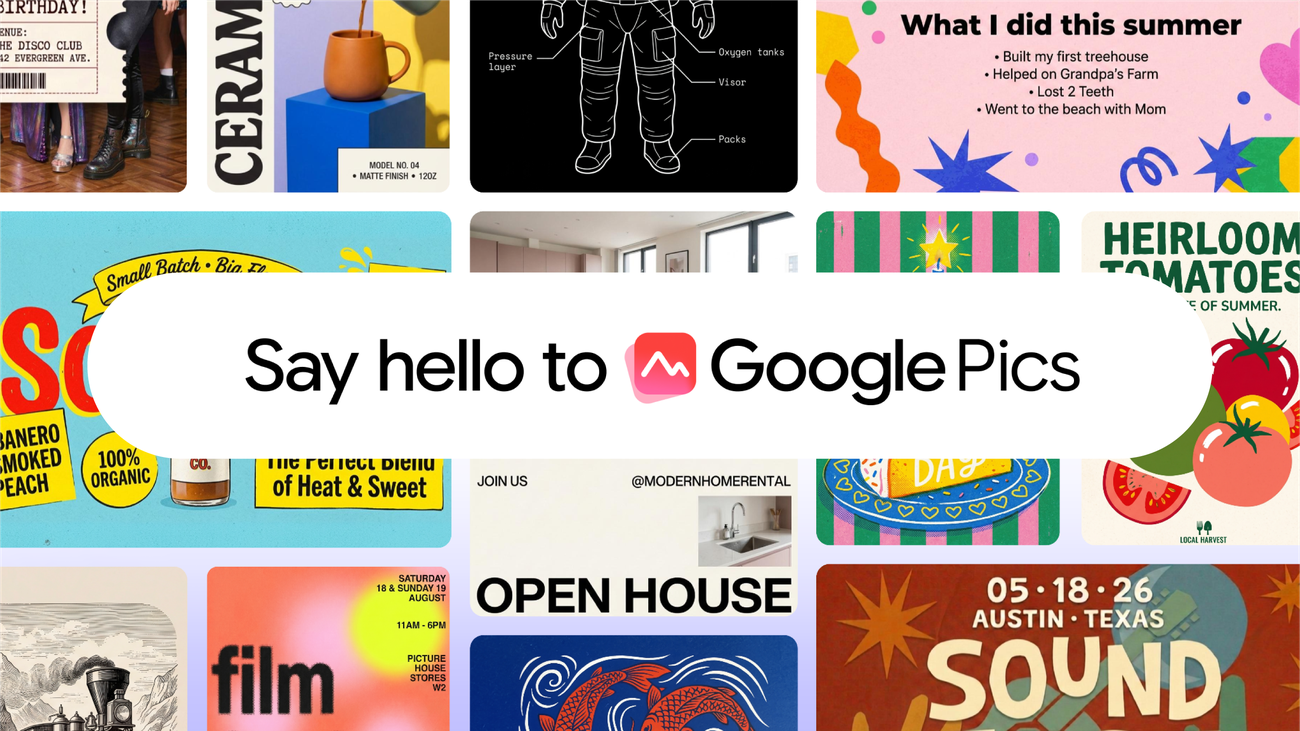
Google has launched Google Pics, a new AI image creation and editing product for Workspace that is designed to work both as a standalone tool and inside the company’s productivity apps. The release puts image generation and precise editing directly into workflows that already revolve around documents, presentations, and file sharing.
According to the supplied source text, Google Pics is rolling out over the coming weeks to all Google AI Pro and Ultra subscribers and to most Workspace business customers. Google also says the product will be available as a standalone experience while integrating into Workspace apps starting with Slides, Docs, and Drive.
That positioning is notable. Rather than treating AI imagery as a separate creative niche, Google is framing it as a routine office capability: something used to build posters, social posts, illustrations, and internal graphics without leaving the environment where teams already collaborate.
Built on Google’s Nano Banana model
The company says Pics is built on its Nano Banana image generation and editing model. In practical terms, Google is emphasizing not just image generation from prompts but controlled editing after an image already exists. That distinction matters because many workplace use cases are less about creating art from scratch than about revising assets for a presentation, document, or campaign.
The supplied text repeatedly stresses control and refinement. Users are told they can generate, refine, and co-create images with precision, and that the product includes a suite of fine-tuned editing capabilities. Google is presenting Pics as an answer to a common complaint about generative imaging tools: that they may produce eye-catching results, but can be awkward when a user needs a specific, practical adjustment.
By embedding the tool into Workspace, Google is also making a competitive argument. The real advantage is not merely the model quality. It is the reduction of friction. If the editing surface is available inside a document or slide deck, teams can work faster and avoid switching between design software, storage tools, and presentation apps.
What the tool can do
The source text outlines a range of functions that Google is bringing to Pics. Among the highlighted features are object segmentation, which allows a user to isolate an object and change it without altering the rest of the image. The article also says users will be able to edit text inside images and translate words directly within images.
Those features suggest Google is targeting practical business content rather than purely artistic experimentation. A marketing team may want to repurpose a promotional visual for another market. A product team might need to update a diagram or social tile. A sales team could adjust copy in a graphic without rebuilding the entire asset.
The source text also describes collaborative use. Teams can work together on the same image and do so without leaving their usual Google apps. That matters because the strongest Workspace products are built around shared editing and rapid feedback loops. If Pics inherits that behavior, it becomes less like a standalone design product and more like a native part of document production.
- Generate and refine custom graphics from text prompts.
- Isolate and transform objects inside an image.
- Edit or translate text directly within the image.
- Collaborate on visuals inside existing Google workflows.
Where Google is inserting AI into office software
Google says integrations will start with Slides, Docs, and Drive. That selection is strategic. Slides is an obvious fit because presentation decks often require diagrams, hero visuals, title images, and social-style graphics. Docs broadens the use case toward reports, internal communications, and lightweight publishing. Drive, meanwhile, positions Pics as part of the file layer that sits across Workspace rather than as a feature trapped inside one app.
The supplied source also points users to a standalone access point at
pics.new
, underscoring that Google wants the product to work both as a destination and as an embedded capability. That dual role is increasingly common in AI software. The tool needs enough independence to attract attention, but enough integration to become habitual.
Google’s description suggests that future value may come less from one-off image generation and more from repeated, incremental editing. In office settings, that is often the real work: adapting a graphic for a new region, changing text in an announcement, pulling out an object for a slide, or making a fast visual to support a proposal.
A broader shift in Workspace competition
Google’s move also reflects how productivity suites are changing. AI features are no longer limited to writing assistants and summarization panels. Visual generation is becoming part of mainstream office software, especially as presentations, documents, and internal communications increasingly rely on polished media.
By making Pics available to Google AI Pro and Ultra subscribers and most Workspace business customers, Google is tying image creation to both consumer-style premium subscriptions and enterprise software budgets. That approach broadens adoption while reinforcing the idea that advanced AI media tools belong inside the productivity stack, not outside it.
The launch may also signal a growing expectation that workplace AI should be multimodal by default. A modern office tool is no longer judged only by how well it handles text, spreadsheets, or slide layouts. It is increasingly judged by whether it can help produce the accompanying visual layer quickly and with enough precision to be useful.
What Google is really selling
At launch, Google Pics is being marketed as an image generator and editor. But the deeper pitch is workflow compression. Instead of drafting content in one app, sourcing visuals in another, editing them in a third, and then uploading them back into shared storage, users can keep more of that process inside Workspace.
That does not guarantee that Pics will replace specialist creative tools. The supplied source does not make that claim, and the product appears aimed at accessible, everyday creation rather than high-end design production. Still, for businesses that need speed, consistency, and collaboration more than artistic complexity, that may be exactly the point.
If Google succeeds, Pics will matter less as a flashy AI demo and more as invisible infrastructure for routine content work. The announcement suggests the company understands that the next stage of generative AI competition will be decided not just by what models can make, but by how smoothly those capabilities fit into existing work.
For Workspace, that means AI-generated visuals are no longer adjacent. They are becoming native.
This article is based on reporting by Google AI Blog. Read the original article.
Originally published on blog.google