Google deepens AI Mode’s role in travel planning
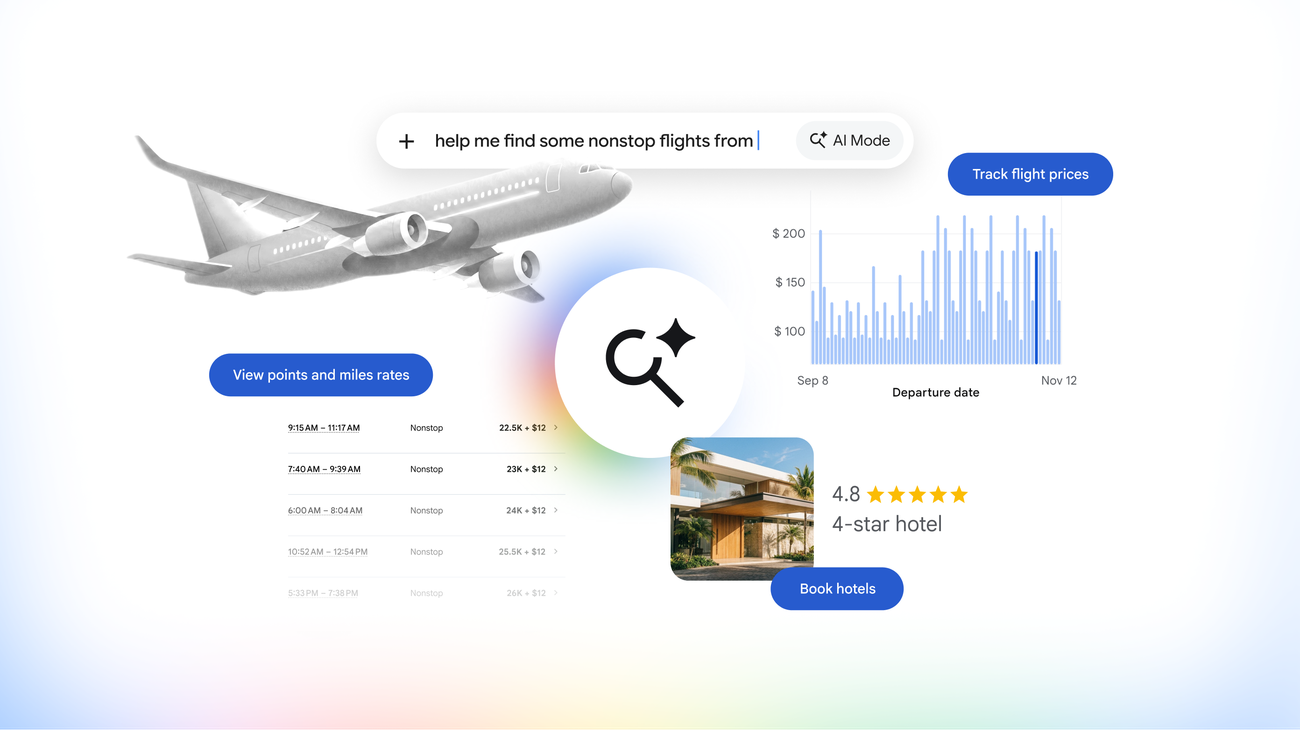
Google is widening the commercial reach of AI Mode in Search with a new batch of travel features that move the product beyond trip inspiration and closer to booking behavior. In a post published August 27, 2026, the company said AI Mode can now help users track flight prices, view award travel rates in points or miles, and book hotels directly from the conversational search experience.
The announcement is notable because it shows how Google is trying to turn AI Mode into a practical interface for decisions that depend on live inventory, price changes, and partner data. Travel has long been one of Search’s most lucrative and competitive categories. By putting more of the planning and comparison process inside AI Mode, Google is effectively arguing that generative search should not stop at summarizing options. It should also manage monitoring, comparison, and purchase handoff.
Flight price tracking moves into the chat flow
The first major addition is flight price tracking. Google said users can describe where and when they want to travel, and AI Mode will surface available options and current prices using data from more than 300 partner airlines and travel sites. If a traveler is not ready to book immediately, they can ask AI Mode to track those fares and receive an email when prices change.
That feature matters less as a novelty than as a workflow shift. Price tracking already exists in Google Flights, but moving it into AI Mode reduces the need to jump between a conversational interface and a dedicated booking tool. Google’s pitch is that a user can stay inside one query session, refine destinations and dates, examine price-sensitive choices, and then activate alerts without leaving the chat context.
Google said flight price tracking in AI Mode is now available in more than 180 countries and territories. The scale of that rollout suggests the company views this as a broadly deployable feature rather than a narrow experiment tied to a limited market.

Rewards programs become part of search conversation
The second upgrade brings loyalty economics into AI Mode. Users can ask for flights or hotels priced in points or miles, not just cash. Google’s example centered on a traveler wanting to fly from Atlanta to Miami using American Airlines miles for specified dates, with AI Mode showing the mileage needed for matching nonstop options. The same idea extends to hotel reward programs.
This is an important addition because points redemptions are often harder to compare than cash prices. Availability can be fragmented, transfer rules vary across programs, and the search process is usually spread across airline or hotel sites. By inserting rewards-rate visibility into AI Mode, Google is trying to make loyalty balances a first-class search input rather than an afterthought.
Google said points-and-miles rate viewing is now globally available, with initial support for Alaska Airlines/Hawaiian Airlines, American Airlines, Choice Hotels International, Hilton, and Wyndham Hotels & Resorts. The company also said support for Accor, Flying Blue, Hyatt, LATAM Airlines, and Lufthansa Group would follow in the coming weeks.
That staged rollout matters. It means the feature is already live in a limited but commercially meaningful set of programs, while also signaling that Google intends to widen partner coverage quickly. For users, the practical implication is straightforward: the utility of AI Mode for rewards travel will depend heavily on whether their preferred airline or hotel ecosystem is already integrated.
Hotel booking becomes a more direct handoff
The third feature pushes AI Mode further toward transaction readiness by helping users book hotels that fit their goals. Google framed this around finding a “dream hotel,” but the larger product move is the integration of recommendation, pricing context, and booking transition inside one interface. Travelers can use AI Mode to assess options and then follow links to partner sites to complete reservations.
This preserves the economics of Google’s broader travel ecosystem. The company is not presenting AI Mode as a closed booking engine that replaces partners. Instead, it is strengthening Google’s role as the orchestration layer that captures intent, narrows choices, and sends users outward when they are ready to purchase. That can make AI Mode more valuable to consumers while keeping the underlying referral and partnership structure intact.

Why the update matters for AI search competition
These travel additions are significant partly because they reveal where Google thinks AI search can defend and extend its core business. Travel queries are high intent, time sensitive, and often monetizable. They also depend on fresh structured data, which makes them a useful proving ground for AI products that need to combine natural-language interaction with current market information.
Google emphasized that AI Mode can already compare flights and hotels, pull recommendations from across the web, and help build itineraries. The new capabilities add persistence through alerts, more pricing formats through rewards integration, and a stronger path from research to booking. In other words, AI Mode is becoming less of a question-answer surface and more of an action layer for commercial search.
There are still limits visible in the announcement. Booking still happens through an airline website or a preferred booking platform, not entirely within Google’s own interface. Rewards support is also partner dependent. Even so, the direction is clear. Google is making AI Mode more useful where users have concrete purchase decisions, and travel is one of the clearest domains in which that strategy can pay off.
For the broader AI market, the update is a reminder that conversational interfaces are increasingly being judged by what they let users complete, not just what they can explain. Google’s latest move ties AI assistance to price surveillance, loyalty optimization, and purchase routing. That is a more defensible product category than generic summarization alone, and it may offer a preview of how large search platforms plan to convert AI adoption into durable user habits.
This article is based on reporting by Google AI Blog. Read the original article.
Originally published on blog.google