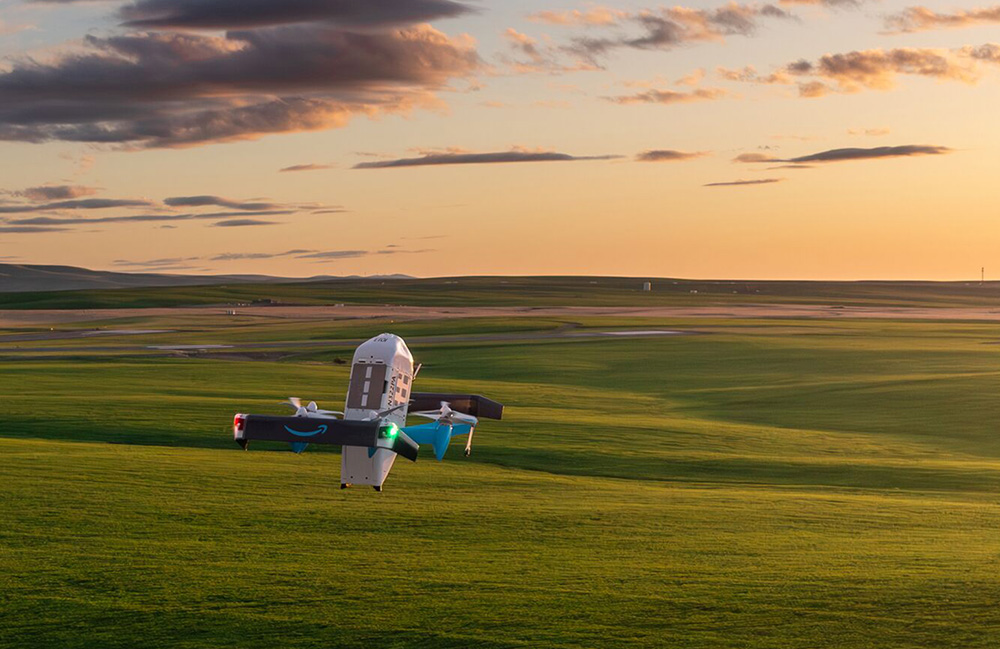
Amazon sets an aggressive new target for drone delivery
Amazon says it plans to expand its Prime Air drone delivery service to nearly 500 cities and towns in the United States by the end of 2026, a dramatic increase from its current footprint and one of the clearest signals yet that the company believes aerial delivery is moving beyond pilot status and toward broader commercial infrastructure.
According to the company, that would represent a sixfold expansion from where the service operates today. Amazon says the move would give tens of millions of customers access to drone delivery, extending a program that already serves customers in cities across seven states: Arizona, Florida, Kansas, Louisiana, Michigan, Nebraska, and Texas.
The company also identified several metro areas where launches are expected soon, including Chicago, Syracuse, Cleveland, Atlanta, and Boise. More communities are slated to follow later this year.
From experiment to logistics layer
Amazon has spent years promoting drone delivery as a way to compress wait times for small, urgent orders. The latest announcement suggests the company now sees Prime Air as a more meaningful layer inside its broader fulfillment system rather than a narrow technology demonstration.
David Carbon, vice president of Amazon Prime Air, said the company has already delivered hundreds of thousands of packages by drone this year. Amazon says eligible orders can arrive in as fast as 30 minutes, with most orders taking about an hour after checkout. That speed matters less for routine bulk shopping than for replacement goods, medications, household supplies, and other purchases where immediate delivery changes the value proposition.
The company’s pitch is straightforward: customers use the same Amazon app, the same checkout flow, and the same customer service framework, but can choose drone fulfillment when an item qualifies and a delivery point has been confirmed. That framing is important because it shows Amazon is not building Prime Air as a separate consumer product. It is trying to make drone delivery feel like an invisible upgrade to the existing retail experience.
What Prime Air can and cannot carry
Prime Air remains constrained by physics and regulation. Amazon says the service is intended for items weighing 5 pounds or less that can fit in a large shoebox. Even with that limit, the company claims more than 60% of the items its customers buy most frequently are eligible.
That figure highlights why the program matters strategically. Many of the most commonly reordered household goods, health items, and small electronics fall within those weight and size boundaries. If Amazon can reliably automate delivery for a large share of those transactions, it could reduce pressure on vans and drivers for certain routes while offering customers a premium speed option.
At the same time, the limits show why Prime Air will complement rather than replace conventional delivery. Larger, heavier, or awkwardly shaped goods will still need ground transport, and dense urban environments may present different operating challenges from suburban or semi-rural areas where delivery zones are easier to manage.
Safety, regulation, and customer acceptance remain central
Amazon says Prime Air holds Federal Aviation Administration Part 135 certification, the same regulatory framework used for air carriers. That is a meaningful operational milestone because commercial drone delivery at scale depends not just on aircraft design, but on the ability to satisfy aviation safety rules while maintaining reliability across different weather conditions, delivery densities, and local environments.
The company says its drones verify that no people, pets, or vehicles are in the drop zone before releasing a package. That step goes to the heart of public acceptance. Fast delivery matters, but routine drone operations over neighborhoods will only expand if customers and regulators believe the aircraft can navigate safely and deliver without creating new hazards on the ground.
Amazon is also extending Prime Air outside the United States. The company recently launched the service in Darlington in the United Kingdom, its first international Prime Air market. Customers within a 7.5-mile radius of the local fulfillment center can receive eligible items by drone. That international debut adds weight to Amazon’s U.S. expansion plan because it suggests the company is testing how repeatable the operating model is across different regulatory and geographic contexts.
The bigger competitive meaning
This announcement is not just about convenience. It is about who gets to define the next operating model for e-commerce logistics. For years, drone delivery has hovered between technical promise and commercial uncertainty. Amazon’s new target indicates that the company believes scale itself may now be the advantage: the more delivery points, fulfillment integration, and customer familiarity it can build, the harder it becomes for smaller rivals to match.
There is also a robotics angle. Prime Air is a real-world autonomy system operating in messy, variable environments, not a controlled warehouse aisle. Expansion therefore becomes a test of whether consumer-facing robotics can move from isolated deployments into a persistent public service. If Amazon succeeds, it could influence how retailers, regulators, and municipalities think about automated last-mile delivery more broadly.
That does not guarantee a frictionless rollout. Community resistance, noise concerns, operational failures, weather limitations, and local regulatory scrutiny could all slow adoption. But Amazon’s announcement shows the company is now willing to be judged on scale, not just vision.
For the wider industry, that is the real development. Drone delivery is no longer being framed primarily as a futuristic demo. Amazon is presenting it as a practical logistics option for millions of customers, with a firm near-term expansion target and a growing list of markets. Whether the company can execute that promise consistently across hundreds of locations will determine if Prime Air becomes a durable part of everyday commerce or remains an ambitious edge case with impressive headlines.
This article is based on reporting by The Robot Report. Read the original article.
Originally published on therobotreport.com