NASA’s Moon Base concept is moving from rhetoric to procurement
NASA has put real numbers behind its long-term Moon Base ambitions, outlining nearly $1 billion in early contract awards aimed at building out the first robotic support layer for a sustained human presence at the lunar south pole. The announcement is significant not because a base now exists in any practical sense, but because the agency has started converting a strategic concept into specific vehicles, delivery plans, and surface logistics.
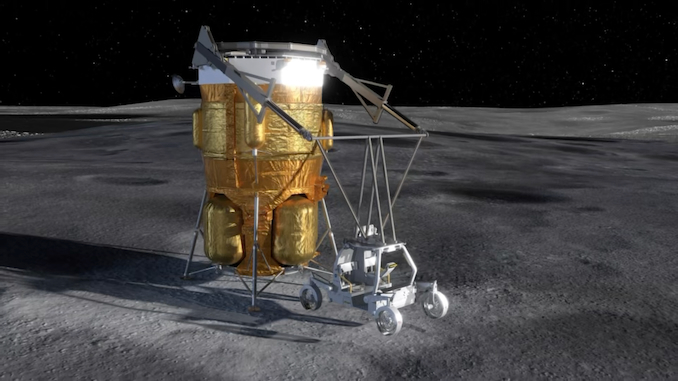
According to the source report, two companies developing lunar terrain vehicles, Astrolab and Lunar Outpost, will each receive contracts worth about $220 million to complete their designs and deliver those systems to the Moon. Astrolab’s vehicle, CLV-1, evolves from its earlier FLEX design, while Lunar Outpost’s Pegasus draws heritage from its previous Eagle concept. NASA also awarded Blue Origin a delivery contract worth $234 million for each lunar terrain vehicle delivered using its Blue Moon Mark 1 lander.
Taken together, those awards represent the clearest indication yet that NASA wants mobility to be part of the early lunar architecture rather than a later upgrade. Surface transport is not cosmetic. If NASA intends to operate across multiple sites near the south pole, rovers and their landing strategy become foundational infrastructure.
Why NASA changed its approach
The source text shows that NASA has already revised its requirements. The agency had previously sought lunar terrain vehicles capable of surviving on the Moon for up to 10 years, but it adjusted those expectations in favor of more readily available systems that could support earlier astronaut missions. That change suggests a pragmatic shift: initial lunar operations will prioritize deployable capability over idealized permanence.
NASA Administrator Jared Isaacman framed the effort as iterative rather than definitive. In the source report, he said the agency intends to send a demand signal to industry for landers, rovers, technology demonstrations, and scientific payloads, applying a stepwise logic to what he described as the “science of survival.” That language matters. It implies NASA sees the first missions less as polished infrastructure rollouts and more as experiments in operational learning under severe environmental constraints.
This is a sensible reading of the Moon itself. The south pole offers scientific interest and potential resource value, but it is also one of the most unforgiving places NASA could try to industrialize. Dust, lighting extremes, terrain uncertainty, thermal management, and landing safety all complicate even basic surface operations.
Distance from landers is now an engineering requirement
One of the more revealing details in the announcement concerns where the rovers will sit when future crewed landers arrive. NASA plans to keep lunar terrain vehicles about 2 kilometers away during landings to protect them from plume surface interaction. In plain terms, the exhaust and regolith kicked up by major landers from SpaceX and Blue Origin could damage nearby equipment.
That detail underscores how early lunar logistics are already driving system design. On the Moon, infrastructure cannot be treated as independent pieces. Rovers, cargo landers, human landing systems, and scientific payloads all have to coexist in an environment where the arrival of one vehicle can threaten another. If NASA is serious about long-duration operations, then staging, separation, and traffic management on the surface become as important as the vehicles themselves.
The planning also shows how lunar missions are becoming a systems-integration problem rather than a single-launch spectacle. The public story of Moon exploration often centers on the dramatic arrival. The harder engineering challenge begins after touchdown, when hardware has to persist, move, coordinate, and remain usable across multiple missions.
Industry is being asked to build the early operating layer
NASA’s current strategy leans heavily on commercial providers. Astrolab and Lunar Outpost are not just making machines; they are being asked to define the working characteristics of the first serious lunar mobility systems. Blue Origin, meanwhile, is positioned as the delivery layer for those assets. That distribution of roles mirrors NASA’s broader modern approach: set mission objectives, fund enabling systems, and rely on industry to execute distinct pieces of the architecture.
The advantage is speed and optionality. Multiple vendors create competition and redundancy while letting NASA refine requirements through actual mission experience. The risk is complexity. A commercial stack can diversify capability, but it also creates dependencies across companies operating to separate schedules, hardware assumptions, and risk tolerances.
Still, the source report suggests NASA sees that tradeoff as acceptable, especially for the missions scheduled to begin in the second half of 2026. Those robotic flights are intended to prepare the ground, literally and operationally, for later Artemis-era astronaut activity.

The contracts do not guarantee a base, but they do make the program more concrete
It is too early to mistake these awards for proof that NASA has solved the challenge of lunar permanence. The Moon Base vision remains aspirational in the broad sense. But procurement has a disciplining effect. Once vehicles, landers, separation distances, and mission timelines are specified, the conversation becomes less about concept art and more about whether the pieces can function together.
That is what makes the nearly $1 billion commitment meaningful. NASA is no longer talking only about returning humans to the Moon in symbolic terms. It is investing in the equipment needed to support repeated work on the surface, even if those first steps are robotic and limited in scope. The agency’s revised requirements further suggest that it has accepted an important truth: durable presence is likely to be built through useful, imperfect hardware deployed early, not through waiting for a flawless end-state design.
If the first missions succeed, NASA will have more than rovers on the Moon. It will have a starting template for how multiple commercial systems can establish the operating rhythm of a future base. That is still a long way from permanence, but it is much closer to reality than a slogan.
This article is based on reporting by Spaceflight Now. Read the original article.
Originally published on spaceflightnow.com