Roman begins its trip to deep space
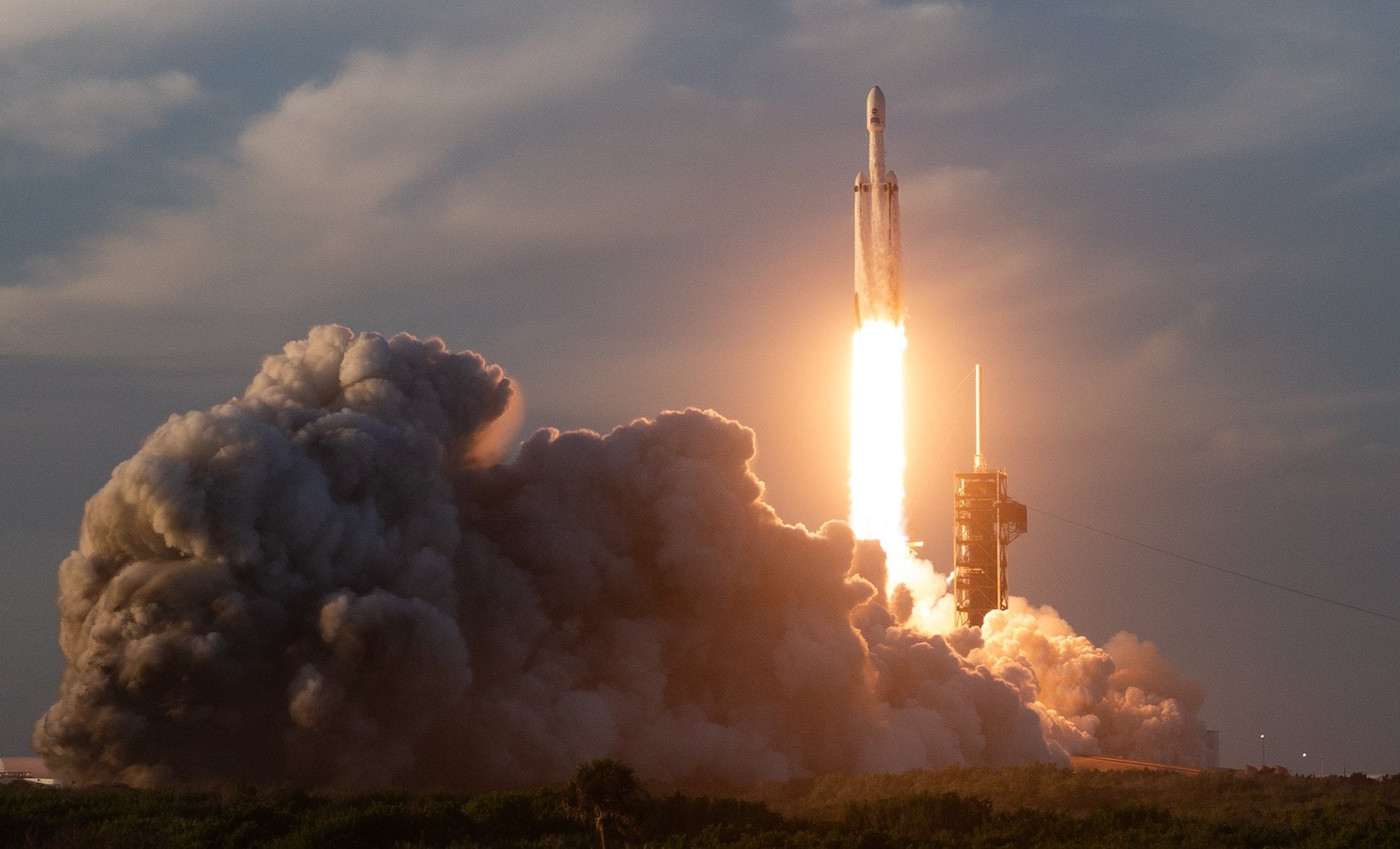
NASA’s Nancy Grace Roman Space Telescope is now on its way to its operational post a million miles from Earth, marking the start of one of the agency’s most ambitious astronomy missions in years. The observatory launched August 30 from Kennedy Space Center aboard a SpaceX Falcon Heavy, beginning a three-month cruise to the Earth-sun L2 gravitational balance point.
The launch itself appears to have gone smoothly. Roman separated for its journey after liftoff at 7:26 a.m. Eastern, while Falcon Heavy’s side boosters returned to land on Florida’s coast and the core booster splashed down at sea. The clean ascent matters because Roman is not just another space telescope. It is meant to become a central instrument for wide-field infrared surveys, tackling some of the biggest open questions in modern astrophysics.
NASA had originally targeted 2027 for liftoff, making the earlier-than-expected launch notable on its own. According to the supplied source, the roughly $4.3 billion mission arrived ahead of schedule and under budget, an uncommon combination for a flagship science program of this scale.
Why Roman matters
Roman is designed to combine Hubble-like sharpness with a radically larger field of view. That pairing is the core of the mission’s promise. Hubble has delivered some of the most important images and measurements in astronomy, but its view of the sky is comparatively narrow. Roman is expected to keep similar resolution and sensitivity in infrared observations while surveying areas more than 100 times larger at once.
That changes the kind of science astronomers can do. Instead of looking at a tiny patch of sky in extreme detail, Roman can sweep across enormous regions and still preserve the precision needed to spot faint structures, rare objects, and subtle patterns. The telescope is being positioned as a machine for scale: scale in area covered, scale in data returned, and scale in the statistical power of its surveys.
The source text says Roman’s high-gain antenna is expected to return about 1.4 terabytes of science data every day, the highest data rate yet for a NASA astrophysics mission. Its biggest images are expected to reach a trillion pixels. Those figures point to a mission built not just around headline imagery, but around data-heavy mapping of the universe.
A telescope with unusual origins
Roman’s backstory also sets it apart. Its two mirrors were originally intended for next-generation National Reconnaissance Office spy satellites. After that project was canceled, the mirrors were transferred to NASA and eventually folded into what was first known as WFIRST, short for the Wide-Field Infrared Survey Telescope.
The mission was later renamed after Nancy Grace Roman, the former NASA chief astronomer often called the “Mother of Hubble” for her role in helping make the Hubble Space Telescope possible. Roman died in 2018, but her name now sits on an observatory designed to extend the space-based astronomy legacy she helped create.
That origin story reflects a broader pattern in space science: highly capable hardware developed for one national priority can sometimes be repurposed into long-horizon scientific infrastructure. In Roman’s case, that transfer appears to have helped enable a telescope that can operate at Hubble-class sharpness while opening a much wider survey window.
The science agenda
Roman’s mission profile is expansive. The telescope is expected to investigate dark matter and dark energy, two of the least understood components of the universe despite their apparent importance to cosmic structure and expansion. A wide-field infrared instrument is especially useful here because it can map large numbers of galaxies and observe how matter is distributed across vast distances and timescales.
The telescope is also positioned to search for Earthlike planets. The source frames Roman as a mission that could help reveal new worlds while also finding the “weird, the rare and the unusual.” That is a concise description of what wide-area sky surveys often do best: they do not merely confirm what scientists expect, they create the opportunity to notice outliers that smaller, targeted observations might miss.
Infrared capability is central to that work. It allows Roman to peer through dust, detect distant objects whose light has shifted toward longer wavelengths, and collect the kind of uniform survey data researchers can use across multiple scientific questions. Instead of being optimized for a single discovery, Roman is better understood as a platform that can support many different discoveries at once.
A strategic moment for NASA astronomy
Roman’s launch lands at a meaningful moment for NASA’s science portfolio. The agency already has Hubble operating in Earth orbit and the James Webb Space Telescope working at L2. Roman adds a different capability rather than duplicating either one. If Webb is built for extremely deep, highly detailed observations of selected targets, Roman is built to scan broad territory and generate the cosmic context around those targets.
That division of labor could prove important for the next decade of astronomy. Large survey missions often become force multipliers for the entire research community because they create catalogs, maps, and candidate objects that other observatories can investigate in more detail. Roman is therefore not just a standalone observatory. It is likely to function as discovery infrastructure for follow-up work across astronomy.
There is also symbolic weight in the mission arriving ahead of schedule. NASA’s most visible science programs are often judged on cost and timing as much as scientific ambition. A successful launch after schedule acceleration gives the agency a strong early narrative for Roman: technically complex, operationally disciplined, and built for long-term scientific return.
What comes next
The immediate next phase is transit and commissioning. Roman must travel to Earth-sun L2 and prepare its systems for science operations. If that process stays on track, researchers will gain a new observatory capable of pairing high-resolution infrared imaging with enormous sky coverage.
The most important point is that Roman has moved from promise to execution. For years it existed mainly as a concept tied to future cosmology and exoplanet research. With launch complete, the mission has crossed into a more consequential stage: the point where hardware, schedule, and scientific aspiration begin to converge in space.
- Launch date in source: August 30, 2026
- Launch vehicle: SpaceX Falcon Heavy
- Destination: Earth-sun L2, about 1 million miles from Earth
- Core strengths: wide-field infrared surveys, high data return, Hubble-like sharpness
This article is based on reporting by Universe Today. Read the original article.
Originally published on universetoday.com