A lopsided interior may still be shaping Mars
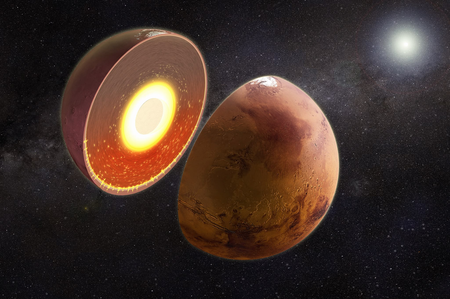
Mars is cold, dry, and geologically quieter than Earth, but new research suggests the planet’s interior may remain far less uniform than scientists once assumed. According to a report on findings presented in Nature, an international team has concluded that the southern hemisphere of Mars may be roughly 200 to 400 degrees Celsius hotter internally than the northern hemisphere.
If the result holds, it would sharpen a major shift in how researchers think about the Red Planet. Rather than behaving as a mostly symmetrical world that cooled evenly over time, Mars may still preserve a strong internal imbalance linked to its deep structure and long geological history. That matters because internal heat helps determine how a planet evolves, how seismic energy travels, and how long volcanism and other internal processes can persist.
Why interior heat matters on a cold planet
Modern Mars appears inactive compared with early Mars, but its past was much more dynamic. Universe Today describes a world that once had a warmer interior, active volcanism, a magnetic field, and flowing liquid water at the surface. Over time, Mars cooled faster than Earth, a consequence often tied to its smaller size. As the interior lost heat, volcanism waned, the magnetic field was largely lost, and surface water disappeared.
That long decline is already central to planetary science. The new finding adds a new layer: the cooling may not have happened in the same way everywhere inside the planet. A 200 to 400 degree Celsius difference between hemispheres is not a minor wrinkle. It suggests Mars’s internal engine may be spatially uneven, with consequences for how the crust, mantle, and deeper structures interact.
Even if the surface looks globally barren, the internal state of the planet still informs how researchers reconstruct its past and model its future. Heat distribution affects mantle behavior, the propagation of waves from marsquakes, and the interpretation of gravity and topography data gathered over decades of missions.
How researchers built the case
The team drew on archival measurements from three NASA orbiters: Mars Global Surveyor, Mars Odyssey, and Mars Reconnaissance Orbiter. Mars Global Surveyor ended its mission in 2006, while Odyssey and Mars Reconnaissance Orbiter remain active. By combining orbital data with long-established knowledge of Mars’s eccentric orbit and planetary tilt, the researchers assembled a new gravitational model of the planet’s interior.
The method highlighted in the report is tidal tomography. In broad terms, the approach uses subtle changes, including slight shifts in spacecraft velocities over time, to infer how Mars responds internally to gravitational forcing. Those responses can then be used to estimate characteristics of the planet’s deeper structure, including how heat may be distributed beneath the surface.
This kind of work is valuable because direct access to a planet’s deep interior is impossible. Scientists instead build indirect pictures using seismic behavior, gravity fields, orbital mechanics, and surface geology. Here, the combination of multiple spacecraft datasets and planetary parameters gave the team a way to test whether Mars behaves like a roughly spherical, internally balanced body or a more asymmetric one.
The south appears warmer than the north
The researchers’ conclusion is striking: the southern hemisphere’s interior may be hotter by about 200 to 400 degrees Celsius than the northern hemisphere’s interior. Universe Today notes that the result is consistent with earlier hints from NASA’s InSight lander, which found that seismic waves traveling through the southern hemisphere dissipated more quickly than waves passing through the north.
That connection is important because it links separate lines of evidence. Orbital gravity-based inference and in situ seismic observations are different tools, but both appear to point toward a warmer, more dissipative southern interior. When independent methods begin to align, confidence in an emerging planetary picture tends to increase.
The finding also pushes back on a simplifying assumption common in planetary modeling: that the interiors of rocky bodies are generally close to spherically symmetric. Mars may preserve a stronger hemispheric contrast than expected, perhaps reflecting ancient processes that never fully evened out. While the underlying Nature study would carry the technical detail, the reported outcome alone is enough to recast Mars as a planet with an interior that remains meaningfully unbalanced.
What could explain the imbalance
The supplied report does not fully resolve the cause, but it gives context for why such an asymmetry is plausible. Mars differs from Earth in both orbital eccentricity and axial tilt, and the researchers explicitly combined those factors with spacecraft data in building their model. More broadly, Mars is famous for a north-south geological divide, with extensive differences between the heavily cratered southern highlands and the lower northern plains.
The interior temperature contrast may therefore fit into a larger story of hemispheric divergence that extends from surface geology into the mantle or deeper layers. Whether the heat imbalance reflects ancient formation conditions, later internal evolution, or persistent structural differences is a question for follow-on work. What is clear from the reported findings is that Mars cannot be treated as a uniformly cooling sphere without potentially missing important physics.
Why this matters for future Mars science
The practical impact of a warmer southern interior is that scientists may need to revise models for Mars’s thermal history, seismic behavior, and internal dynamics. Missions that study marsquakes, crustal structure, or volcanic history could gain a sharper framework for interpreting data if hemispheric temperature differences are real and large.
It may also influence how researchers think about the legacy of volcanism and magnetic protection on early Mars. A planet with uneven internal heat could have sustained activity differently across regions and over time. That does not mean the south is volcanically active today based on the supplied report, but it does mean Mars’s interior history may be more regionally complex than a simple global-cooling narrative implies.
For planetary science, the broader lesson is familiar: old mission data can still produce new discoveries when combined in novel ways. Mars Global Surveyor, Mars Odyssey, Mars Reconnaissance Orbiter, and InSight were designed for different scientific roles across different eras, yet together they are helping reveal a deeper picture of the planet. On a world long studied but still only partially understood, that is a reminder that major insights do not always require a brand-new mission. Sometimes they come from asking a better question of the data already in hand.
This article is based on reporting by Universe Today. Read the original article.
Originally published on universetoday.com