A magnetar may have revealed how empty space changes light
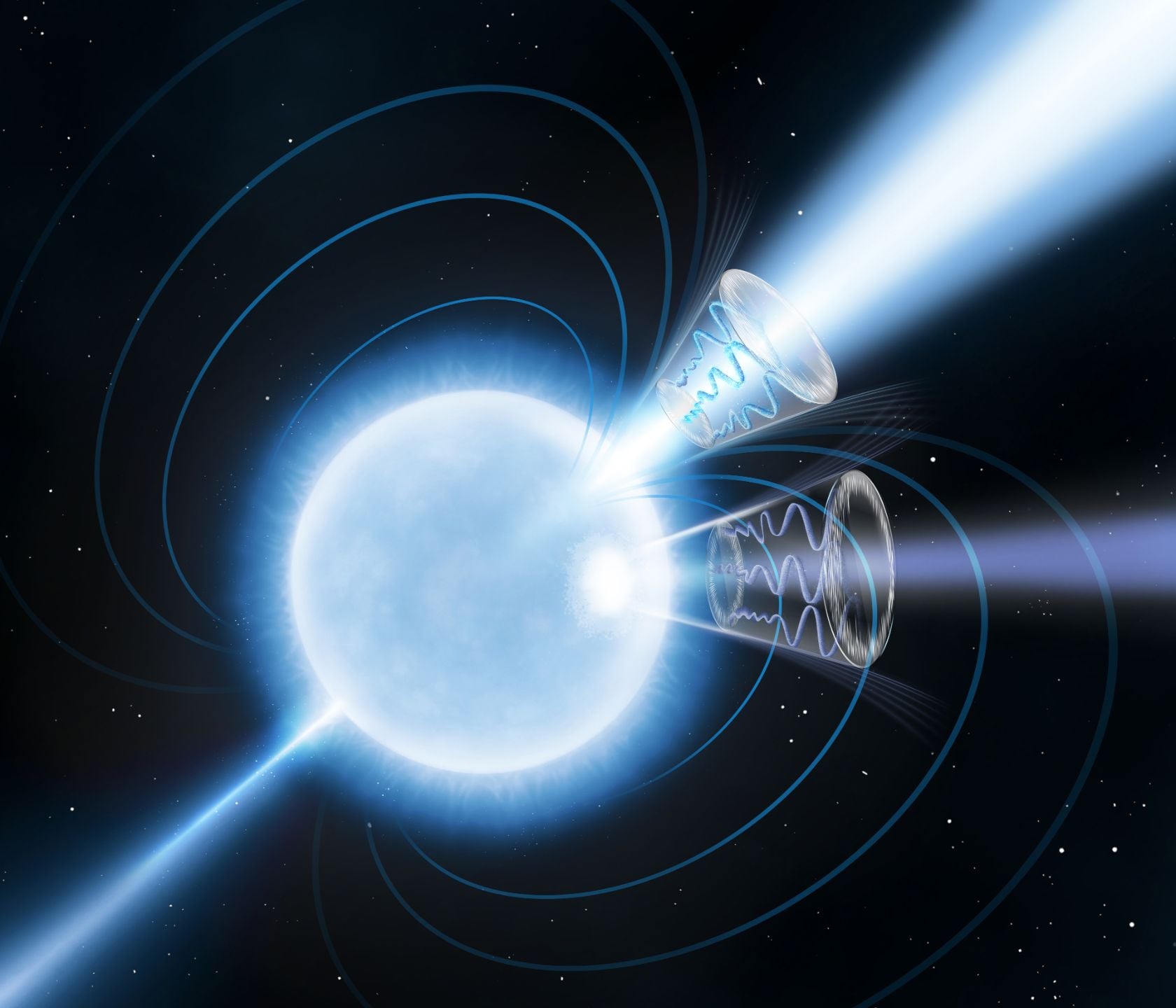
Astronomers studying one of the most extreme objects in the universe say they may finally have evidence for a strange quantum effect that physicists have chased for decades. Using observations of the magnetar 1E 1547.0–5408, an international research team found signs consistent with vacuum birefringence, the idea that even empty space can alter the behavior of light when exposed to an extraordinarily strong magnetic field.
The result matters because vacuum birefringence has been a long-standing prediction of quantum mechanics. The effect was first proposed in the 1930s, when physicists argued that a vacuum is not truly empty. Instead, it should be filled with short-lived virtual particles that flicker in and out of existence. Under normal conditions, that quantum activity is impossible to see directly. But in the presence of a magnetic field strong enough to distort how light propagates, the vacuum itself is expected to act a bit like a prism, changing the light in measurable ways.
According to the source material, the team used NASA’s Imaging X-ray Polarimetry Explorer, or IXPE, to observe the magnetar. Magnetars are a rare class of neutron stars and are known for having the strongest magnetic fields in the universe. Those fields are so intense that researchers see them as natural laboratories for testing ideas that cannot be reproduced on Earth.
Why magnetars are central to the result
The core challenge in detecting vacuum birefringence has always been the required field strength. The source text says the effect demands a magnetic field more than 100 million times stronger than anything scientists have produced in terrestrial experiments. That makes ordinary laboratory confirmation exceptionally difficult, even after decades of work in nuclear physics and particle accelerators.
Magnetars solve that problem by existing far beyond human engineering limits. They compress enormous mass into a tiny remnant left behind after a star’s collapse, and in the process generate magnetic fields powerful enough to influence matter, radiation and, researchers suspect, the quantum vacuum itself. In this case, the team focused on 1E 1547.0–5408, a known magnetar whose properties made it a candidate for precisely this kind of test.
The observation campaign was led by researchers including Rachael E. Stewart of George Washington University, and the study appeared in Nature, according to the source text. The team also included scientists from NASA centers, the South African Radio Astronomy Observatory, Los Alamos National Laboratory, Swinburne University of Technology and other institutions.
That breadth of collaboration is notable because the signal being sought is subtle even in an extreme astrophysical environment. Researchers are not seeing empty space directly. They are instead looking at how light behaves after traveling through a region where theory predicts that the vacuum should no longer be optically neutral. If the polarization properties of the X-rays line up with those expectations, that becomes evidence that the vacuum has effectively become birefringent.
What vacuum birefringence actually means
Birefringence is a familiar concept in optics. In some materials, light splits or changes depending on its orientation, because the material affects different components of the light wave differently. The quantum version applies that logic to empty space itself. In a sufficiently intense magnetic field, the vacuum is predicted to stop behaving like a featureless backdrop and start behaving like a medium with structure, at least from the standpoint of passing light.
If confirmed, that would be a striking demonstration that quantum effects are not confined to exotic laboratory apparatus or abstract equations. It would mean the fabric of apparently empty space can take on observable optical properties under extreme conditions. That is one reason the result carries weight beyond astronomy. It touches the foundations of quantum electrodynamics and the way physicists understand the relationship between fields, particles and radiation.
The source text is careful about the wording. It describes the result as what could be the first evidence of vacuum birefringence, not the final closing of the case. That distinction matters. Extraordinary claims in physics typically require repeated scrutiny, cross-checks and independent analyses before they are treated as settled. But even as a strong candidate signal, the finding would represent a major milestone because the effect has remained out of reach for nearly 90 years.
Why this result reaches beyond one star
The implications extend in two directions. One is practical for astrophysics: magnetars could become more important as test sites for frontier physics. Instead of viewing them only as unusual remnants of stellar evolution, scientists may increasingly use them as instruments for probing how nature behaves under conditions that cannot be recreated on Earth.
The second is conceptual. Quantum mechanics has long described a vacuum as an active arena rather than an empty void, but direct observational windows into that picture are rare. Evidence from a magnetar would strengthen the idea that the universe’s most violent environments can expose the hidden structure predicted by quantum theory. In that sense, the result is not just about one neutron star. It is about whether cosmic extremes can verify phenomena that remain inaccessible in conventional experiments.
The source text also points to future opportunities for scientists exploring the quantum realm. That likely means similar observations of other magnetars, better X-ray polarization measurements, and more detailed modeling of how radiation behaves in ultra-strong magnetic fields. If multiple systems show the same signature, confidence in the interpretation would rise sharply.
For now, the significance lies in the convergence of theory, instrumentation and astrophysical luck. A hypothesis dating back to the early twentieth century has survived long enough to meet a modern observatory and a suitable cosmic target. If the analysis holds, empty space may no longer be treated as merely the absence of matter in this context. It becomes an active participant in the journey of light.
That is the deeper appeal of the result. Physics often advances by making the invisible measurable. In this case, astronomers may have used one of the universe’s fiercest magnetic objects to reveal that the vacuum itself is less empty than it looks.
This article is based on reporting by Universe Today. Read the original article.
Originally published on universetoday.com