The Sun's Hidden History
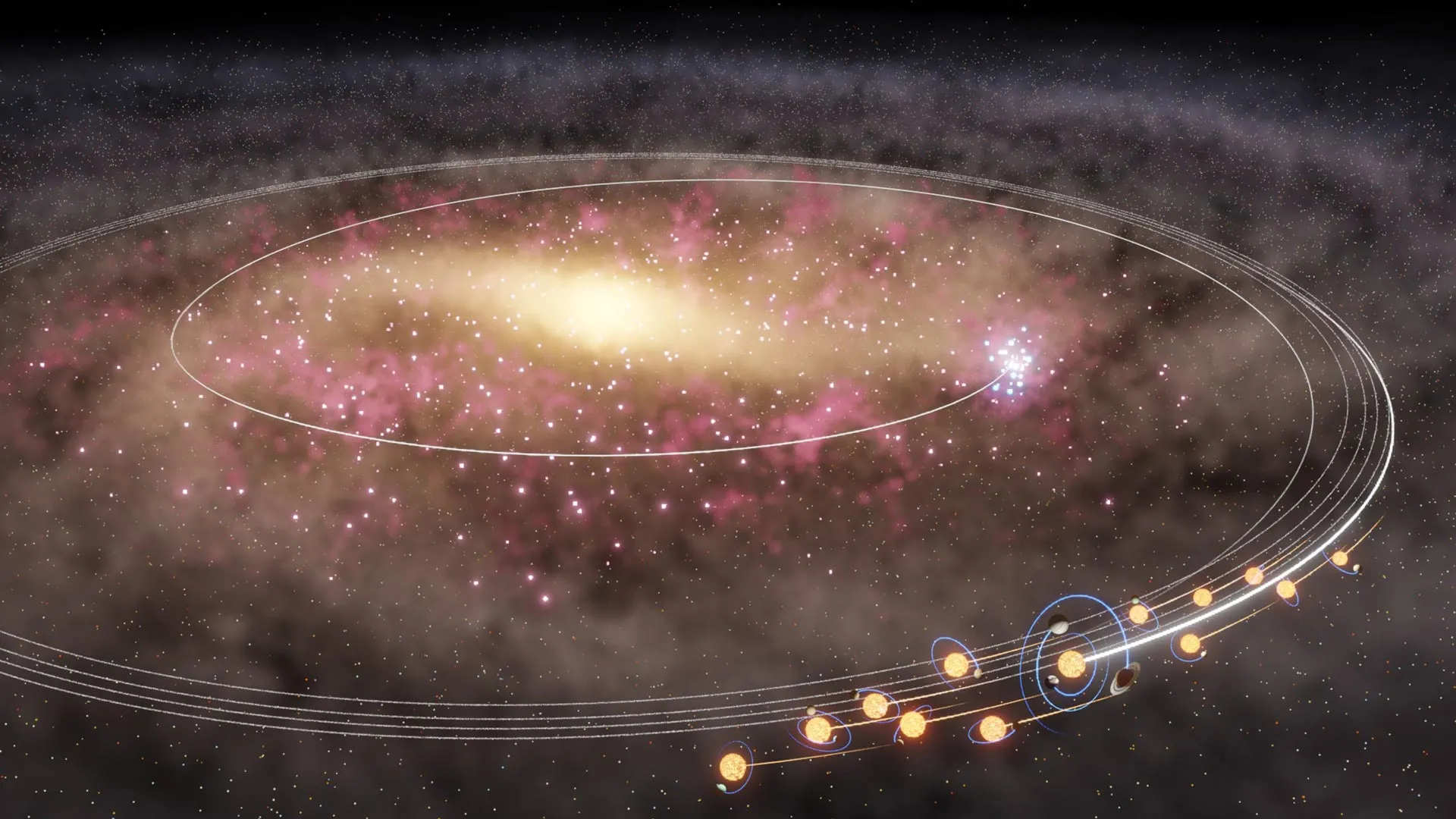
Scientists have uncovered evidence that our Sun may have traveled across the Milky Way as part of a massive migration of similar stars billions of years ago, moving from the galaxy's crowded, radiation-intense center to the calmer outer regions where it resides today. The finding, published in a new study, suggests that the Sun's current location—so hospitable to life—may not be where it was born, and that a galactic-scale journey may have been a necessary precondition for Earth's habitability.
The research team identified a population of stars in the galactic disk that share chemical signatures with the Sun, suggesting they formed in similar environments. Tracing these stars' orbits backward through simulations of galactic dynamics, the team found evidence that many of them, including possibly the Sun itself, originated in the inner regions of the Milky Way—closer to the supermassive black hole at the galaxy's center—before a process called radial migration carried them outward.
What Is Radial Migration?
Radial migration is a phenomenon in which stars are gradually displaced from their original orbital radii through gravitational interactions with density waves, spiral arms, and other stars. Unlike dramatic events like supernovae or near-miss encounters, radial migration is a slow, cumulative process driven by repeated small gravitational perturbations over millions of years.
The Milky Way's spiral arms act as regions of enhanced gravitational influence that can transfer angular momentum to stars, nudging them onto larger orbits over time. Stars that interact repeatedly with spiral arms in the right configuration can travel large distances radially across the galaxy over billions of years—potentially moving from the inner disk to the outer disk or beyond.

Thousands of Solar Twins
The study identified what researchers are calling "solar twins"—stars with masses, ages, and chemical compositions closely matching the Sun's—scattered throughout the Milky Way's disk. The distribution of these stars suggests they did not all form in the same neighborhood and then disperse. Instead, the pattern is more consistent with stars that formed in similar inner-galaxy environments and then migrated outward through radial migration over the course of billions of years.
Identifying the Sun among this migrant population would explain several puzzles about the solar system's chemical composition. The Sun is known to be enriched in certain heavy elements relative to what models predict for stars that formed at its current galactic radius. If the Sun formed closer to the galactic center, where metallicity is higher, its chemical fingerprint would be more naturally explained.
Life in the Quiet Zone
The galactic center is an inhospitable environment by the standards of life as we know it. It is denser with stars, richer in cosmic radiation from supernovae and active stellar remnants, and subject to gravitational disturbances that could disrupt planetary systems over time. The outer disk, where the Sun currently resides, is calmer: lower stellar density means fewer disruptive close encounters, lower radiation levels allow complex organic chemistry to persist, and more stable orbital dynamics allow planetary systems to survive billions of years of evolution.
If the Sun migrated from the inner galaxy, its journey to the quieter outer disk may have been an unlikely but essential factor in allowing Earth to develop and sustain life over 4.5 billion years. A Sun that remained in the inner galaxy might have experienced too many disruptions—passing stellar systems perturbing the outer planets, heightened radiation levels damaging early biological chemistry—to produce a world like ours.

How the Study Was Conducted
The research combined data from the Gaia space telescope, which has produced the most precise map of stellar positions and velocities in the Milky Way's history, with spectroscopic surveys that measured the chemical compositions of hundreds of thousands of stars. By correlating chemical profiles with inferred birth radii derived from galactic dynamics models, the team was able to construct a population-level picture of stellar migration across the galaxy.
The analysis is statistical in nature: it does not definitively prove that any specific star, including the Sun, underwent radial migration. But the population-level signature is strong enough that the team concludes migration is the most parsimonious explanation for the observed distribution of solar-type stars.
Implications for Galactic Habitability
The finding has potential implications for the search for life elsewhere in the galaxy. If radial migration is a common pathway by which solar-type stars find their way to the calmer outer disk, then the outer disk may be more populated with stars that formed in chemically rich inner regions than previously assumed. Such stars would have planetary systems enriched in the heavy elements—including carbon, oxygen, phosphorus, and iron—that life as we know it requires.
Future research using next-generation spectroscopic surveys and improved galactic dynamics models may be able to test the migration hypothesis more rigorously, potentially narrowing down the Sun's likely birth radius and reconstructing, at least probabilistically, the early history of our solar system's journey through the galaxy.
This article is based on reporting by Science Daily. Read the original article.

Originally published on sciencedaily.com