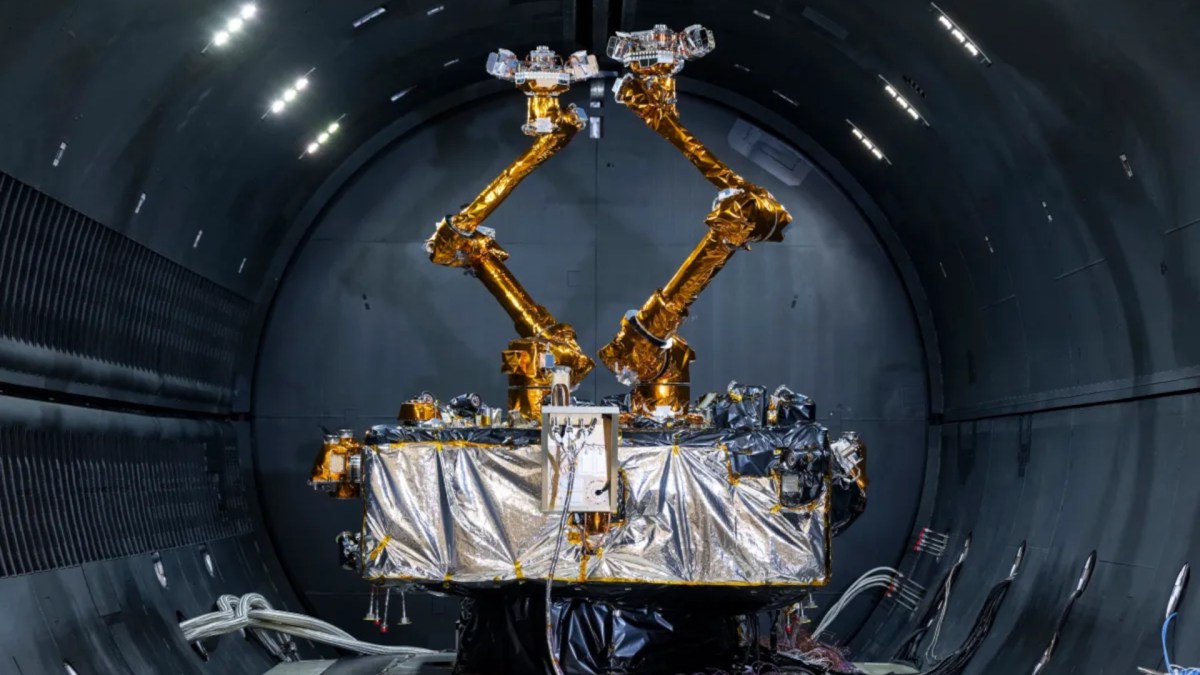
Northrop Grumman’s servicing spacecraft is launching into a more contested space era

Northrop Grumman’s first Mission Robotic Vehicle, or MRV, is set to launch as the company pushes deeper into on-orbit satellite servicing. On paper, the vehicle’s role is straightforward: repair, relocate and refuel satellites in geosynchronous orbit, and install mission-extension devices that can keep spacecraft operating for years longer than originally planned.

But the discussion around the launch quickly expanded beyond commercial servicing. During a Northrop Grumman earnings call, an analyst asked directly about the market potential for an offensive version of the same robotic spacecraft, one that could be used to disable adversary satellites. Chief executive Kathy Warden did not endorse such a mission, but she also did not rule it out, saying decisions about that kind of capability would be left to the U.S. government.

That exchange matters because it captures a broader shift in space policy and military planning. Technologies designed to inspect, repair and extend the life of spacecraft can also raise obvious questions about proximity operations, control and coercion in orbit. In a domain where the same maneuvering and robotic capabilities can support peaceful servicing or disruptive action, the MRV arrives at a time when dual-use implications are becoming harder to separate from commercial ambition.

A commercial satellite helper with unusually flexible hardware

Northrop described the MRV as the first commercial robotic spacecraft able to repair, relocate and service satellites in geosynchronous orbit using two robotic arms. The vehicle is also designed to install mission extension pods, described by the company as jetpack-like systems that can prolong a satellite’s useful life by as much as eight years for government or commercial customers.

That pitch fits a growing market logic. Satellite operators want to preserve expensive orbital assets, delay replacements and recover value from spacecraft that may still function except for fuel depletion or limited hardware problems. A platform that can physically interact with those satellites could help turn servicing into a recurring business rather than a one-off rescue mission.

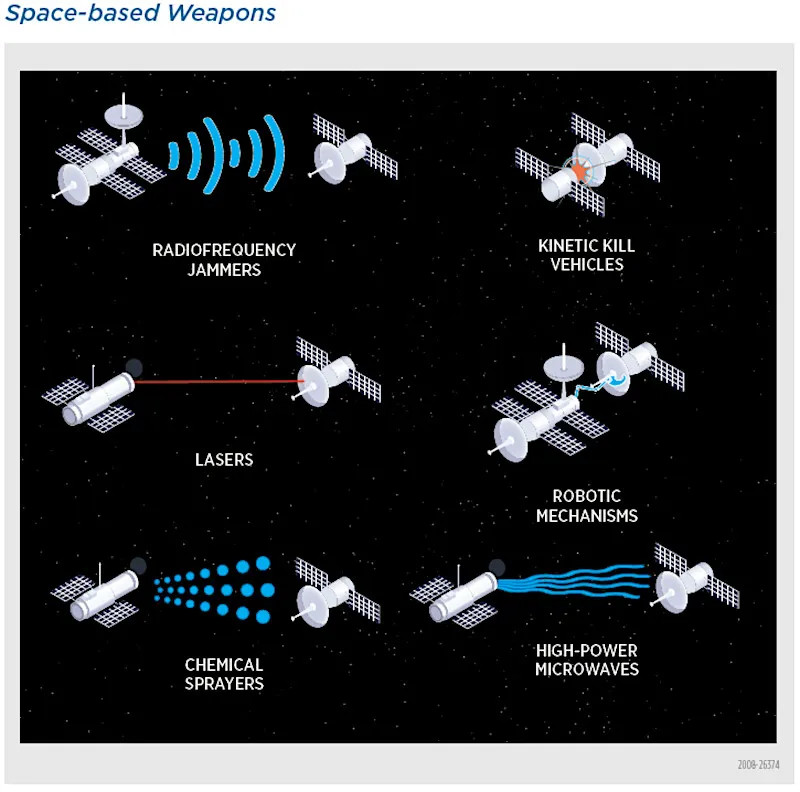
A U.S. Defense Intelligence Agency graphic highlighting some of the ways on-orbit attack can be carried out, including via robotic arms. DIA

In that sense, the MRV is part of a larger evolution in space infrastructure. Rather than treating satellites as disposable hardware, operators are increasingly interested in building a maintenance layer around them. If successful, robotic servicing could change assumptions about spacecraft lifetime, replacement cycles and the economics of operating in geosynchronous orbit.

Why the military question surfaced immediately

The War Zone’s report centered on a basic tension: a spacecraft able to approach another satellite, grasp it, move it or attach new hardware is also a spacecraft with capabilities that could be repurposed in a conflict. The concern is not that Northrop announced a weapon. It did not. The concern is that the technical foundation for servicing overlaps with the technical foundation for interference.

The analyst question on the earnings call reflected that reality bluntly. If a spacecraft can repair or reposition friendly assets, can a related system also disable hostile ones? Warden’s answer was careful. She framed the issue as one for government mission planners, while also indicating that Northrop’s objective is to offer capabilities aligned with customer requirements. That is not a declaration of intent, but it is a signal that the company sees the platform as adaptable.

The timing of the question also reflects a strategic backdrop that has changed. According to the report, the U.S. Space Force has publicly said it is pursuing offensive space-based capabilities, primarily to help protect friendly satellites against growing threats. In that environment, even clearly commercial spacecraft can draw scrutiny if they demonstrate rendezvous, manipulation and persistent on-orbit presence.

Dual-use technology is becoming the norm in orbit

The MRV is not controversial because robotic arms are inherently aggressive. It is controversial because space systems are increasingly judged by what they could do, not only what they are built to do today. A refueling vehicle, inspection craft or life-extension platform may all occupy the same technological neighborhood as a counterspace system.

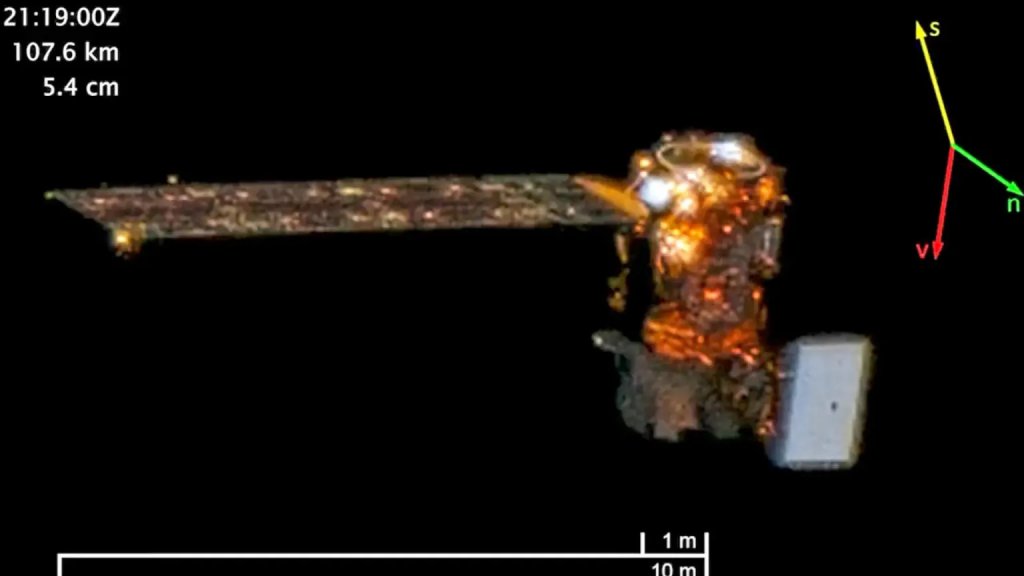
A commercial image of Landsat 8 taken from another satellite, WorldView-3, in orbit. Maxar Technologies (now Vantor) via NASA

That makes intent, policy and transparency just as important as hardware. Commercial operators may see servicing spacecraft as a way to improve sustainability and reduce waste. Defense planners may see resilience, responsiveness and strategic leverage. Rivals may see ambiguity. All three readings can coexist.

For policymakers, that creates a familiar governance problem. The more capable orbital robotics become, the harder it will be to distinguish stabilizing infrastructure from latent military capacity. That does not make the technology undesirable. It does mean future launches like this one will be evaluated not just on commercial merit, but on signaling, norms and rules of behavior in space.

What to watch after launch

The immediate milestone is operational: whether Northrop can demonstrate that the MRV can perform the servicing tasks it has been built to do. If the vehicle succeeds, it could strengthen the business case for a broader fleet and help normalize satellite life-extension as a routine part of orbital operations.

Beyond that, three questions will shape how the program is interpreted.

  • Whether commercial customers adopt robotic servicing at meaningful scale.
  • How openly governments discuss the line between satellite servicing and counterspace capability.
  • Whether companies building orbital robotics choose to emphasize transparency and mission constraints to reduce strategic ambiguity.

Northrop’s launch is therefore more than a product milestone. It is also a marker for the next phase of space operations, one in which useful servicing tools and potential coercive tools may increasingly share the same design DNA. The MRV is being introduced as a commercial maintenance craft. The response to it shows that the industry, the military and outside observers are already thinking about the wider consequences.

This article is based on reporting by twz.com. Read the original article.

Originally published on twz.com