A decades-old idea is starting to look usable
For most of the modern era, the atomic clock has represented the ceiling of practical precision. That standard may now be under pressure. According to the supplied New Atlas text, two research teams have independently demonstrated working versions of a nuclear clock based on thorium-229, marking a milestone for an approach that has been pursued for decades and could eventually surpass the best performance of conventional atomic clocks.
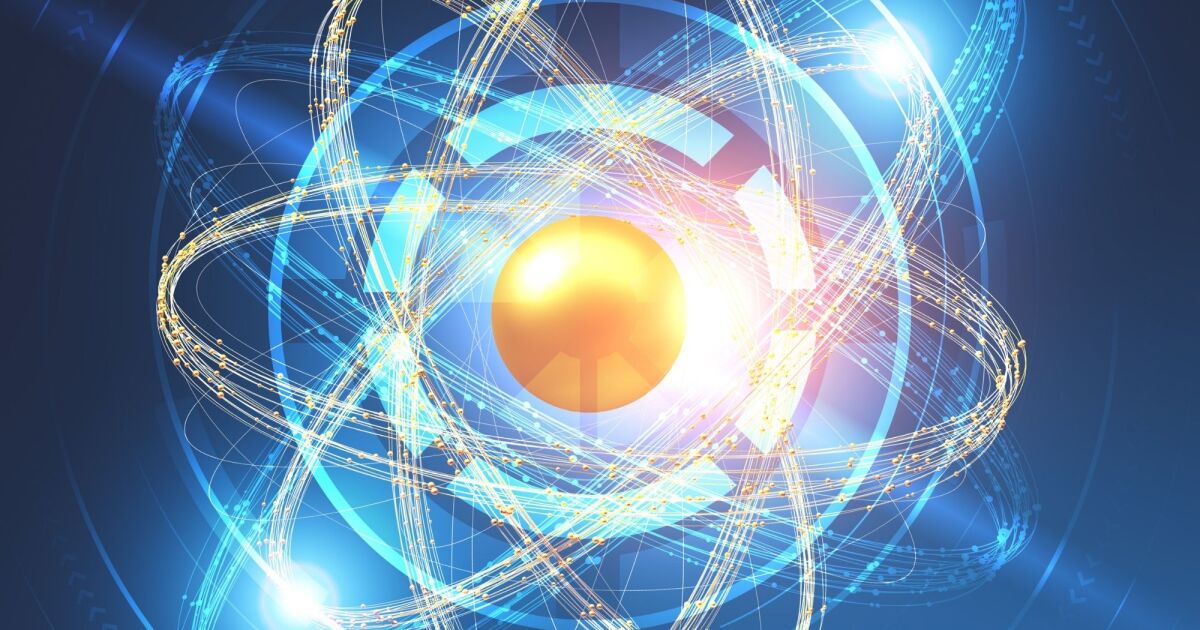
The distinction between the two clock types is fundamental. Atomic clocks rely on electronic transitions, tracking predictable changes in the energy states of electrons. Nuclear clocks instead aim to use transitions in an atom’s nucleus. Because nuclear transitions occur at higher energies, they can in principle provide more oscillations per second and therefore support finer time resolution. In effect, a nuclear clock offers the possibility of dividing time into even smaller and more stable increments than today’s leading systems.
The thorium-229 transition has long been viewed as the most promising route because researchers concluded in 2003 that the required nuclear excitation might be reachable with modern lasers. Even so, the field advanced slowly. The phenomenon was only observed years later, the exact ultraviolet wavelength had to be pinned down experimentally, and the final major obstacle was figuring out how to reliably transmit and handle light in a spectral range that is easily absorbed by atmospheric gases.
The new experiments appear to have cleared that barrier. One team, led by Luca Toscani De Col at the Vienna Center for Quantum Science and Technology, and another led by Beichen Huang at Tsinghua University, both used thorium-229 nuclei embedded in calcium fluoride. According to the source text, Huang’s group increased laser power while the Vienna team raised isotope concentrations, with both paths producing practical devices. That matters because the result is no longer just a theoretical claim about what nuclear timekeeping could do. It is an experimental platform that researchers can now refine.
Why pursue such extreme precision? The answer is that better clocks are not only about keeping better time. They are measuring instruments for reality itself. Improvements in precision timing help scientists detect tiny effects linked to gravity, acceleration, and the behavior of matter under extreme conditions. The source text notes that current top-end clocks can measure time to 19 decimal places and that nuclear clocks are expected to exceed that. Even incremental gains at that level can unlock new tests of fundamental physics.
The practical horizon is equally interesting. More stable clocks strengthen navigation, telecommunications, synchronization of large technical systems, and any application where tiny timing errors compound into meaningful drift. Nuclear clocks are not about replacing a wristwatch. They are about extending the precision infrastructure that underlies advanced science and technology.
There is still a gap between a laboratory proof point and a mature instrument. The phrase “could surpass” remains important. Researchers have shown a workable path, not a finished industry standard. Engineering challenges, reproducibility, and system integration still lie ahead. But the field has moved from a long-standing aspiration to a demonstrated architecture, and that is a substantial change in status.
The result is one of those advances that can seem esoteric at first glance but become foundational in hindsight. The better humanity gets at carving time into exact units, the more sensitive its tools become. If nuclear clocks continue to improve, they may not just refine timekeeping. They may open a new layer of measurement across physics itself.
This article is based on reporting by refractor.io. Read the original article.
Originally published on refractor.io