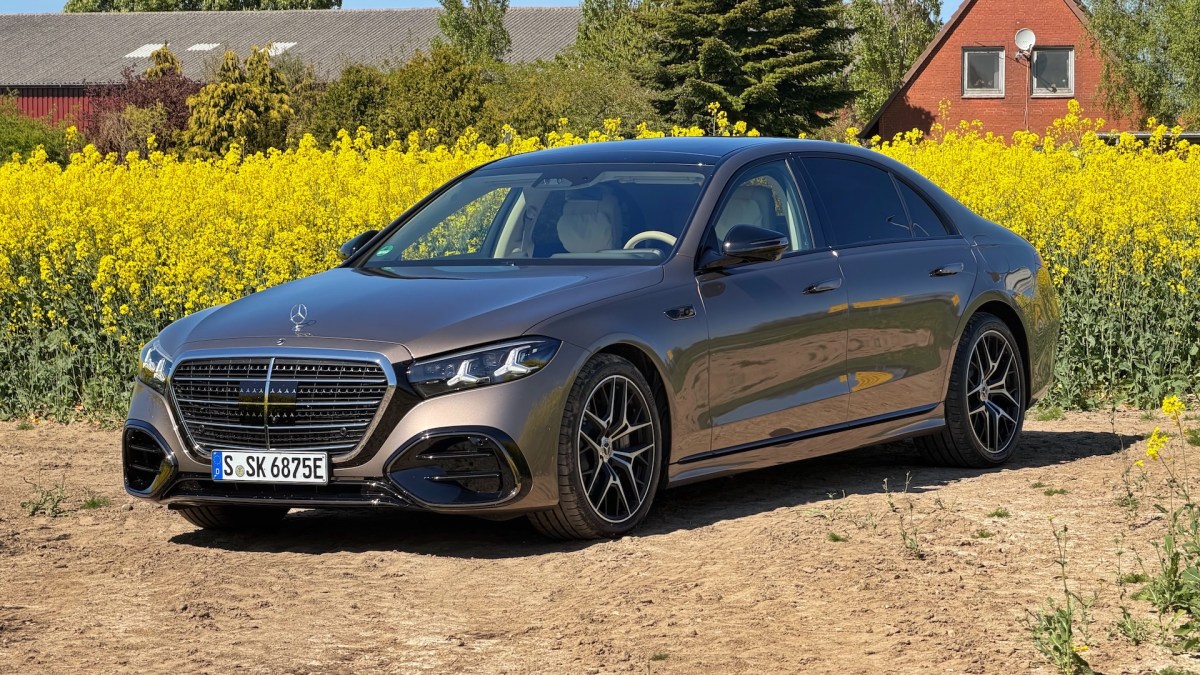
Mercedes refreshes its flagship without reinventing it
The next phase of the Mercedes-Benz S-Class is arriving with an unusual message for the luxury-car market: the flagship sedan still matters, even in an era dominated by SUVs, electrification debates, and changing buyer expectations. Based on details from a first drive in northern Germany, the 2027 S-Class will reach the United States in three trims and will combine familiar proportions with major underlying revisions, including new cabin technology and a range of electrified powertrains.
Visually, Mercedes appears to be taking an evolutionary approach. The updated S-Class does not dramatically depart from its predecessor, but the company says the car is 50% new and incorporates more than 2,700 new parts. The most visible exterior changes include a larger grille, revised headlight and taillight treatments, new wheel designs, and an illuminated hood ornament. The message is clear: Mercedes wants the car to remain instantly recognizable while still giving buyers reasons to treat it as a new flagship rather than a cosmetic carryover.
Three powertrains for a complicated market
The U.S. lineup is set to include the S500, S580e, and S580. Those variants show how Mercedes is trying to satisfy several kinds of luxury buyers at once. The S500 uses a mild-hybrid twin-turbo 3.0-liter inline-six rated at 442 horsepower. The S580e pairs a twin-turbo 3.0-liter inline-six with plug-in hybrid hardware for a combined 576 horsepower. The S580 keeps a twin-turbo 4.0-liter V8 with 530 horsepower for buyers who still want a more traditional large-displacement flagship experience.
All models use a nine-speed automatic transmission and 4Matic all-wheel drive. That consistency suggests Mercedes is treating the S-Class less as a platform for radical experimentation and more as a stable benchmark at the top of its combustion and hybrid luxury range. In market terms, that may be the sensible play. The top end of the auto business is still navigating how quickly wealthy buyers want to move from internal-combustion prestige products to full battery-electric equivalents.
The S-Class therefore occupies a strategic middle position. It can absorb electrification through mild-hybrid and plug-in hybrid versions while continuing to serve customers who are not ready to abandon a V8 flagship. That flexibility may be one of its strongest assets as the segment adjusts to inconsistent global demand patterns.

The cabin becomes the headline feature
If the exterior is restrained, the interior takes a more assertive turn. Mercedes is making its MBUX Superscreen standard in the S-Class, extending the multi-screen layout already associated with some of the brand’s EQ models. The interface combines three displays across the dashboard and becomes one of the car’s clearest statements about how Mercedes wants luxury to feel in the second half of the decade.
That choice is significant because cabin technology increasingly defines perceived value in high-end cars. Buyers in this segment still care about ride quality, noise isolation, and rear-seat comfort, but they also expect large-format displays, integrated software, and visual drama. By making the Superscreen standard, Mercedes is signaling that digital presence is no longer a novelty feature. It is part of the baseline expectation for a flagship sedan.
At the same time, the decision shows how luxury automakers are trying to reconcile heritage and screen culture. The S-Class carries decades of brand meaning as a rolling showcase for engineering prestige. The new model still leans on that history, but it also acknowledges that the modern flagship has to compete in a world where software presentation matters nearly as much as mechanical refinement.
Why this refresh matters
The 2027 S-Class matters because it reveals Mercedes’ reading of the upper-end market. Rather than making the sedan a dramatic technological manifesto, the company appears to be refining a proven formula: keep the silhouette familiar, broaden the powertrain appeal, and push the cabin deeper into the digital era. That is a conservative strategy, but not a passive one.
Luxury sedans face pressure from every direction. SUVs continue to absorb demand, China exerts strong influence over flagship design and equipment choices, and electrification remains uneven at the very top of the market. Against that backdrop, Mercedes is not abandoning the S-Class template. It is updating it carefully, adding hybrid variety and screen-heavy theater while preserving the core identity that made the nameplate a benchmark.
Whether buyers see that as reassuring or insufficient will depend on how the market evolves by launch. But on the evidence currently available, Mercedes is making a deliberate bet: the flagship luxury sedan does not need reinvention to remain relevant. It needs disciplined modernization, and the 2027 S-Class is intended to deliver exactly that.
This article is based on reporting by The Drive. Read the original article.
Originally published on thedrive.com


![Nissan reveals its newest EV, an affordable electric city cruiser with 259 km of range [Images]](https://electrek.co/wp-content/uploads/sites/3/2026/09/Nissan-affordable-Pixo-EV.jpeg?quality=82&strip=all&resize=1200,628)

