A planetary system that refuses to stay still
Most planetary systems are described with a simple picture in mind: planets circling their star in roughly the same flat plane, moving with enough regularity that repeated observations become easier over time. The newly described behavior of the TOI-201 system challenges that expectation.
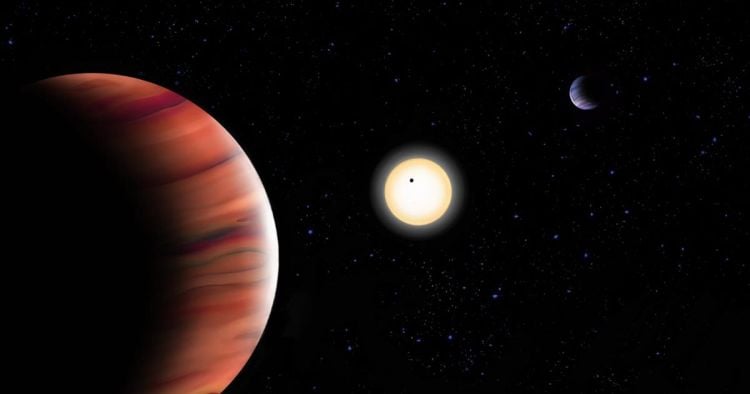
According to the source text, an international team of more than 50 researchers combined telescope observations and computer simulations to study three planets around the F-type star TOI-201, located about 371 light-years from Earth. What they found was not just an unusual arrangement of worlds with different sizes and orbital periods. They found a system whose geometry appears to be actively changing in ways astronomers can follow in real time.
What makes TOI-201 unusual
The system includes a super-Earth, a gas giant known as TOI-201 b, and a more massive gas giant, TOI-201 c. Their estimated orbital periods are about 5.8 days, 53 days, and 2,900 days, respectively. That wide spread already hints at a dynamically complex system. The bigger surprise is that the planets do not seem to share the kind of stable, near-coplanar architecture that many observers expect from mature systems.
The source reports that the researchers found changing transit times, meaning the moments when the planets pass in front of their star do not remain fixed in the way a simpler system would suggest. They also found that the planets’ orbital angles are changing. That combination implies a system that is not just eccentric in the everyday sense, but actively evolving in a measurable way.
TOI-201 c appears especially important in shaping that behavior. Unlike the mostly circular planetary orbits familiar from our own solar system, its orbit is highly elliptical. That elongated path can create stronger gravitational disturbances, especially in a tightly packed multi-planet environment. Instead of planets tracing stable, nearly flat rings, the system seems to be undergoing continuing dynamical interactions that shift how the planets are aligned from Earth’s perspective.
Why astronomers are paying attention
The striking claim in the source material is that these orbital-angle changes are happening fast enough to observe on human timescales. In astronomy, evolution usually means processes unfolding over millions or billions of years. Scientists reconstruct those histories indirectly by comparing many objects at different stages. TOI-201 offers something rarer: a chance to watch part of a system’s architecture change while the observers themselves are still around to measure it.
That matters because transit observations are one of the most productive methods for finding and characterizing exoplanets. If the orbital alignment changes, then the same planets can effectively disappear from transit surveys even though they are still there. The researchers estimate that all three planets may stop passing in front of their star from Earth’s point of view in about 200 years, and then take roughly 10,000 years to return to a transiting configuration.
In practical terms, TOI-201 is a reminder that observation is shaped by geometry. Planet hunters do not just discover what exists; they discover what happens to line up with their instruments. A system that transits today may not transit for future astronomers, and one that appears invisible now may have been easier to detect in the past or become easier again in the distant future.
A broader challenge to neat solar-system analogies
There is a tendency in exoplanet science to compare every new system with our own. That is useful up to a point, but TOI-201 underlines how limited that instinct can be. Our solar system offers one successful outcome of planetary formation and long-term stability. It does not define the full range of possibilities.
The TOI-201 findings suggest that planetary systems can remain visibly dynamic, especially when massive planets, short-period inner worlds, and eccentric outer orbits interact. That expands the catalog of plausible system architectures and sharpens the case for continued, repeated observations rather than one-off detections.
The work also highlights the value of combining observing sites and methods. The source notes that one telescope used in the study was at the ASTEP facility in Antarctica, where long stretches of winter darkness make continuous observations possible. For a system whose transits and alignments are changing, that kind of persistent monitoring can be critical.
What TOI-201 could teach next
- How gravitational interactions reshape orbital planes over comparatively short timescales.
- How many exoplanet systems may be undercounted because their transit windows are temporary.
- How unusual system architectures complicate the search for orderly solar-system analogues.
For now, TOI-201 stands as a useful corrective. Exoplanet science has already shown that hot Jupiters, tightly packed inner worlds, and highly eccentric giants exist. This system adds another layer: sometimes the architecture itself is in motion fast enough for humanity to watch. That makes TOI-201 not just an exotic curiosity, but a live laboratory for understanding how planetary systems behave when gravity refuses to settle down.
This article is based on reporting by Universe Today. Read the original article.
Originally published on universetoday.com