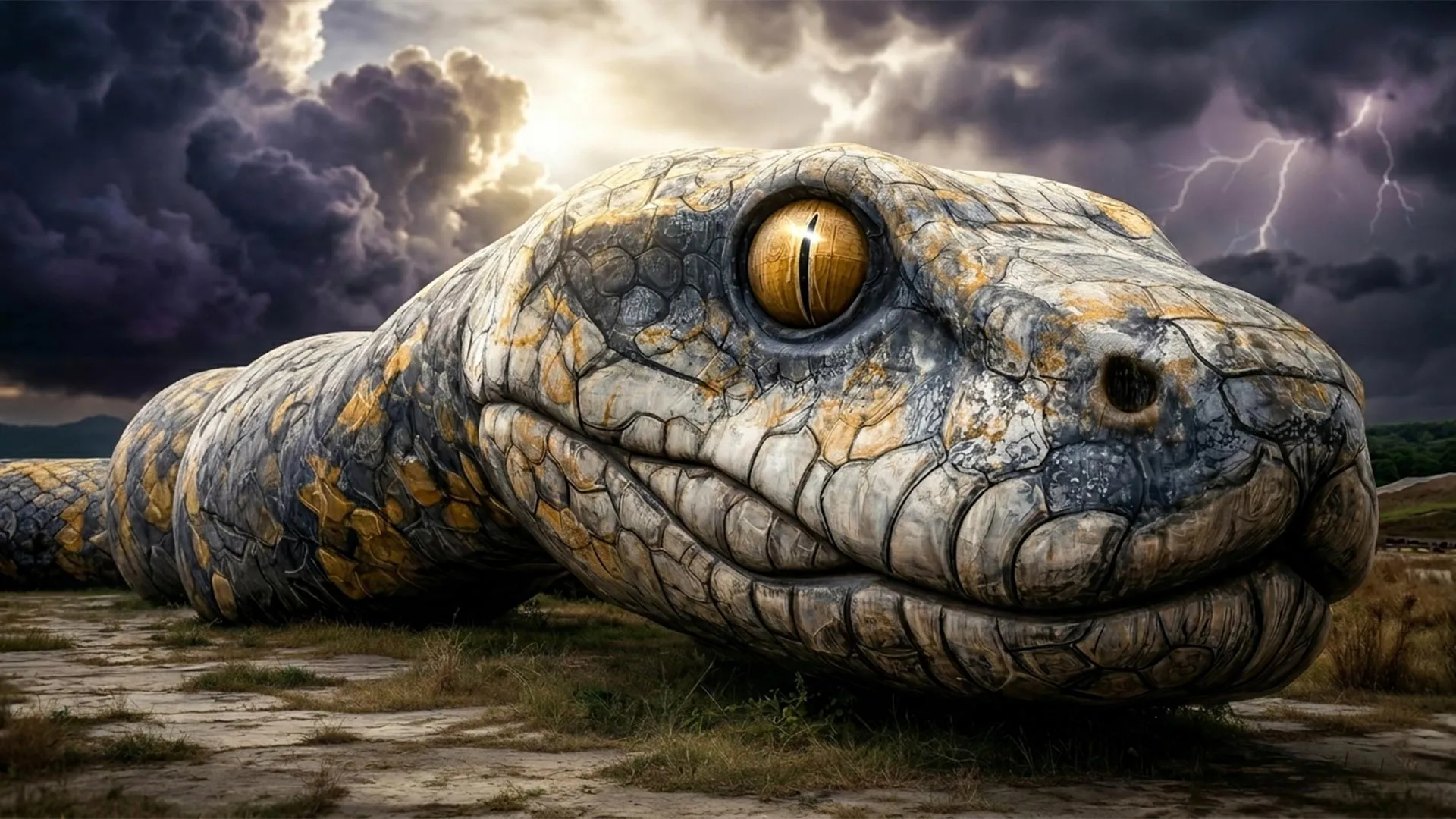
A giant snake enters the fossil record
A newly described prehistoric snake from India may belong in the same size conversation as Titanoboa, the most famous giant snake ever discovered. According to research summarized in the supplied source text, the species, named Vasuki indicus, lived around 47 million years ago and may have reached roughly 11 to 15 meters in length, or about 36 to 50 feet.
If those estimates hold, the animal would rank among the largest snakes known to science. The discovery comes from fossils recovered in Gujarat and described by researchers Debajit Datta and Sunil Bajpai in a study published in Scientific Reports. The remains date to the Middle Eocene and add a major new data point to the evolutionary history of giant reptiles on the Indian subcontinent.
What the fossils show
The specimen includes 27 mostly well-preserved vertebrae, some of them still articulated, indicating they belonged to an adult snake. Those bones are the basis for the size estimate that has made the discovery so striking. According to the source text, the vertebrae measure between 37.5 and 62.7 millimeters in length and 62.4 to 111.4 millimeters in width.
The researchers interpret those dimensions as evidence of a thick, cylindrical body. That morphology matters because it suggests not only a very large snake, but one built in a particular way. This was not necessarily a fast, slender pursuit predator. It appears to have been a heavy-bodied animal whose shape is more consistent with strength and stealth than speed.
Based on those skeletal clues, the report says the snake was likely slow-moving and relied on ambush tactics, in a manner comparable to modern anacondas. That is an important ecological insight because giant size alone does not say much about behavior. Body form helps fill in how such an animal might have lived.

Why the India origin matters
The discovery is also significant biogeographically. The researchers classify Vasuki indicus within the extinct Madtsoiidae family, but say it represents a unique lineage that originated on the Indian subcontinent. That gives the fossil broader importance than its headline size estimate.
Ancient giant snakes tend to attract attention because of scale, but their real scientific value often lies in what they reveal about where lineages evolved and how they spread. In this case, the source text suggests India was not merely a place where madtsoiid snakes happened to appear. It may have been the center of origin for this particular lineage.
The name itself reflects that setting. Vasuki references the serpent of Hindu mythology associated with Shiva, while indicus points directly to India. The result is a species name that ties the fossil both to its scientific context and to the cultural geography of its discovery.
How big is big?
The size estimate naturally invites comparison with Titanoboa, the colossal snake from Paleocene South America that has become the benchmark for prehistoric snake gigantism. The source text says Vasuki indicus falls into the same general size range, though it also notes uncertainty remains in the estimates.
That caveat is essential. Length reconstruction from vertebrae is a scientific estimate, not a direct measurement. Even so, the lower end of the projected range already places the animal among extraordinarily large snakes. The upper end pushes it into truly exceptional territory.
That makes the fossil important even if future analysis adjusts the numbers. Whether it ultimately proves slightly smaller or nearly identical in scale to Titanoboa, the specimen still expands the known record of giant snakes and shows that such body sizes were not confined to one famous lineage in one region.

What this says about ancient ecosystems
A snake of this size implies an ecosystem capable of supporting a large ambush predator. The source text does not offer a full reconstruction of the surrounding environment, but the snake’s heavy build and inferred hunting style suggest a habitat in which concealment and short-range power mattered.
That is one reason giant fossil predators are scientifically valuable. They act as indirect indicators of ecological structure. A massive reptile cannot exist in isolation from climate, habitat, and available prey. Even when the fossil record is fragmentary, such animals hint at the energy and stability of the systems they inhabited.
The discovery of Vasuki indicus therefore operates on several levels at once:
- It introduces a newly described species
- It adds evidence for giant snakes in the Eocene of India
- It suggests a heavy-bodied ambush ecology
- It strengthens the paleontological importance of the Indian subcontinent for ancient reptile evolution
A new giant with lasting scientific value
The biggest public takeaway will be simple: a 50-foot ancient snake may once have lived in India. But the scientific importance goes beyond scale. The fossils provide anatomical evidence for a giant, thick-bodied madtsoiid snake from the Middle Eocene, and they support the idea of a distinct Indian lineage within that extinct family.
That combination of size, preservation, and geographic importance is what makes the find stand out. It is not merely a spectacular fossil headline. It is a meaningful addition to the story of how snakes diversified, how giant forms evolved, and how prehistoric ecosystems on the Indian subcontinent are being reconstructed through new field evidence.
Vasuki indicus may become widely known because of its comparison to Titanoboa. Its longer-term value, though, is likely to come from the quieter scientific work it enables: refining estimates, testing lineage relationships, and building a clearer picture of a world in which giant serpents were not myth, but biology.
This article is based on reporting by Science Daily. Read the original article.

Originally published on sciencedaily.com