Smell May Be Mapped More Like Other Senses Than Scientists Thought
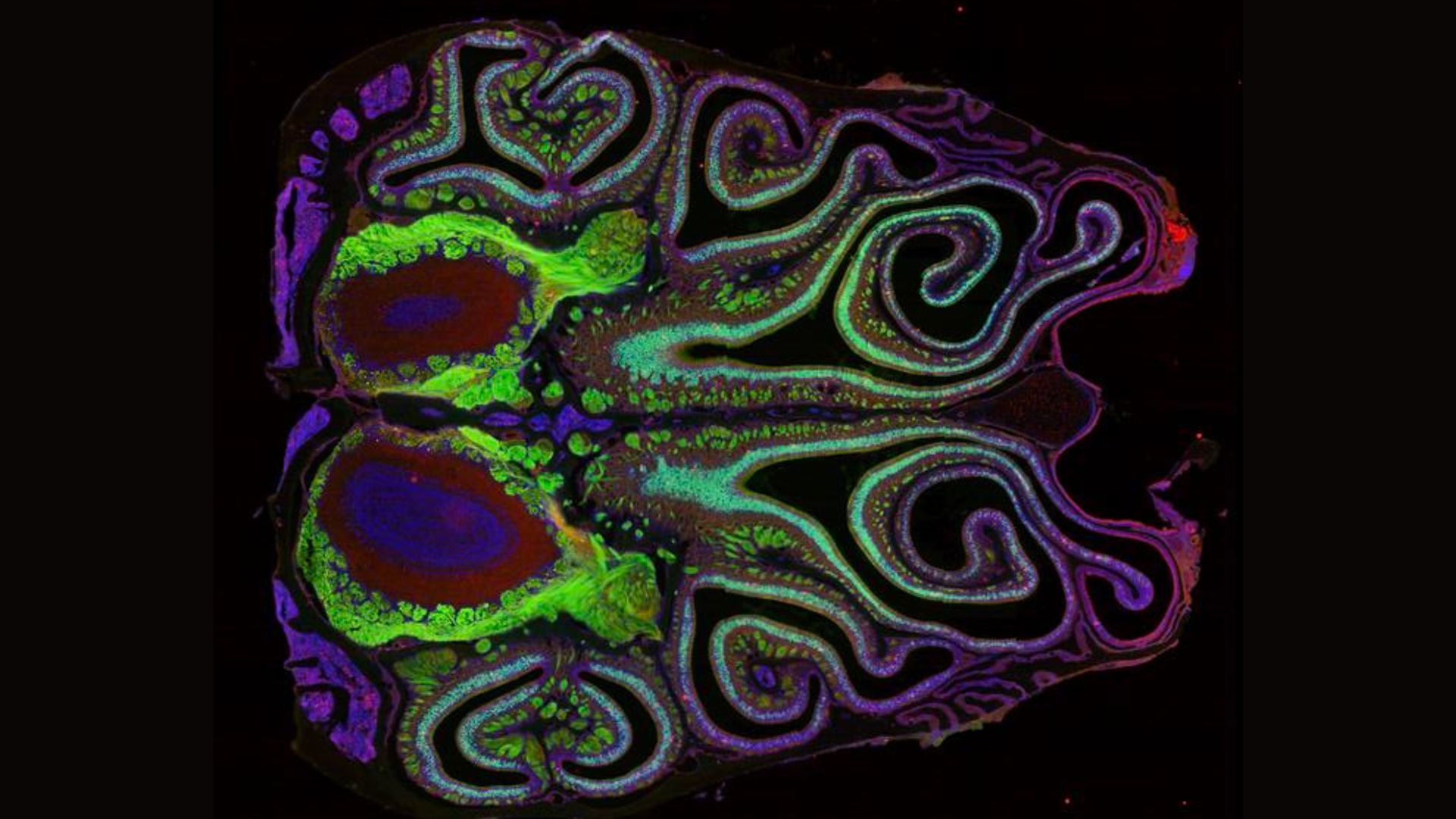
Scientists have produced what the supplied source text describes as a first-of-its-kind map of smell receptors in the mouse nose, and the result challenges a long-standing assumption about how olfaction is organized. Instead of being randomly distributed across the lining of the nasal cavity, olfactory receptors appear to be arranged in tight, highly ordered bands.
The study, published April 28 in Cell according to the source, offers a new picture of one of biology’s most fundamental senses. Smell has often been treated as the exception among sensory systems, lacking the kind of clear spatial mapping known in touch, hearing, and vision. This work suggests that may have been an artifact of limited measurement rather than a true feature of the system.
More Than 1,100 Receptors, Millions of Cells
The scale of the new map is one reason it stands out. The source says researchers examined around 5.5 million neurons from more than 300 individual mice. Each mature olfactory sensory neuron expresses one of 1,172 different receptors encoded in mouse DNA, with each receptor tuned to detect a different type of smell.
That receptor diversity has long made the nose difficult to study as a coherent spatial system. If thousands of receptor types are scattered unpredictably, then the organization of smell would look fundamentally different from other senses. But the new map suggests that assumption was wrong. The receptors are not randomly strewn across the tissue. They occupy what the source calls “tight bands” and form overlapping stripes of odor receptor expression.
That is a major conceptual shift. It means olfaction may use anatomical order in ways scientists previously underestimated.

New Tools Made the Map Possible
The source attributes the breakthrough to newer techniques that have matured over the past six or seven years. One is single-cell sequencing, which allowed researchers to examine mature olfactory sensory neurons one at a time and identify which receptor each one was expressing. Another is spatial transcriptomics, which helped the team locate those receptors within the nasal tissue.
Together, those techniques solved a problem that has constrained smell research for decades: it was possible to know what genes were present, or where cells were located, but much harder to connect those facts at the necessary scale and precision. By combining cell-by-cell identification with spatial placement, the researchers could build what the source calls a “beautiful map” of more than 1,100 smell receptors.
The result is not just a better image. It is a new framework for asking how smell information is structured before it ever reaches the brain.
Why the Discovery Matters
Other senses are known to rely on maps. In hearing, for example, different frequencies are encoded at different positions in the cochlea. The source uses that comparison to show why the new finding is important. If smell also uses a spatial logic, even if it differs from hearing or vision in detail, then olfaction may be more computationally organized than once assumed.
That matters because the nose is not merely a passive detector. It is the front end of a complex interpretive system. Where receptors sit, and which receptors are near one another, may influence how odor information is sampled, combined, and transmitted. The newly observed stripes and bands suggest that receptor geography could be part of how the system sorts chemical information before the brain assembles it into recognizable smells.
The source does not claim that the full decoding problem has been solved. But it does show that the starting map is far more structured than the field once believed.

A New Foundation for Olfactory Biology
The research could open several lines of inquiry. A more precise anatomical map gives scientists a better foundation for studying development, regeneration, receptor turnover, and disease. It may also help explain how the olfactory system remains functional despite the constant exposure of nasal tissue to the environment and the ongoing replacement of sensory neurons over time.
Even at a basic level, the work reshapes how smell is taught and imagined. A sense that often seemed diffuse and messy now appears to rest on a striking internal order. The mouse nose, rather than being a receptor mosaic without clear geometry, looks more like a structured sensory surface with its own hidden logic.
That is why the study stands out as more than a technical mapping exercise. It revises a core assumption in neuroscience and provides a clearer starting point for understanding how chemical signals become perception. In a field where some of the most important changes come from finally seeing the system properly, the new map may prove to be exactly that kind of advance.
This article is based on reporting by Live Science. Read the original article.
Originally published on livescience.com