A key rift zone may be further along than scientists thought
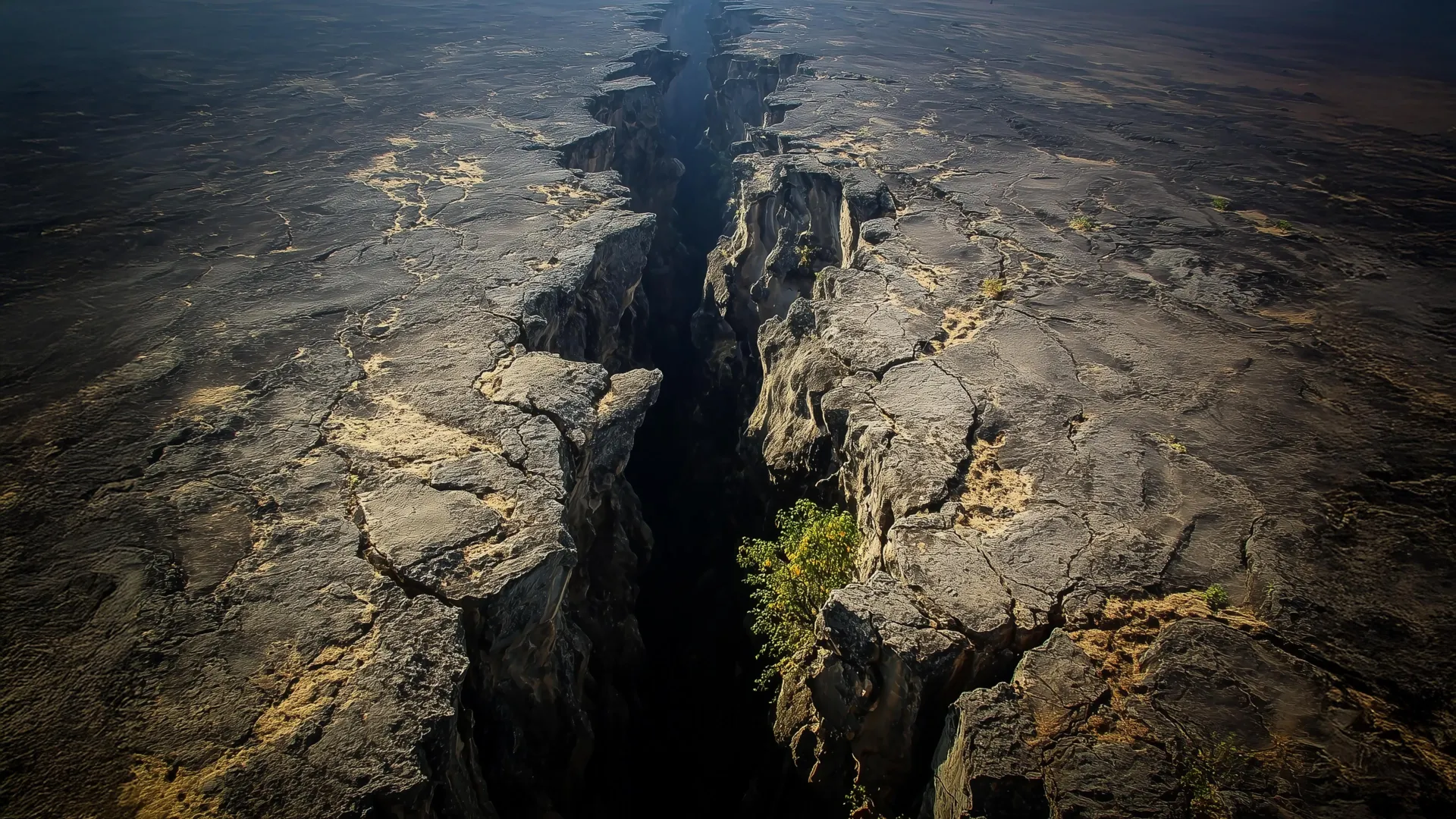
New research from the Columbia Climate School, summarized by Science Daily, suggests that one of the most important tectonic regions on Earth has progressed further toward continental breakup than previously understood. Beneath East Africa's Turkana Rift, scientists found that the crust is thinner than expected and appears to be in an advanced stage of deformation known as necking, a sign that the land is being stretched toward eventual separation.
The finding does not mean a new ocean is about to open in human timescales. The process still unfolds over millions of years. But it does change the scientific picture of where the Turkana Rift sits along that path. Instead of being a comparatively early-stage rift, the region may already be much deeper into the mechanics of continental splitting.
The Turkana Rift runs roughly 500 kilometers across Kenya and Ethiopia and forms part of the much larger East African Rift System, which extends from the Afar Depression in northeastern Ethiopia down toward Mozambique. In the Turkana region, the African and Somali plates are moving apart at about 4.7 millimeters per year. That slow motion may sound negligible, but over geological time it is enough to reshape continents.
What necking means in geological terms
As tectonic plates pull apart, the crust is stretched sideways. That strain causes the surface to crack and buckle and helps magma rise from deeper within the planet. Not every rift advances to the point of creating a new ocean basin. Some stall. Others continue until the crust becomes so thin that it ultimately breaks, allowing new oceanic crust to form.
The newly described necking stage is important because it marks a more advanced state of extension. In simple terms, the continental crust has been thinned enough that deformation is becoming concentrated, a necessary step on the road from broad stretching to outright breakup. According to the source, the study's lead author, Christian Rowan of Columbia University's Lamont-Doherty Earth Observatory, said the rifting in this zone is more advanced and the crust thinner than anyone had recognized.
That is the central scientific development. East Africa was already one of the world's iconic rift systems. The new work suggests that at least this segment of it may be closer to the endgame of continental division than researchers had appreciated.

Why Turkana matters beyond tectonics
The Turkana Rift is not just a geological feature. It is also one of the richest regions on Earth for early human fossils. That overlap has long shaped public interest in the area, and the new study adds a fresh interpretation. Rather than proving the rift was uniquely a birthplace of humanity, the scientists argue that the same tectonic and volcanic processes pulling the region apart may also help explain why the fossil record there is so exceptional.
That is a subtle but important distinction. The source summary says Turkana may not necessarily be where the most important events in human origins happened, but rather where those events were especially well preserved. The shifting crust, volcanic activity, and sedimentary conditions associated with the rift could have created a landscape unusually favorable to preserving remains that would have disappeared elsewhere.
This idea broadens the significance of the tectonic study. The work is not only about the future geography of Africa, but also about why scientists possess such a vivid record of the deep past in this region today.
How the plates are moving
The East African Rift System reflects the gradual separation of multiple tectonic units, including the African, Arabian, and Somali plates. In the Turkana sector, the motion between the African and Somali plates is slow but persistent. Over time, lateral stretching reduces crustal thickness and can channel magma upward. That volcanic activity has been one of the region's most visible geological features.
What changes with the new findings is the inferred degree of thinning. If the crust beneath Turkana is already more reduced than expected, then models of the region's tectonic evolution may need adjustment. A rift closer to breakup behaves differently from one in a broad early-stage extension phase. That affects how geoscientists understand the distribution of deformation, the role of magmatism, and the likely long-term trajectory of the basin.
Although the supplied source text truncates the detailed methods, it makes clear that the researchers relied on a rare high-quality seismic dataset to reach their conclusions. That matters because crustal thickness and internal structure are difficult to assess from surface observations alone. Better subsurface imaging often changes the interpretation of where a rift stands in its life cycle.

A slow-motion planetary event
Stories about continents splitting apart can invite exaggerated timelines, but this one is best read as a refinement of process, not an imminent forecast. No coastline is about to peel away. The significance lies in the mechanics. Earth scientists are seeing clearer evidence that Turkana is not merely cracking. It may already be necking toward eventual rupture.
That makes the region an extraordinary natural laboratory. Few places let researchers observe so many linked processes at once: tectonic stretching, volcanism, crustal thinning, landscape change, and fossil preservation. In that sense, Turkana is valuable not only because of what it may become millions of years from now, but because of what it reveals right now about how continents break apart.
The study also serves as a reminder that the Earth's surface is not fixed on any meaningful deep-time horizon. Africa's present shape feels permanent on human scales, yet plate tectonics ensures that permanence is an illusion. The East African Rift System is one of the clearest places where that transformation can be watched in progress.
For geologists, the latest result sharpens a big picture story into a more precise chapter. East Africa is still opening. Turkana, however, appears to be further into that opening than expected. For everyone else, it is a vivid example of how the same forces that build dramatic landscapes and preserve ancient fossils can also begin to redraw the outline of a continent.
This article is based on reporting by Science Daily. Read the original article.
Originally published on sciencedaily.com