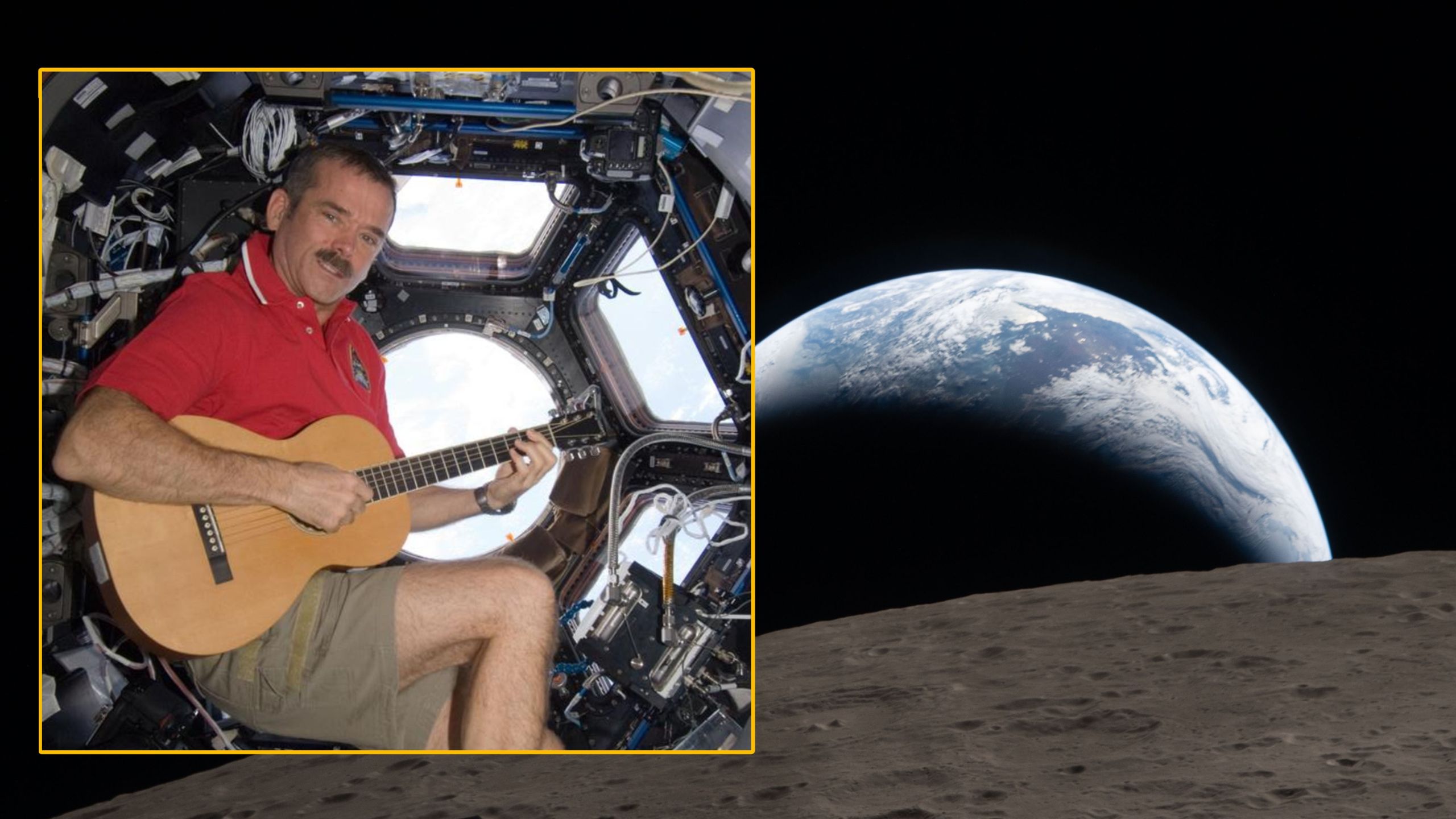
Hadfield’s case for long-term impact
Retired Canadian Space Agency astronaut Chris Hadfield is making a distinctly long-view argument about Artemis II. In an interview reported by Live Science, Hadfield described the mission’s influence not as a short burst of spectacle but as something with a “measurable, enormous global impact” that could take decades to fully register. His point is less about a single launch window or a single crewed flight and more about what public examples of exploration can do to people who are still years away from choosing careers, research paths, or ambitions.
That framing stands out because it moves the conversation beyond immediate mission milestones. Artemis II, in this telling, matters not only because it is a major spaceflight event, but because it can plant ideas early and deeply. Hadfield’s argument is that the real force of a mission like this often shows up later, when people who watched it as children or students become engineers, scientists, technicians, teachers, or explorers themselves.
In other words, the mission’s operational timeline may be measured in months, but its social timeline could be measured in generations.
Why public examples matter
The Live Science interview emphasizes Hadfield’s belief in the importance of “strong” and “undeniable” public examples of something positive. That phrase captures the core of his view. Spaceflight, especially human spaceflight, is visible in a way few other research or engineering efforts are. It condenses science, risk, national ambition, and human curiosity into images and moments that travel widely. Because of that, missions can influence people who never read a technical paper and never work directly in aerospace.
Hadfield’s own public profile has long reflected that broader understanding of space activity. He is not presented here as arguing only for the engineering merits of Artemis II. He is arguing for its cultural power. A mission can function as a kind of proof that difficult, constructive projects are still possible. That public proof can alter what young people think is worth studying and what societies think is worth attempting.
That may be the most important part of the interview’s premise. Exploration does not only produce hardware outcomes. It also produces examples, aspirations, and shared reference points.
Artemis II as a bridge to a larger lunar effort
Live Science frames the interview at a moment when NASA is pushing ahead with plans to build a permanent human habitat on the moon. That context gives Hadfield’s comments added weight. If Artemis II is part of a broader effort to establish a sustained human presence beyond low Earth orbit, then public support and long-term talent formation become central, not incidental. Large space programs depend on both technical execution and durable public legitimacy.
Hadfield’s argument fits that reality. A permanent lunar effort cannot be sustained by one crew, one announcement, or one dramatic image alone. It requires a continuing stream of people willing to design systems, solve problems, and justify the work across years of political and budgetary change. The public inspiration case is often treated as secondary to engineering, but for a program that stretches across decades, inspiration is also part of the operating environment.
That does not make the mission symbolic only. Rather, it suggests that symbolism and execution reinforce one another. A visible mission can help produce the future workforce and public commitment that longer-term exploration needs.
The delayed returns of exploration
There is a practical discipline in Hadfield’s long-term framing. He is not arguing that the most meaningful effect of Artemis II will necessarily be immediate. He is explicitly suggesting delay. The children who watch a mission today will need years to absorb it, years more to enter training or study, and still more time to become professionals in any field shaped by that early interest. That is why the impact could take decades to hit.
That is also why missions are often judged too narrowly if they are evaluated only by near-term headlines. The obvious metrics for a mission are things like launch success, hardware performance, and schedule progress. Those matter. But Hadfield is pointing to a second layer that is harder to measure quickly: how many people changed direction because they saw an example that felt real and positive.
Live Science presents that idea as emotionally resonant for Hadfield. The mission “hit him hard,” according to the story’s framing. That emotional register matters because it speaks to a seasoned astronaut reacting not simply as a commentator but as someone who understands how symbolic moments in spaceflight can echo through education, career choices, and public imagination.
Why this argument lands now
Hadfield’s comments arrive at a time when space programs are expected to justify themselves on many fronts at once. They are asked to demonstrate scientific value, technological advancement, geopolitical significance, and public meaning. His argument does not replace those standards. It adds another one: whether a mission can provide a constructive model that broad audiences can see and remember.
That may be especially relevant in an era saturated with fragmented media and rapid news cycles. A mission that cuts through that noise can do more than entertain. It can set a benchmark for what a society publicly celebrates. Hadfield’s point, as presented in the interview, is that these moments matter because they tell people what kinds of effort still count as admirable, serious, and possible.
Framed that way, Artemis II becomes more than a transportation milestone in NASA’s lunar plans. It becomes an argument about public imagination. If the mission succeeds in becoming the sort of example Hadfield describes, its most durable legacy may not be confined to aerospace. It may be found years later in classrooms, laboratories, startups, research institutes, and institutions shaped by people who first encountered exploration as something vivid and worth joining.
A mission with cultural as well as technical stakes
The Live Science interview does not ask readers to choose between inspiration and substance. It suggests the two are connected. Artemis II can be a major spaceflight achievement and also a cultural signal. For Hadfield, that second dimension is not a soft afterthought. It is one of the reasons spaceflight matters at all.
If the deepest value of Artemis II takes decades to show itself, that should not be read as delay in the usual sense. It should be read as the normal timescale of human influence. A mission can launch in a day and shape lives over decades. That is the scale at which Hadfield appears to be thinking.
For programs aimed at the moon and beyond, that perspective is a reminder that exploration is judged not only by where spacecraft go, but by what people decide to do after watching them go there.
This article is based on reporting by Live Science. Read the original article.
Originally published on livescience.com


