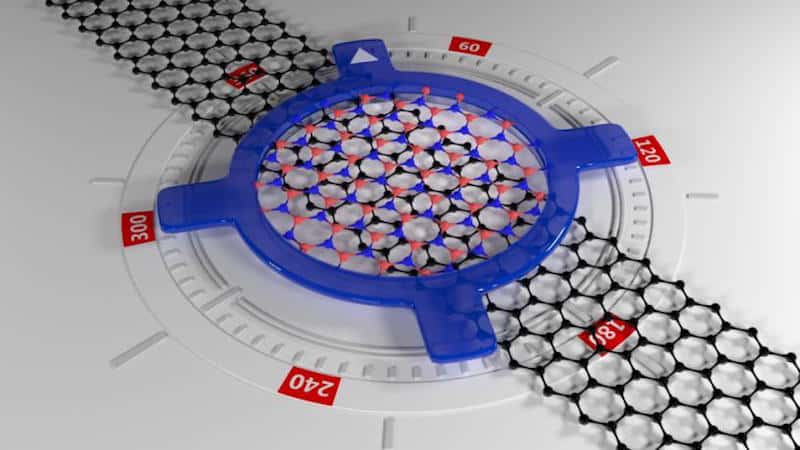
Most magnets people handle in everyday life are simple two-pole affairs: a north and a south, a positive and a negative. That familiar arrangement, known as a dipole, underpins everything from refrigerator magnets to the read heads inside hard drives. But as quantum mechanics has matured, researchers have discovered that magnetism can take far stranger forms inside certain crystalline materials, including an "octupolar order" in which a lattice of particles behaves collectively as though it carried eight magnetic poles rather than the customary two.
The difficulty with these higher-order magnetic states is that they are extraordinarily difficult to observe. Their net magnetic moment frequently cancels out, leaving conventional experimental tools effectively blind to an order that is present in the material all along. A team of quantum physicists at the University of Toronto has now demonstrated a method for detecting such hidden states by using light to probe the atomic vibrations generated as electrons spin. The study, published in Physical Review Letters, is described by its authors as a critical first step toward exploiting multipolar magnetism in next-generation data storage and computing hardware.
A Magnetic Order That Ordinary Instruments Cannot See
Textbook magnetism assumes a straightforward picture: each magnetic atom acts like a tiny bar magnet, and the collective alignment of those bars produces the effects we observe. Multipolar magnetism breaks that picture. Instead of a simple pair of poles, the arrangement of particles within the crystal produces a more complicated geometric signature — in the octupolar case, one that reads as though eight poles were distributed through the structure.
Because the poles are arranged symmetrically, their contributions can cancel in ways that hide the underlying order from standard magnetic measurements. Arun Paramekanti, a professor in the Department of Physics and the Center for Quantum Information and Quantum Control at the University of Toronto, and the senior author of the work, framed the challenge plainly: the team identified signatures of a hidden magnetic state that cannot be detected using ordinary probes.
That invisibility is the central obstacle in the field. A magnetic state that cannot be reliably read is a magnetic state that cannot be reliably used, no matter how promising its theoretical properties may be.

Using Light to Listen for Chiral Phonons
The Toronto researchers approached the problem indirectly. Rather than trying to measure the magnetic order head-on, they shone light onto a crystalline material and triggered minuscule vibrations within its atomic structure. Those vibrations, they found, carry information about magnetic patterns that conventional techniques miss.
The specific packets of vibrational energy the team focused on are known as phonons, which move through a solid's crystal lattice much as a wave travels along a stretched string. Among these, the researchers singled out chiral phonons: vibrational modes that do not match their own mirror image.
Why handedness matters
The word chiral comes from the Greek for hand, and the analogy is apt. A left hand cannot fit cleanly over a right hand even though the two are mirror images of one another. Chiral phonons possess precisely this kind of handedness, and it is that property which appears to couple to the otherwise invisible magnetic arrangement in the lattice.

By observing how light interacts with these handed vibrations, the team could infer the presence of magnetic order that leaves no obvious trace in a conventional measurement. The approach effectively turns the crystal's own atomic motion into a sensor for a state that would otherwise remain hidden.
Toward Read-Write Memory and Quantum Devices
The practical appeal of higher-order magnetism lies in control. If a magnetic state can be switched reliably and read back, it can serve as a bit. Multipolar orders are attractive candidates because they are robust against certain kinds of disturbance while still being, in principle, switchable.
Paramekanti noted that the research opens the possibility of using higher-order magnets in several applications, including controllable read-write memory elements of the sort found in everyday computers. Potential directions identified by the team and the broader field include:
- Memory cells whose magnetic state is read and written through optical or vibrational signatures rather than conventional field sensing.
- Data storage architectures that exploit multipolar order to pack more distinguishable states into a single material.
- Quantum technologies that rely on long-lived, well-protected internal states inside crystalline solids.
- Computing components in which switching is driven by light-triggered lattice vibrations.
None of these applications is imminent. The Toronto result concerns detection — establishing that a hidden order can be observed at all — rather than the engineering of a working device. But detection is the prerequisite step: without a reliable readout mechanism, the design of any memory or logic element built on octupolar order would be guesswork.

Open Questions and the Road Ahead
Several questions remain before multipolar magnetism moves from the physics laboratory toward practical technology. Researchers will need to determine how robust chiral phonon signatures are across different materials and temperatures, how quickly a state can be switched without destroying the order that makes it useful, and whether the same optical probe can be adapted to write as well as read.
The broader significance of the work is methodological. For years, multipolar magnetic orders have been predicted and debated largely because they were so difficult to confirm experimentally. Demonstrating that light-driven vibrational spectroscopy can expose an octupolar state gives researchers a new instrument for testing those predictions directly.
For now, the result stands as a proof of principle from a university quantum physics group, published in a peer-reviewed journal. Its importance lies less in any single device than in the fact that a hidden form of magnetism has been made visible — and a hidden form of magnetism, once visible, becomes something engineers can begin to think about controlling.
This article is based on reporting by Phys.org. Read the original article.
Originally published on phys.org