A Galaxy That Is Almost Not There
In the vast expanse of the Perseus galaxy cluster, some 300 million light-years from Earth, astronomers have identified one of the most peculiar objects in the known universe. Named CDG-2, this galaxy is so dim that it borders on invisible, earning it the evocative nickname of a ghost galaxy. What makes CDG-2 extraordinary is not what it contains but what it lacks: visible matter. Approximately 99 percent of the galaxy's total mass consists of dark matter, the mysterious substance that interacts with gravity but produces no light.
The discovery, made using the Hubble Space Telescope, represents a significant advance in astronomers' ability to detect the universe's most elusive objects. CDG-2 is classified as a low-surface-brightness galaxy, a category of objects so faint that they produce barely detectable amounts of light across their entire surface. Many such galaxies likely exist throughout the cosmos but have remained hidden simply because our instruments and detection methods were not sensitive enough to find them.
An Ingenious Detection Method
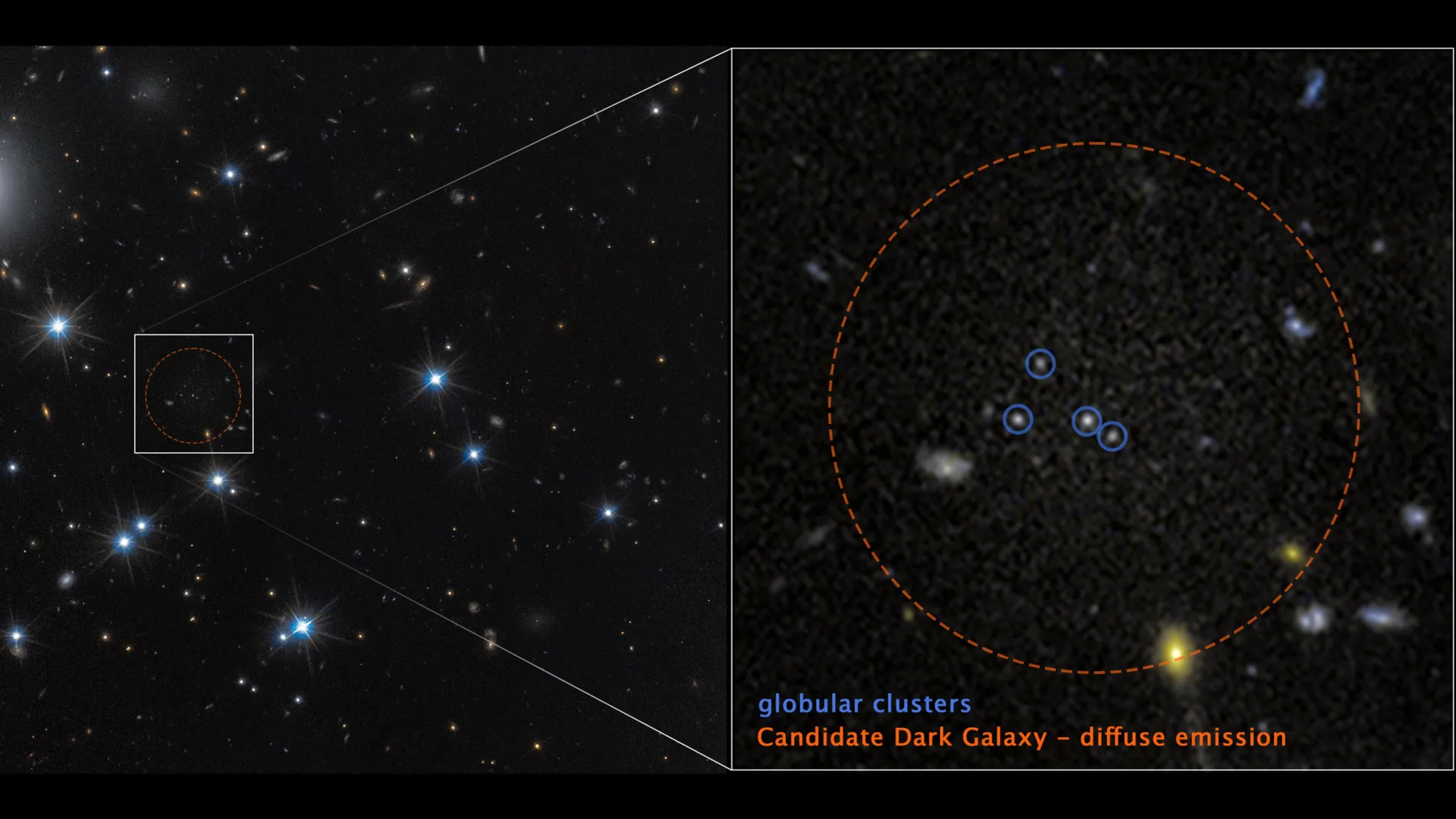
Finding a galaxy that produces almost no light required creative thinking. The research team did not discover CDG-2 by searching for the diffuse glow of starlight that characterizes most galaxy discoveries. Instead, they employed an innovative approach: searching for tight groupings of globular clusters.
Globular clusters are dense, spherical collections of stars, typically containing hundreds of thousands to millions of stars packed into a relatively compact volume. These ancient stellar assemblages are among the oldest structures in the universe and are commonly found orbiting galaxies. The key insight was that globular clusters, despite the faintness of their host galaxy, would still be individually detectable by Hubble's sharp optics.
When the researchers identified a suspicious grouping of four globular clusters that appeared to be spatially associated, they investigated further and discovered the extremely faint underlying galaxy. The four globular clusters account for a remarkable 16 percent of all visible light emitted by the entire CDG-2 system, highlighting just how little ordinary luminous matter the galaxy contains.

The Dark Matter Dominance
While all galaxies contain some dark matter, the proportion in CDG-2 is extreme. In a typical galaxy like the Milky Way, dark matter accounts for roughly 85 to 90 percent of total mass. Visible matter, including stars, gas, dust, and planets, makes up the remaining 10 to 15 percent. In CDG-2, visible matter constitutes approximately one percent of the total mass, making it one of the most dark-matter-dominated systems ever observed.
This raises fundamental questions about galaxy formation and evolution. How does a galaxy form with so little ordinary matter? What physical processes could strip away virtually all of the gas and stars while leaving the dark matter halo intact?
The researchers believe the answer lies in CDG-2's environment. The Perseus cluster is one of the most massive and dense galaxy clusters in the nearby universe, containing thousands of galaxies gravitationally bound together. In such crowded environments, galaxies frequently interact with one another and with the hot intracluster gas that fills the space between them.
These interactions can dramatically alter a galaxy's composition through several mechanisms:
- Ram pressure stripping occurs when a galaxy moves through the hot intracluster gas, which acts like a powerful wind that blows away the galaxy's own gas supply. Without gas, the galaxy cannot form new stars
- Gravitational tidal forces from nearby massive galaxies can physically pull stars and gas out of a smaller galaxy, redistributing them into the intergalactic medium
- Harassment through repeated close encounters with other galaxies gradually heats and ejects material from the galaxy over billions of years
The researchers concluded that much of CDG-2's hydrogen gas, the raw material needed for star formation, was likely stripped away by gravitational interactions with other galaxies in the crowded Perseus cluster. Over billions of years, the galaxy was essentially gutted of its visible material while its dark matter halo, which is far more extended and gravitationally robust, remained largely intact.
What CDG-2 Tells Us About Dark Matter
The existence of CDG-2 provides valuable constraints on the nature of dark matter itself. Different theoretical models of dark matter predict different distributions and densities of dark matter in galaxy-scale structures. An object composed almost entirely of dark matter, with virtually no complicating contributions from baryonic (ordinary) matter, offers an unusually clean test case for these models.
If dark matter behaves as predicted by the standard cold dark matter model, galaxies like CDG-2 should exhibit specific characteristics in terms of their mass distribution, size, and gravitational influence on surrounding objects. Deviations from these predictions could point toward alternative dark matter models, including warm dark matter or self-interacting dark matter theories.
CDG-2 also contributes to the ongoing debate about the so-called missing satellites problem. Standard cosmological models predict that large galaxy clusters should contain far more small dark-matter-dominated structures than astronomers have observed. If many of these predicted structures are ghost galaxies similar to CDG-2, too faint to detect with conventional methods, then the discrepancy between theory and observation may be smaller than previously thought.

A New Approach to Finding Hidden Galaxies
The detection technique used to find CDG-2 has implications that extend well beyond this single discovery. By demonstrating that globular clusters can serve as reliable markers for identifying ultra-faint galaxies, the research team has provided the astronomical community with a new search strategy.
Globular clusters are bright enough to be detected at considerable distances, even when the galaxy they orbit is far too dim to see directly. Systematic surveys of globular cluster populations in galaxy clusters could potentially reveal a large population of ghost galaxies that have been hiding in plain sight, overlooked by surveys that depend on detecting diffuse starlight.
Future observations with the James Webb Space Telescope, which has greater sensitivity in infrared wavelengths, could extend this search to even fainter and more distant objects. The combination of Hubble's sharp optical imaging and JWST's infrared capabilities provides astronomers with a powerful toolkit for mapping the universe's hidden structures.
Implications for Cosmology
The discovery of CDG-2 adds another piece to the complex puzzle of how the universe is structured at its largest scales. Dark matter accounts for approximately 27 percent of the universe's total mass-energy content, yet it remains one of the least understood components of the cosmos. Every new observation that constrains its properties and behavior brings scientists incrementally closer to understanding what dark matter actually is.
Ghost galaxies like CDG-2 may be far more common than current surveys suggest. If that proves to be the case, it would mean that a significant fraction of the universe's galactic structures are essentially invisible, detectable only through their gravitational effects and the occasional presence of globular clusters clinging to their dark matter halos. The universe may be considerably more populous with galaxies than the visible census indicates, with much of its galactic content wrapped in darkness.
This article is based on reporting by Science Daily. Read the original article.

Originally published on sciencedaily.com