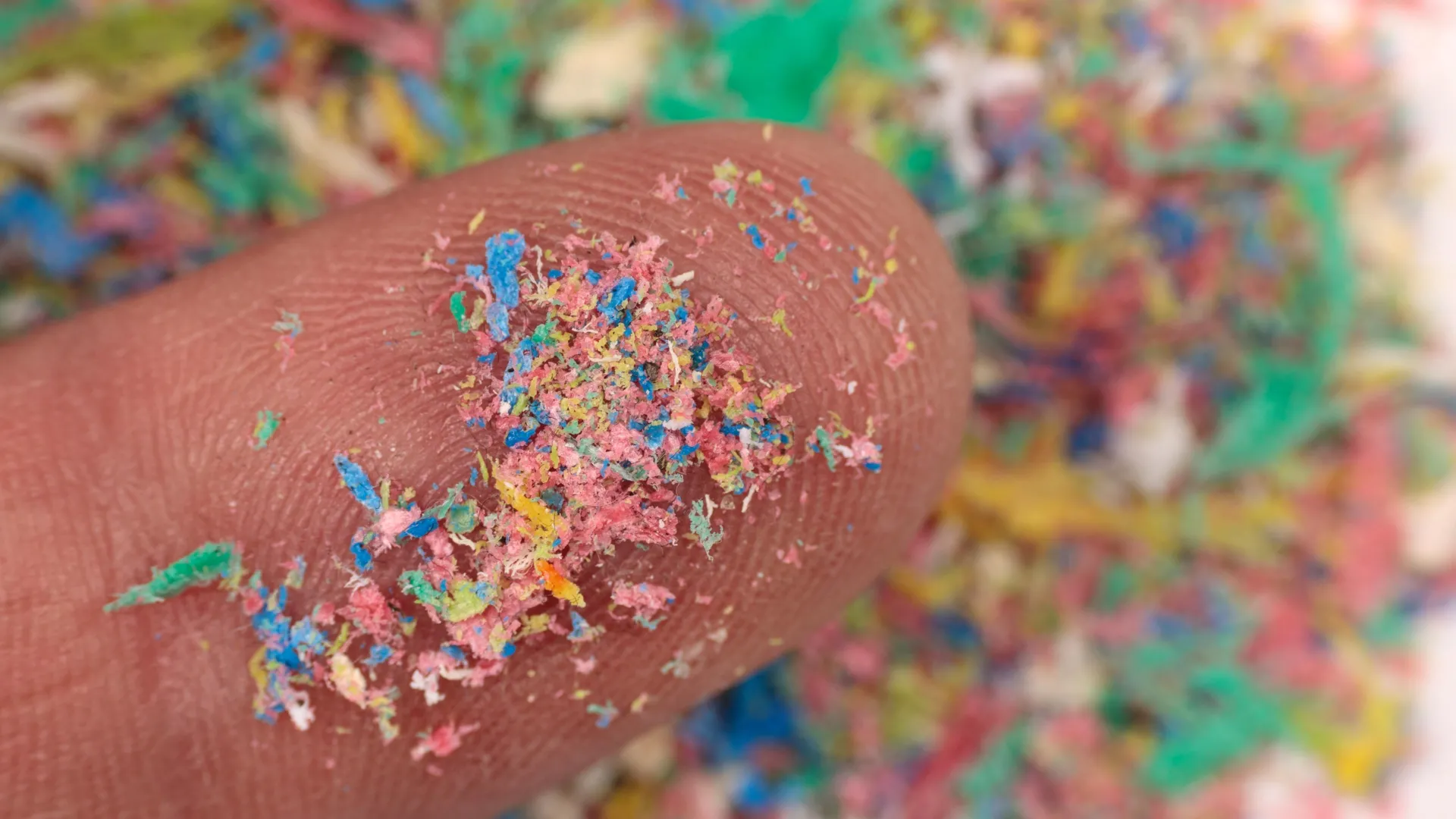
Microplastics may be chemically active, not merely persistent
Microplastics are often discussed as a contamination problem: tiny fragments that persist in food, water, ecosystems and, increasingly, samples from the human body. New research described by Columbia University and the University of California, Berkeley points to a more active concern. The researchers found that microplastics can interact with water to generate reactive oxygen species, highly reactive molecules that can damage biological material.
The work, published in Nature, challenges the assumption that plastic fragments are largely inert once they have entered the environment. Plastics may be chemically stable in their larger manufactured forms, but fragmentation changes their behavior. As objects weather into microplastics and even smaller nanoplastics, their exposed surface area rises sharply. Those surfaces can then participate in reactions with surrounding water.
That distinction matters because water is not only ubiquitous in rivers, oceans and drinking-water systems. It is also a major component of blood, cells and tissues. If the mechanism operates under biological conditions, plastic particles could contribute to damage through their chemistry as well as through their physical presence.
A possible source of oxidative stress
The reactive molecules identified in the research are commonly known as reactive oxygen species, or ROS. In living systems, ROS can play normal signaling roles at controlled levels. At higher or poorly controlled levels, however, they can damage cell components and tissues. The authors say their results offer a possible mechanism for the biological harm observed in animal studies and for concerns raised by evidence linking microplastic exposure with serious health outcomes.
Wei Min, a Columbia professor of chemistry and biomedical engineering, said the essential finding is that fragmenting plastic changes the water around it. The smaller a plastic particle becomes, the more surface it presents. That expanded interface can produce high-energy radicals, the researchers said, which could plausibly contribute to biological damage associated with exposure.
The study does not establish that microplastics cause particular diseases in people. It instead identifies a chemical pathway that could help researchers investigate why exposure has become a health concern. That difference is important: a plausible mechanism is not the same as a clinical conclusion. But it can strengthen the case for carefully designed research on dose, particle type, exposure route and real-world health effects.

Why particle size changes the question
The public conversation around plastic pollution often focuses on visible waste such as bottles, bags and packaging. The new findings turn attention toward what happens as those materials break apart. A single object can produce vast numbers of smaller particles, and those particles collectively expose much more surface to their environment than the original object did.
Microplastics are already widespread because plastic is used in products ranging from packaging and water bottles to toys. Their small size allows them to move through environmental systems in ways larger debris cannot. The research suggests that as particles become smaller, assessing their risk may require more than measuring how much plastic is present. The chemistry at particle surfaces, and the conditions in the water around them, may also be relevant.
That is a meaningful shift in framing. Instead of treating microplastics as passive carriers of possible additives or pollutants, scientists may need to consider whether the particles themselves can create reactive chemical conditions. It also raises questions about how aging, wear and fragmentation affect risk. Different plastics, particle shapes and environmental histories may not behave identically.
Questions for health and environmental research
The findings create a clearer agenda for follow-up studies. Researchers will need to determine which kinds of plastics produce ROS most readily, how long the reactions persist and whether the effect varies in saltwater, freshwater, blood or cellular environments. They will also need to compare laboratory observations with the concentrations and particle sizes people and wildlife are likely to encounter.
For health research, the central question is whether ROS production from particles meaningfully adds to oxidative stress in the body. The source material notes that reactive oxygen species can damage cellular structures and tissues. Establishing the extent of that contribution will require studies that separate the effect of plastic particles from other environmental exposures and from the body’s own normal production of ROS.
For environmental science, the work suggests that the consequences of plastic breakdown may not end with dispersal. Fragmentation could alter the chemical behavior of waste as it moves through water. That may be relevant to monitoring programs, material design and efforts to reduce the creation of small particles in the first place.

From warning signal to evidence base
The study is best read as a warning signal and a research advance, not as a final verdict on individual health risks. It identifies an unexpected process that connects the physical breakdown of plastic with a well-known form of chemical stress in living systems. That connection gives scientists a concrete phenomenon to test rather than relying solely on correlations between exposure and outcomes.
As microplastic research matures, the most useful answers will likely come from combining chemistry, materials science, toxicology and public-health studies. The immediate takeaway is narrower but significant: tiny plastic particles may not simply accumulate in watery environments. Their surfaces can change those environments in ways that warrant closer scrutiny.
This article is based on reporting by Science Daily. Read the original article.
Originally published on sciencedaily.com