A new measure of distance
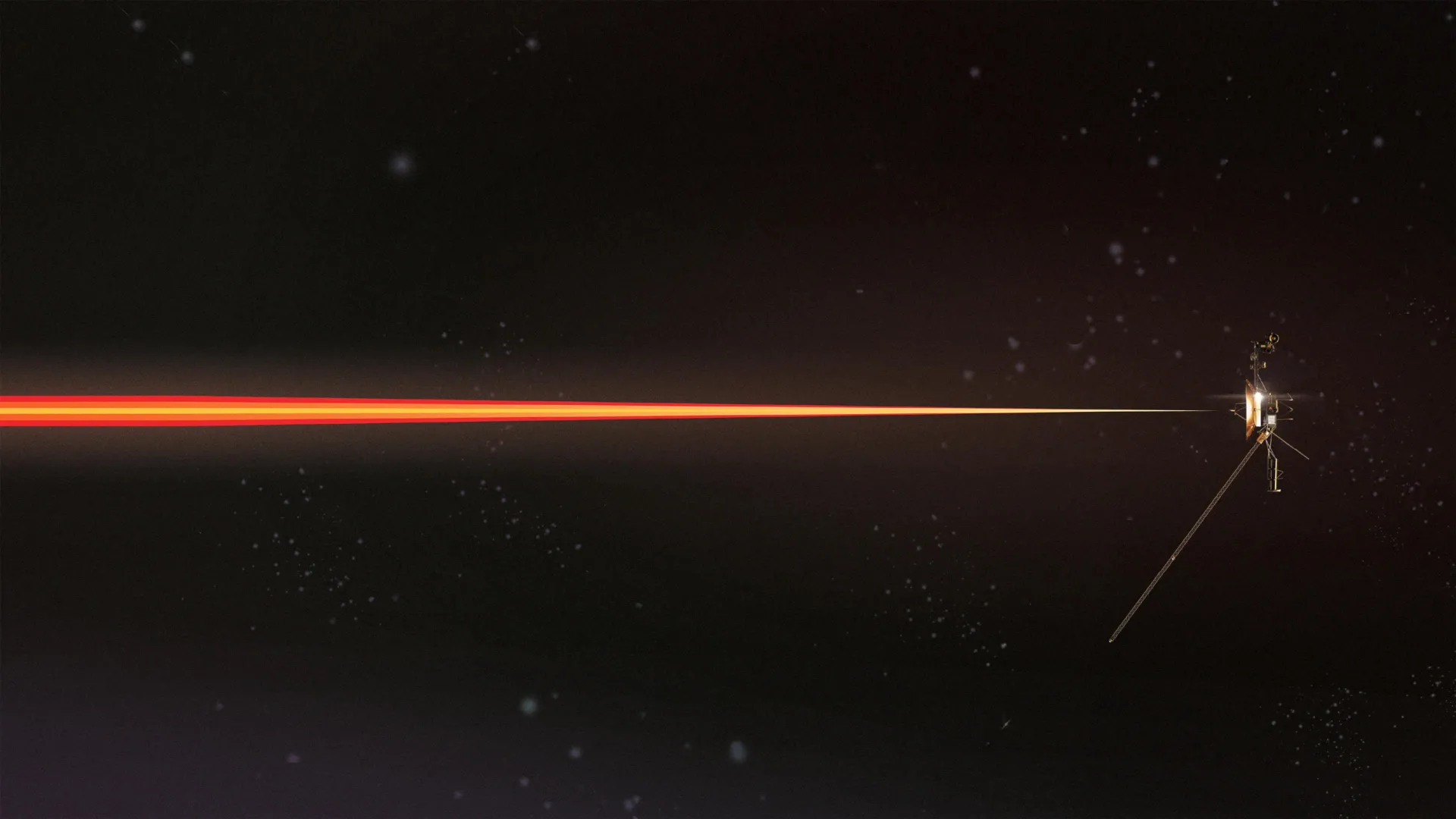
NASA’s Voyager 1 has become the first human-made spacecraft far enough away that a signal traveling at light speed takes a full day to reach Earth. The probe reached the one-light-day mark on November 18, 2026, at a distance of roughly 16.1 billion miles, or 25.9 billion kilometers, from home.
The milestone is simple to state but hard to visualize. Light travels through a vacuum at about 186,000 miles per second. It takes sunlight only about 1.3 seconds to travel from Earth to the Moon, while a signal needs roughly four hours to reach Neptune. Voyager 1 is now another 20 hours of light-travel time beyond that distant planet.
For mission engineers at NASA’s Jet Propulsion Laboratory in Southern California, the distance changes the practical rhythm of operating a spacecraft. A command sent from Earth now takes 24 hours to arrive. A confirmation or response takes another 24 hours to return. Even a basic exchange therefore spans two days.
A spacecraft built for another era
Voyager 1 launched nearly 50 years ago. Its original mission focused on the outer solar system, but the spacecraft outlived that initial assignment and continued on a journey that has taken it farther from Earth than any other object made by people.
It now travels through interstellar space, the region beyond the protective influence of the Sun’s heliosphere. The spacecraft’s longevity makes the achievement more than a numerical record. Voyager 1 is still returning information from an environment no earlier spacecraft had reached, using hardware designed decades before modern digital communications and today’s space missions.
The probe’s distance also places its achievements in perspective. A light-day is immense on a planetary scale, but it remains tiny compared with interstellar distances. One light-year measures about 5.88 trillion miles, or 9.46 trillion kilometers. Voyager 1 is not approaching another star; rather, it is extending humanity’s direct physical presence farther into the space between stars.

Longer delays, tighter choices
At its present range, communication is governed by physics rather than computing power. Ground teams cannot operate Voyager 1 in real time, and they cannot quickly troubleshoot an unexpected problem. Every instruction must be planned, sent, and then evaluated after the return signal reaches Earth.
That delay makes careful engineering especially important as the spacecraft ages. NASA has kept Voyager 1 operating far beyond its original mission life despite dwindling electrical power and technical challenges. Its radioisotope power source slowly produces less energy over time, forcing mission managers to make choices about which systems can remain active.
The one-light-day milestone does not change Voyager 1’s trajectory or suddenly create a new capability. Instead, it provides a vivid marker of what the mission has already accomplished: a nearly half-century voyage that still depends on a communication link stretching across 24 light-hours of space.
Why the record matters
Voyager 1’s continuing operation is a reminder that deep-space exploration unfolds on time scales very different from product cycles or launch calendars. A mission can begin with a narrow planetary objective and, through durable engineering and sustained operations, become an observatory for entirely new territory.
The spacecraft’s signal now arrives as a message from a place no human visitor could reach within a lifetime. Its data may be modest by contemporary standards, but the mission’s value lies in the continuity of the record and the unprecedented location from which it is collected.
For the teams that maintain contact with Voyager 1, the 24-hour signal delay is also a measure of responsibility. Each successful exchange confirms that a spacecraft launched in the 1970s remains connected to Earth across a distance measured not merely in miles, but in days of light travel.
This article is based on reporting by Science Daily. Read the original article.

Originally published on sciencedaily.com