Introduction
In the ongoing quest for ever-more-precise timekeeping, a new study published in Science (Volume 393, Issue 6813, pages 795–799, August 2026) reports on laser Mössbauer spectroscopy of thorium-229 (²²⁹Th) embedded in calcium fluoride (CaF₂). While the full technical details remain behind a paywall, the title alone signals a significant step for the field of nuclear clocks, which aim to outperform today's best atomic clocks by using an exotic nuclear transition rather than electron orbits.
The paper, authored by a team of physicists, explores how a crystalline host material—calcium fluoride—affects the behavior of thorium-229 nuclei under laser excitation. This is not merely an academic curiosity; the unique properties of ²²⁹Th make it the prime candidate for a next-generation timekeeping device that could redefine the second and enable new tests of fundamental physics.
The Promise of Thorium-229
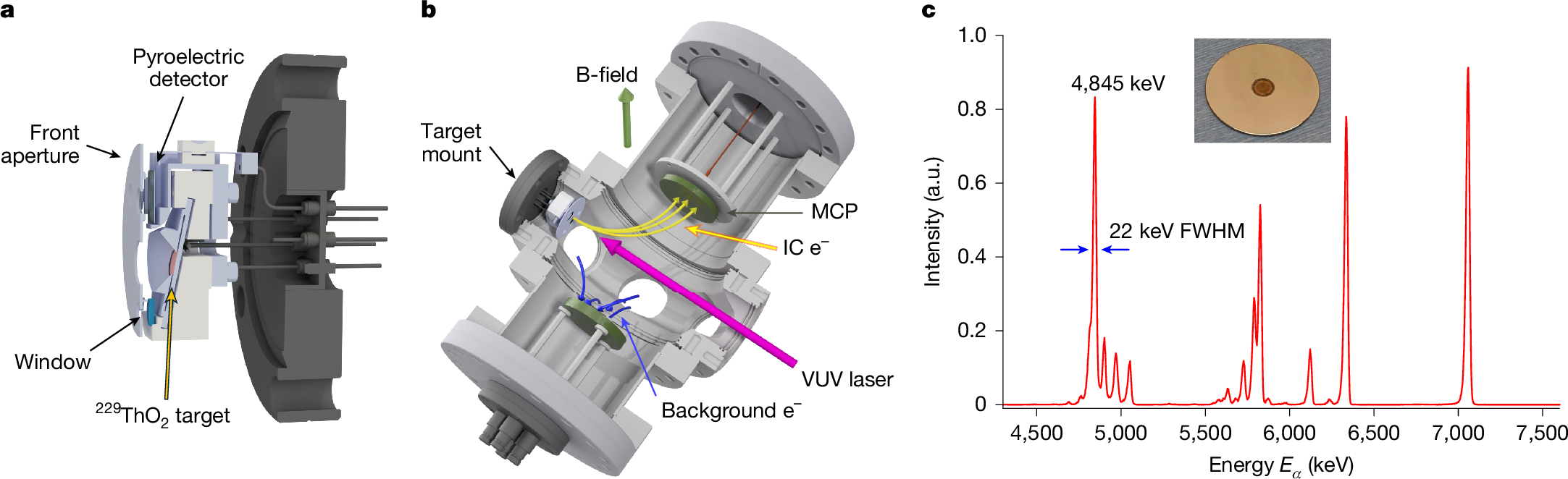
Thorium-229 is a rare isotope that has captured the imagination of precision-measurement scientists because its nucleus possesses an extraordinarily low-lying excited state, known as an isomeric state. The energy difference between the ground state and this isomer is so small that it falls into the vacuum-ultraviolet (VUV) region of the electromagnetic spectrum—meaning it can be excited by a laser. No other nucleus has such a transition, making ²²⁹Th uniquely suited for nuclear clock development.
In a nuclear clock, the 'ticking' would be based on the frequency of light needed to flip the nucleus between these two states. Because nuclear energy levels are far less sensitive to external perturbations (such as magnetic fields or temperature changes) than atomic electron levels, a nuclear clock could be significantly more stable and accurate than current atomic clocks. Such clocks are not just about keeping time; they are sensitive detectors for possible variations in fundamental constants, dark matter interactions, and other physics beyond the Standard Model.
Mössbauer Spectroscopy: A Bridge to the Nucleus
To probe the thorium-229 nuclear transition, researchers turn to Mössbauer spectroscopy, a powerful technique first discovered in the 1950s. Traditional Mössbauer spectroscopy measures the recoilless emission and absorption of gamma rays in solid materials. When a nucleus emits or absorbs a gamma-ray photon, the recoil energy can smear the resonance unless the atom is tightly bound in a crystal lattice, allowing the momentum to be taken up by the entire crystal. This phenomenon enables extremely sharp resonance lines, useful for studying tiny energy shifts.
Laser Mössbauer spectroscopy upgrades this approach by using a laser to drive the nuclear transition directly, rather than relying on a radioactive source. In the context of ²²⁹Th, the transition energy is in the VUV range, which challenges both laser technology and the physics of embedding thorium ions in suitable crystals. The choice of calcium fluoride is particularly interesting because it provides a transparent, wide-band-gap host that can accommodate thorium ions while minimizing perturbations to the nuclear energy levels.
Calcium Fluoride as a Host Crystal
Why CaF₂? Calcium fluoride is a well-known optical material with high transparency from the infrared through to the VUV. It has a cubic fluorite structure, often used in lithography and spectroscopy because of its favorable mechanical and optical properties. For nuclear clock applications, the host crystal must not introduce excessive line broadening from crystal-field inhomogeneities or defect sites. The ²²⁹Th ions substitute for calcium ions, but the mismatch in ionic radius and valence requires careful charge compensation. The study reported in Science likely examines whether CaF₂ can preserve the sharpness of the nuclear resonance—a decisive factor for clock performance.
Prior work with thorium-doped crystals (such as LiSrAlF₆) has shown that the internal environment can shift and broaden the nuclear transition frequency. CaF₂ offers a different symmetry and bonding environment, potentially reducing some of these effects. If the Mössbauer spectrum exhibits narrow lines, it would demonstrate that calcium fluoride is a viable host for future nuclear clock solid-state devices.

Implications for Nuclear Clock Technology
The results of this study could accelerate the development of a solid-state nuclear clock. A working nuclear clock would be a compact, robust instrument with applications ranging from geodesy (measuring the Earth's shape and gravity) to deep-space navigation and fundamental physics probing. Unlike atomic clocks that require vacuum chambers and many laser-cooled atoms, a nuclear clock could be built from a thin crystal embedded with thorium ions, excited by a tabletop VUV laser system.
Moreover, the laser-Mössbauer approach offers a direct way to measure the absolute transition energy and linewidth, which are critical parameters. Previous estimates of the isomer energy have been refined over the years, but discrepancies remain. High-precision spectroscopy using CaF₂ samples could resolve these discrepancies and provide a firm anchor for future clock frequency standards.
Broader Scientific Impact
Beyond timekeeping, the interaction between the nucleus and its surrounding crystal lattice is itself a rich field. Laser Mössbauer spectroscopy can reveal how phonons (lattice vibrations) couple to nuclear transitions, and how chemical bonding affects nuclear parameters. This fundamental research has implications for materials science, chemistry, and nuclear physics. Understanding the solid-state environment of ²²⁹Th is also crucial for proposed applications such as nuclear batteries or quantum information processing using nuclear qubits, which could offer long coherence times.
The 2026 publication in Science marks another milestone in a rapidly moving area. As researchers continue to refine both laser systems and crystal growth techniques, the dream of a working nuclear clock moves closer to reality. This study, while focused on spectroscopy, provides the empirical foundation needed to choose optimal host materials and to design next-generation experiments.
Conclusion
In summary, the new report on laser Mössbauer spectroscopy of ²²⁹Th in CaF₂, appearing in the August 2026 issue of Science, underscores the steady progress toward nuclear clocks. While the complete dataset is not yet public, the very existence of such a measurement demonstrates that the field is advancing rapidly. With each step—new crystals, better lasers, higher resolution—the scientific community moves closer to harnessing one of nature's rarest and most valuable resources: the forbidden nuclear transition of thorium-229. This work holds promise not only for timekeeping but for opening a new window into the physics of the atomic nucleus and the fundamental laws that govern our universe.
This article is based on reporting by Science (AAAS). Read the original article.
Originally published on science.org