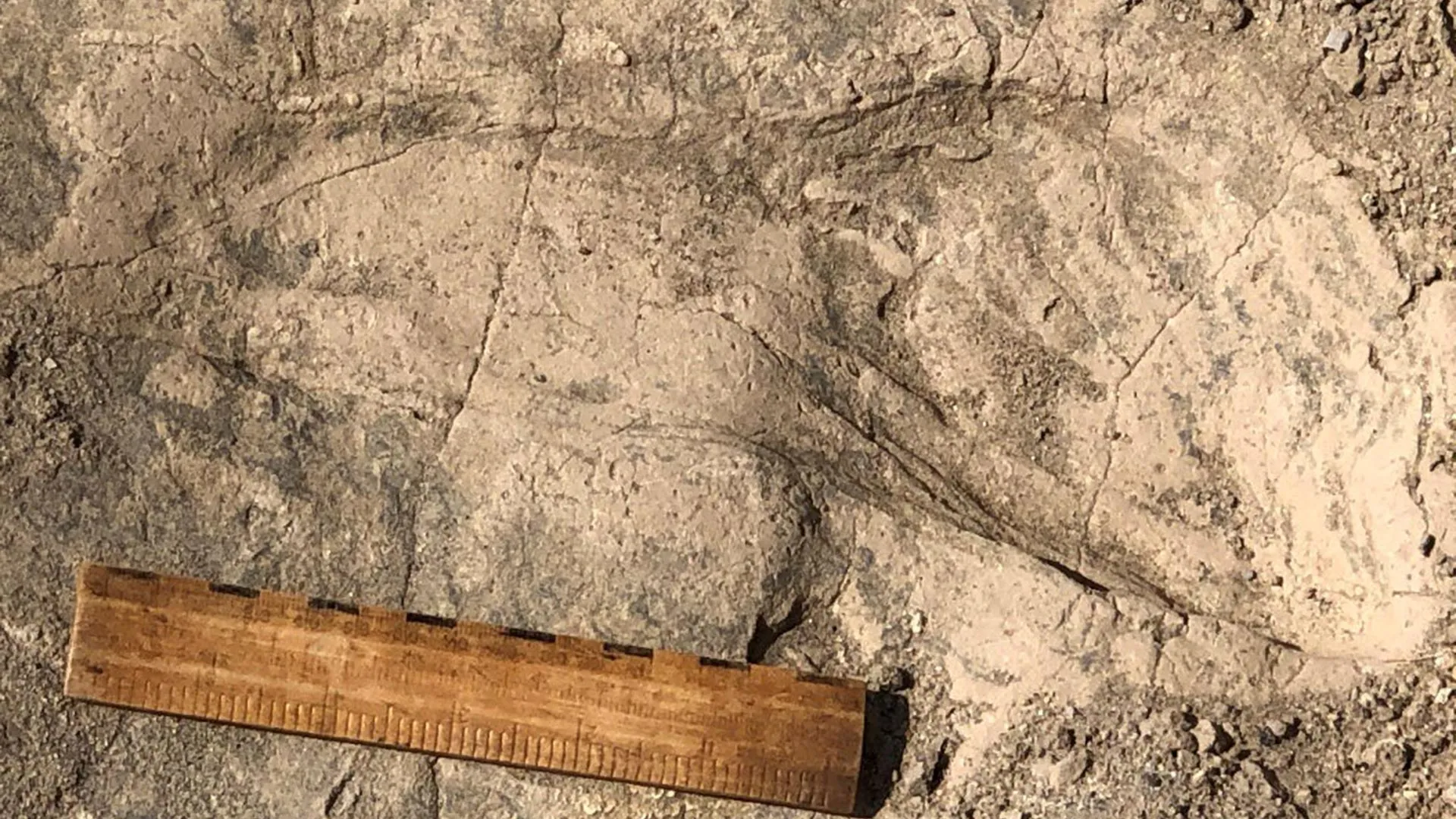
A rare behavioral snapshot from deep prehistory
Fossil bones can reveal anatomy, evolutionary relationships, diet, and sometimes injury. They are less good at showing what a group of extinct relatives was doing together at a single moment in time. That is why the newly reported footprint trail from northern Kenya is significant. According to the supplied source text, the 1.4-million-year-old tracks appear to record eight Paranthropus boisei individuals occupying the same place at roughly the same time along an ancient lakeshore. For paleoanthropologists, that is unusually close to direct evidence of behavior.
The research summary says the footprints offer a snapshot of what scientists call “fossil behavior.” Unlike skeletal remains, which can accumulate over long stretches and from different events, footprints are time-compressed traces. They preserve motion, direction, spacing, and, in favorable cases, the number and relative size of individuals present during a short interval. That gives this Kenyan site a different kind of scientific value. It is not just another data point about what Paranthropus boisei looked like. It may also illuminate how members of the species moved through a landscape together.
Why Paranthropus boisei matters
Paranthropus boisei is one of the better-known extinct hominins from eastern Africa, but much of that visibility has historically come from skulls and teeth rather than from the rest of the body. The supplied source text notes that the species is especially known for skull remains with very large jaws and teeth. By contrast, fossils from below the neck are much rarer, which has limited reconstructions of body size, limb proportions, and locomotion.
That gap helps explain why the new tracks are important. The researchers used analytical techniques the team first developed in 2024 to identify the footprints as belonging to Paranthropus boisei. The classification, according to the source text, relied on clues from foot anatomy as well as the way the individuals appeared to have moved. If that identification holds, the site expands the evidence base for a species whose postcranial form has been comparatively hard to pin down.

The biggest surprise may be body size
The source material says several of the trackmakers appear to have been considerably larger than earlier estimates based on the limited skeletal remains available. Lead author Kevin Hatala is quoted in the text as saying the footprints indicate human-like body sizes, with some individuals reaching up to 1.8 meters in height and about 75 kilograms in mass. Those figures stand out because earlier work had suggested Paranthropus boisei was substantially smaller than Homo erectus, another hominin that lived in the region.
If the footprint-derived estimates are accurate, the finding could force a meaningful reassessment of how variable body size was within Paranthropus boisei and how the species compared physically with its contemporaries. It would not erase the anatomical differences that separate P. boisei from Homo erectus, but it would complicate a simple picture in which one species was plainly smaller and perhaps more limited in ecological or behavioral range.
Footprints are not a perfect substitute for skeletons. They require inference, and body-size estimates can shift depending on the models used to link track dimensions to stature and weight. Still, footprints can reveal scale in a way that is difficult to dismiss when multiple individuals left traces in the same surface. In this case, the pattern seems substantial enough that the researchers regarded the size results as a major finding rather than a marginal observation.
Eight adults, one place, one moment
The study summary says the team concluded all eight trackmakers were likely adults. That detail matters because it sharpens the behavioral interpretation. A mixed-age set of tracks might suggest a family group or broader social unit but would also complicate body-size comparisons. A cluster of adults moving through the same lakeshore setting points to a different question: what kind of social organization brought them together?
The supplied text is careful not to overreach. It does not claim that the researchers have decoded the full social structure of Paranthropus boisei. But it does say the tracks suggest these extinct human relatives may have lived in more complex groups than previously thought. That is a measured but consequential proposal. Paleoanthropology often has to infer social life from indirect evidence such as sexual dimorphism, habitat use, or comparisons with living primates. A trackway that appears to preserve several adults in association offers a more immediate clue.
Even so, “complex groups” should be read as a scientific opening rather than a final verdict. The trackway indicates co-presence and likely coordinated passage through one place. It does not by itself reveal stable group size across seasons, mating systems, division of labor, or the broader texture of daily life. What it does provide is evidence that multiple adult individuals were together in a way worth explaining.

Why footprints can change the conversation
Trace fossils often play a supporting role in discussions of human evolution, overshadowed by dramatic skull finds or ancient DNA. But footprints can challenge entrenched assumptions precisely because they capture living bodies in action. The Kenyan trackway appears to do that on two fronts at once: size and sociality. The first challenges previous estimates of how large Paranthropus boisei could become. The second raises the possibility that the species was behaviorally more social or at least more visibly group-oriented than its fragmentary skeletal record had suggested.
The setting also matters. These tracks were preserved near an ancient lakeshore, an environment that could concentrate movement, resources, and interactions. Such landscapes can become natural stages where multiple individuals pass close enough in time for their traces to survive as a coherent record. For researchers, that means the site may be capturing not an abstract average of the species, but a genuine moment in its ecological life.
The broader importance of the discovery is not that it suddenly makes Paranthropus boisei familiar. The species remains evolutionarily distinct, and many questions about its biology remain unresolved. Rather, the footprints widen the kinds of evidence available for interpreting it. They suggest that one of the most famous robust australopiths may have been larger and socially less simple than a skull-heavy fossil record once implied.
That is why the discovery resonates beyond a single trackway. In human-origins research, the hardest thing to recover is behavior. Bones tell us who was there. Footprints can begin to show what they were doing together. At 1.4 million years old, that is a rare kind of evidence, and one that may reshape how researchers picture Paranthropus boisei moving through its world.
This article is based on reporting by Science Daily. Read the original article.
Originally published on sciencedaily.com