From Laboratory Instruments to Practical Microsystems
Light carries a wealth of information about the materials it interacts with. Hyperspectral imaging captures that information by splitting light into dozens or hundreds of narrow spectral bands, creating a data-rich fingerprint for every pixel in a scene. For decades, the technique has been essential in fields ranging from remote sensing to biomedical diagnostics. But the systems that produce these images have been bulky, slow, and limited to laboratory or satellite platforms. A new microsystem described in the journal Science aims to change that, packing hyperspectral capability into an on-chip device that can image at video rates while running computational algorithms in real time.
What Is Hypervision?
The work, published in the August 2026 issue of Science (Vol. 393, Issue 6814, pp. 888-894), introduces what the authors describe as an on-chip hyperspectral microsystem for online video-rate computational imaging. The name suggests the goal: to give ordinary cameras the power of hyperspectral sensing while making the process quick enough to observe and analyze live scenes.
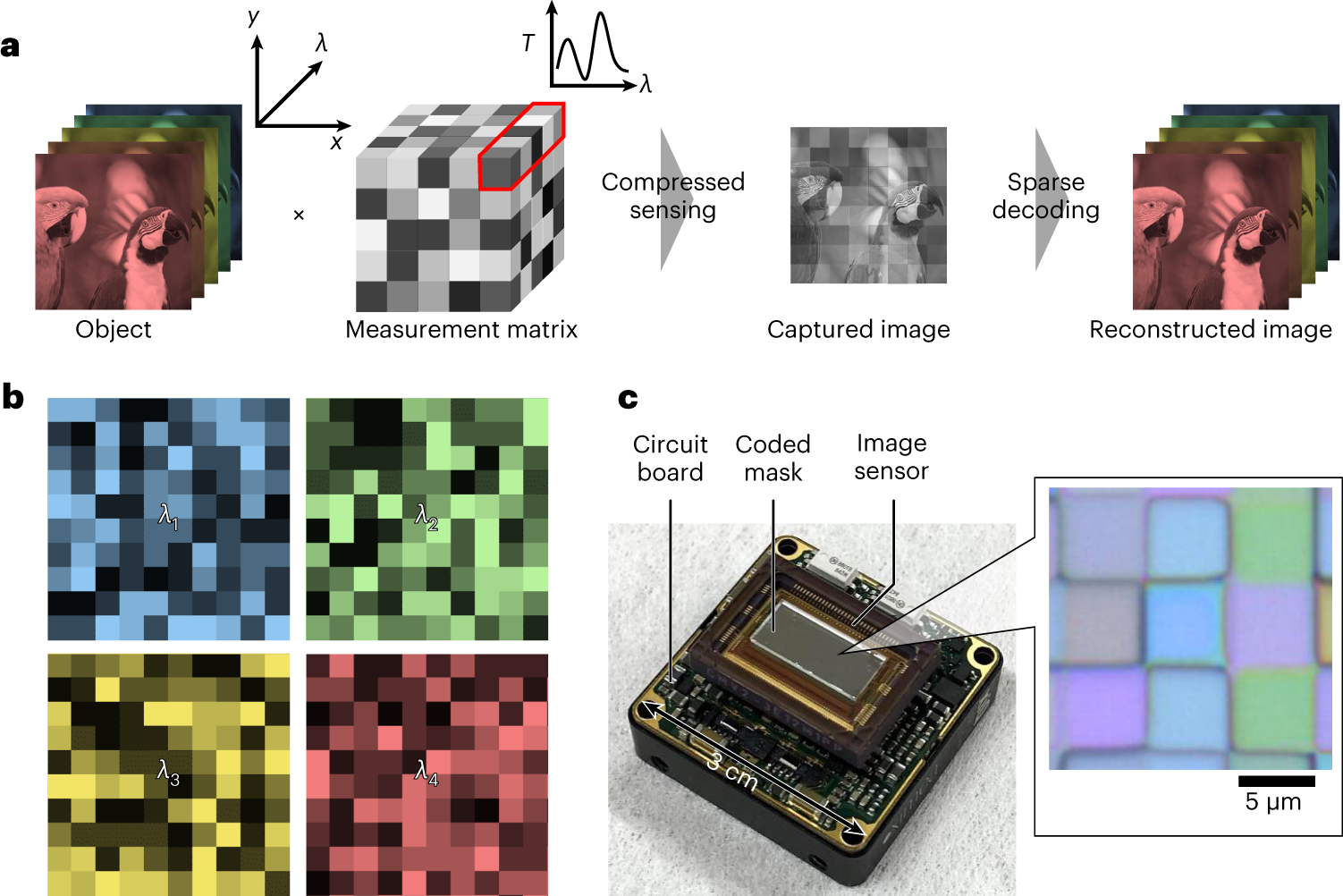
Rather than relying on a separate spectral sensing unit, Hypervision integrates key components directly onto a chip. This microsystem captures spectral information and performs computational reconstruction in real time, yielding a continuous stream of spectral images at video speed. In effect, the sensor does not just record light and color; it records a rich spectral cube for each moment, then processes the data on the fly.

The Role of Computational Imaging
One of the key enablers of the new system is computational imaging. In a traditional camera, the raw sensor data is mapped directly to an image. In computational imaging, the data captured by the sensor is only an intermediate representation, and advanced algorithms reconstruct the final image. Hypervision takes advantage of this principle by moving some of the spectral separation and analysis into software. The optical front-end may collect a mixture of spectral and spatial information that is carefully encoded, and the on-chip processing decodes that mixture into a clean hyperspectral video frame.
This approach helps circumvent the constraints of physical optics. By integrating the computational layer on the same chip or package, the system is not only more compact but also faster, because the massive amount of data generated by spectral imaging can be reduced before being transmitted off the device.
Potential Applications in Science and Medicine
Video-rate hyperspectral imaging opens up entirely new use cases. In biomedical settings, it could allow surgeons to view tissue oxygenation, perfusion, or pathological markers in real time, guiding decisions during an operation without sending samples to a lab. Hyperspectral reflectance patterns can reveal subtle differences in tissue structure and chemical composition that are invisible to the naked eye, giving clinicians a powerful visual aid.
Industrial inspection is another likely beneficiary. A microsystem that can classify materials or detect contaminants on a conveyor belt would be an invaluable quality-control tool. Agriculture and environmental monitoring could use drones or handheld devices to track plant health, water quality, or soil composition in motion.
Research laboratories could also benefit from a compact instrument that mounts directly onto a microscope or a robotic arm, enabling spectral analysis of experiments as they unfold in real time. The fact that the system is miniaturized means that it can be incorporated into other instruments, spreading hyperspectral capability far beyond its traditional niches.

Challenges and Road Ahead
While the paper is likely to attract attention for what it demonstrates, questions remain about spectral resolution and accuracy. On-chip hyperspectral systems often have to balance the number of spectral bands against the sensitivity and pixel count. The video-rate capability suggests that the system is making efficient use of the available light, but real-world performance will depend on the scene, lighting, and how well the on-chip algorithms generalize.
There is also the matter of manufacturing and cost. Any microsystem that promises to go from a lab demonstration to widespread adoption will need to be compatible with existing semiconductor fabrication processes. If Hypervision is built on a manufacturable platform, it could pave the way for consumer cameras, medical devices, and industrial sensors that capture spectral detail as easily as video.
A New Kind of Vision
The Hypervision microsystem represents another step toward the long-promised merger of optics, sensing, and computation. When a sensor can measure the interplay of light across many spectral bands at video frame rates, and do so on a chip small enough to fit in a compact device, the boundary between camera and spectrometer begins to disappear. The result is a type of vision that goes considerably beyond what the human eye can see.
Hypervision adds a live, spectral dimension to ordinary imagery. The full implications are only beginning to be explored, but for now it is enough to recognize that the era of video-rate hyperspectral imaging is drawing closer to practical reality.
This article is based on reporting by Science (AAAS). Read the original article.

Originally published on science.org