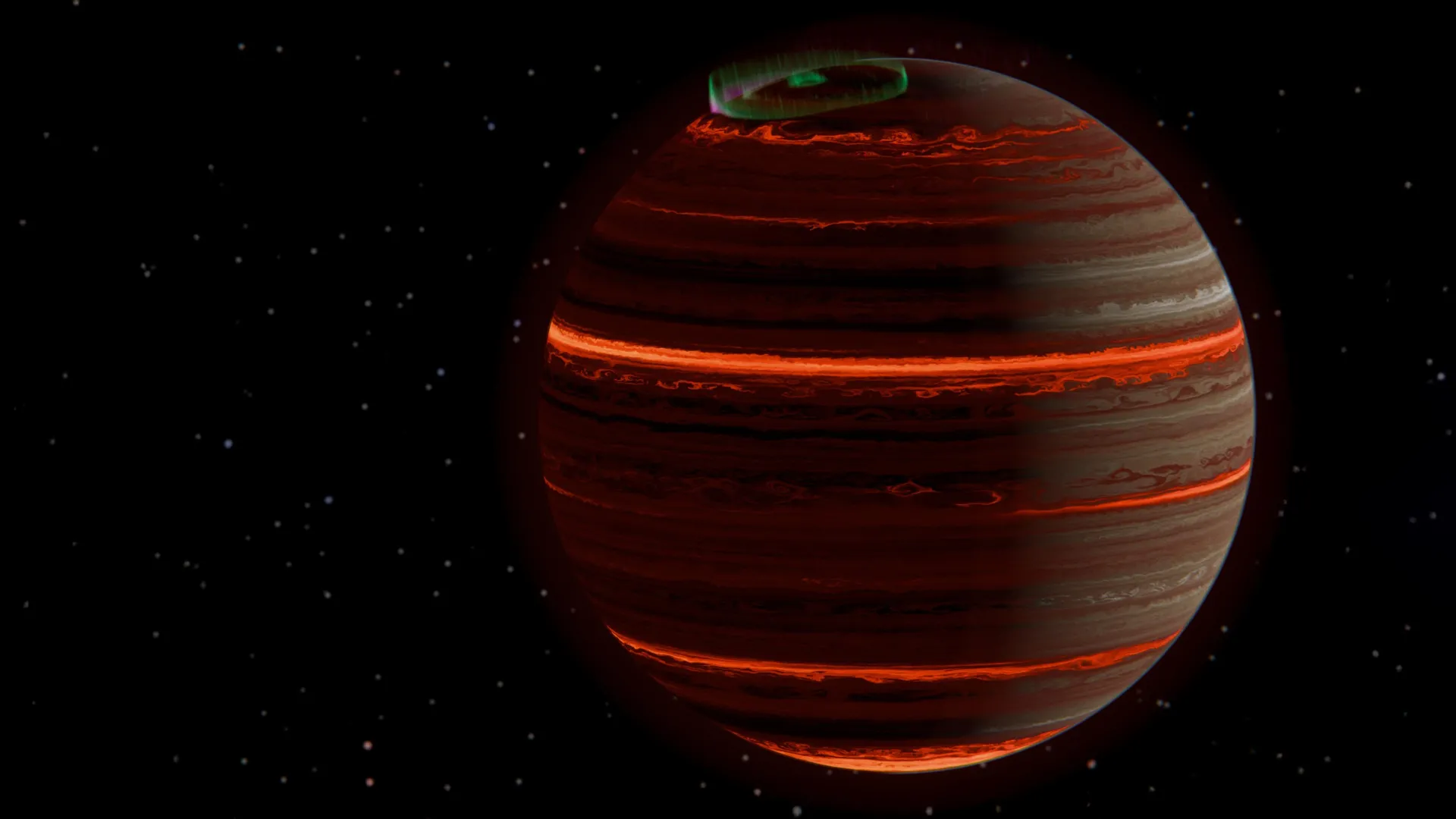
A turbulent world-like object about 20 light-years from Earth may have a far more orderly atmosphere than its changing appearance first suggests. Scientists using the James Webb Space Telescope have found that much of the variability in the atmosphere of the brown dwarf SIMP 0136 can be described by two dominant factors: temperature changes and the vertical structure of clouds.
The result does not make the object’s weather simple. SIMP 0136 remains a distant, dynamic atmosphere that researchers can observe only through subtle shifts in its light. But the study points to a way of extracting a small number of meaningful patterns from data that might otherwise appear overwhelmingly complex.
Reading weather through rotation
SIMP 0136 is a brown dwarf, an object that sits outside the usual categories of stars and planets. Previous work had associated it with phenomena resembling auroras. For the new analysis, researchers at Trinity College Dublin used Webb observations to investigate how the object’s light changes as it rotates.
That changing light is the key to studying an atmosphere that cannot be sampled directly. As different regions rotate into view, small differences in brightness can carry information about temperature and clouds. Webb’s sensitivity allowed the team to detect very small brightness variations and use them as evidence of processes occurring in the atmosphere.
The central challenge is that rotating atmospheric data can contain many overlapping signals. A brightness change might reflect temperature, clouds, the geometry of the observation or smaller fluctuations in the measurements. Treating every variation as a separate phenomenon risks creating a picture that is more complicated than the underlying system.

Letting the data reveal the strongest patterns
To address that problem, the researchers used principal component analysis, or PCA. The mathematical method is designed to identify the strongest patterns in a large and complicated dataset. Rather than starting from a detailed model of how the atmosphere was expected to behave, the team used the observations to identify the most important sources of variation.
In practical terms, PCA helps reduce a crowded set of measurements to the dominant changes that explain most of what is being seen. The technique also helped the researchers distinguish atmospheric changes from smaller fluctuations and measurement noise.
That matters because astronomy frequently deals with indirect evidence. The aim is not merely to collect more observations, but to determine which variations are physically meaningful. In this case, the analysis indicated that the brown dwarf’s complex behavior is largely governed by changes in temperature and by the vertical arrangement of its clouds.
Complex atmosphere, limited set of drivers
The finding is striking because the atmosphere initially appears highly complicated. The observations reveal a changing object, not a static sphere with a single uniform cloud layer. Yet the study suggests that two broad processes account for most of the observed variation.
Temperature changes affect how much light different parts of the atmosphere emit. Cloud structure affects how that light emerges, particularly when clouds are arranged at different altitudes. Together, those processes can create a rich pattern of changing brightness as the brown dwarf turns.
This is not a claim that every atmospheric feature on SIMP 0136 has been solved. The researchers’ result is more useful and more precise: most of the observed complexity can be organized around a small number of leading factors. That provides a framework for asking more specific questions about the remaining variation instead of treating the entire atmosphere as a single unresolved puzzle.

A method for worlds beyond the Solar System
The researchers say the work offers a new way to study weather patterns on distant worlds and atmospheric conditions beyond the Solar System. Brown dwarfs are especially useful targets for this kind of work because their atmospheres can be observed as they rotate, while still presenting conditions relevant to the broader study of planetary atmospheres.
The method’s broader value lies in its restraint. It does not require scientists to begin with a complete account of an atmosphere. Instead, it uses sensitive observations and statistical analysis to identify which physical processes deserve the most attention. For distant objects, where direct measurements are not available, that can be an effective way to turn changing light into an interpretable weather record.
Webb’s role is equally important. The telescope’s instruments can register minute changes in brightness that would otherwise be difficult to isolate. Those measurements make it possible to examine atmospheric variability with a level of detail that supports pattern-finding rather than broad speculation.
The study therefore adds more than a description of one brown dwarf. It demonstrates an analytical route for separating dominant atmospheric signals from noise and minor fluctuations. As astronomers apply related approaches to other distant objects, they may be able to compare how temperature and clouds shape a range of alien atmospheres.
Order without oversimplification
The appeal of the result is that it finds structure without denying complexity. SIMP 0136 still has an active and changing atmosphere. The research simply shows that its changing appearance is not arbitrary. A comparatively small set of physical drivers appears to organize much of what Webb sees.
For astronomers studying worlds that cannot be visited or directly sampled, that is a meaningful advance. A distant point of changing light can become evidence of temperature patterns, cloud layers and atmospheric behavior. The weather on SIMP 0136 remains alien, but it is becoming legible.
- Webb observations tracked small brightness changes as SIMP 0136 rotated.
- Researchers used principal component analysis to identify the strongest patterns in the data.
- Temperature variation and vertical cloud structure explain much of the observed atmospheric behavior.
This article is based on reporting by Science Daily. Read the original article.

Originally published on sciencedaily.com