Coins made against the Vikings ended up with the Vikings
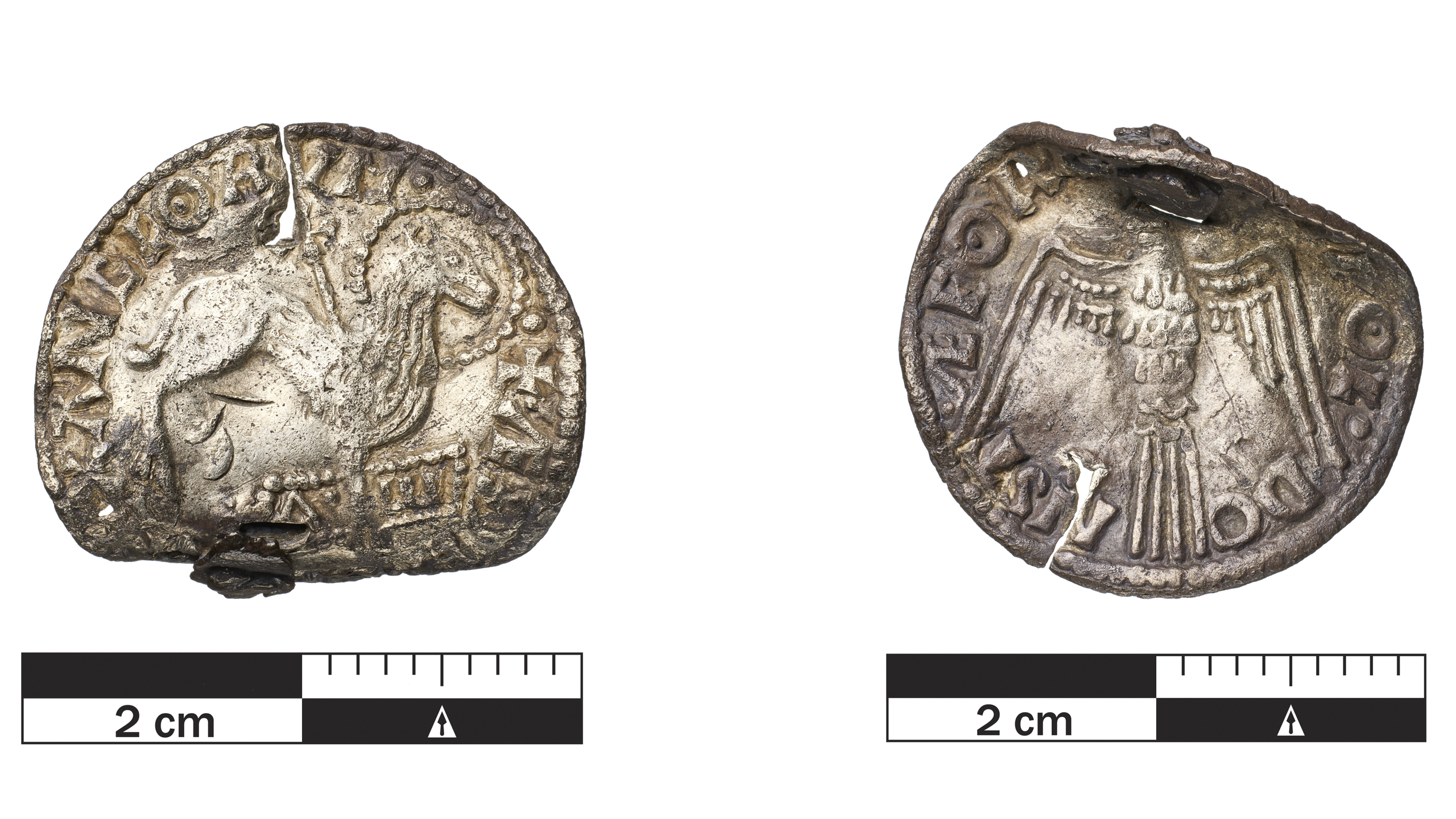
Two rare silver coins discovered in Denmark have exposed a remarkable historical reversal: objects minted in England in the hope of securing protection from Viking attacks were later repurposed by Vikings as jewelry or amulets. The finds, reported by experts at the National Museum of Denmark, date to around 1009 during the reign of the English king Æthelred II and belong to a highly unusual coin type known as Agnus Dei, or Lamb of God.
The irony is unusually sharp even by the standards of medieval archaeology. These coins were not simply ordinary currency that happened to travel. They were minted with heavily religious imagery linked to a moment of deep insecurity in England, when Viking pressure was intense and political authority was strained. Their recovery in Denmark, altered for wearable use, suggests that what may have begun as a spiritual and political gesture in one kingdom became an object of personal or ornamental significance in another.
A rare type with a defensive message
According to the source material, the Agnus Dei coins were issued during Æthelred II’s rule and featured explicitly Christian motifs. On the front is a lamb pierced by a cross, representing Christ’s sacrifice, along with alpha and omega, symbols of God as beginning and end. On the reverse is a dove in flight symbolizing the Holy Spirit. These are not routine design elements for everyday English coinage of the period. Contemporary coins usually carried a cross on the reverse and a profile of the king on the front.
That makes the type stand out immediately. The iconography suggests the coin was intended to do more than facilitate exchange. It carried an appeal to divine protection at a time when earthly defenses were proving fragile. In the source, National Museum of Denmark curator Gitte Ingvardson called the finds almost tragicomical because the coins were made to obtain protection against the Vikings but instead ended up being worn by Vikings.
Why the Danish discovery matters
The archaeological significance lies partly in rarity. Ingvardson said the discovery gave her goose bumps because the coins are extremely rare. Rare objects often illuminate history disproportionately because they preserve decisions that ordinary artifacts smooth over. Here, the coins reveal how ideology, religion, mobility, and material culture could all intersect across enemy lines in the Viking Age.
The fact that they were found in Denmark matters because it provides direct evidence of circulation into Scandinavia. Viking movement across the North Sea is already well established through raids, trade, tribute, and settlement. But these coins add a more textured layer to that history. They show not just that wealth moved, but that symbolic objects could be reinterpreted in new cultural settings.
The source says the Vikings turned the coins into jewelry or amulets. That adaptation is itself revealing. It implies that the coins were valued for more than silver content alone. Their design, rarity, or aura may have made them worth preserving in visible form. Whether the wearers understood or cared about the original English religious intent is another question, but the transformation suggests the objects retained enough meaning or visual appeal to escape the melting pot.
Christian imagery in a Viking context
One of the most interesting dimensions of the find is the way Christian iconography appears inside a Viking-use context. The Viking world was not isolated from Christianity; contact, conversion, trade, and political exchange were all reshaping northern Europe in this period. These coins fit into that larger landscape of interaction, where symbols could move independently of the institutions that created them.
That does not mean the objects carried the same significance in Denmark that they did in England. The source is careful to frame them as jewelry or amulets, not as evidence that their users embraced the exact original religious message. Yet wearable objects are never neutral. Turning a coin into an amulet changes its social function. It becomes something seen, handled, and possibly believed to possess protective or status value.

The finds also reveal the human side of conflict
Archaeology often makes the past feel abstract, especially when dealing with large historical forces such as raids, kingship, and religion. These coins bring the story back to the level of people making choices about small, precious things. Someone in England approved a design meant to invoke divine defense. Centuries later, detectorists in Denmark recovered objects that show someone else decided the same coins were worth wearing.
That contrast captures a recurring truth about material history: objects do not stay loyal to the intentions of their makers. They travel, are stripped of context, gather new meanings, and sometimes end up embodying the opposite of what they were created to express. Few artifacts make that point as neatly as coins minted to ward off Viking danger that later adorned Viking bodies.
A compact but striking historical lesson
The Danish finds are scientifically modest in scale but rich in implication. They reinforce how porous cultural boundaries were in the Viking Age, how political anxiety could be inscribed into everyday objects, and how those objects could later be absorbed into very different value systems. They also remind us that medieval Europe was connected not only by trade and conquest, but by the unpredictable afterlives of material culture.
For historians and archaeologists, that makes these coins more than curiosities. They are evidence of circulation, reinterpretation, and symbolic reversal. For everyone else, they offer something rarer still: a discovery whose irony is immediate enough to make a thousand-year-old conflict feel unexpectedly vivid.
This article is based on reporting by Live Science. Read the original article.

Originally published on livescience.com