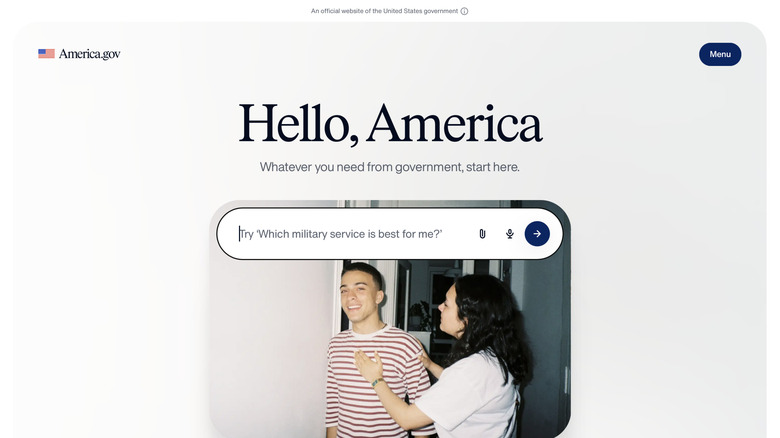
A Single Domain for Federal Services
The United States government now has an official AI chatbot, and the administration behind it is aiming well beyond a novelty tool. As Engadget reported on September 29, 2026, the administration wants America.gov — the site hosting the assistant — to become the main portal for federal services. That is a notable shift in posture. Rather than steering the public through a maze of separate agency websites, benefit portals, forms and PDFs, the government appears to want a single starting point where people can simply ask a question in everyday language.
For anyone who has tried to resolve a federal matter online, the appeal is easy to understand. The hard part of dealing with government is rarely the individual agency's page; it is knowing which agency to visit in the first place. A conversational interface collapses that discovery problem into a prompt.
What Has Actually Been Confirmed
Two things are clear from the reporting. First, there is now an official AI chatbot tied to the U.S. government. Second, the administration's stated intention is for America.gov to serve as the primary destination for federal services. Those are the load-bearing facts.
Almost everything else — architecture, scope, oversight — has yet to be detailed publicly.
- Which agencies and services the chatbot is authorized to cover.
- Whether it can handle or reference personal case information, such as benefit claims or tax records.
- What underlying model it uses and who supplies it.
- How conversations are logged, retained or deleted.
- Whether it can escalate a user to a human being, and how quickly.
- What languages it supports and how it performs for people using assistive technology.
Those gaps matter because each one determines whether the tool is a convenience layer on top of existing services or something closer to a citizen-facing caseworker.
Why Conversational Access Is Tempting
The navigation problem
Fragmentation is the defining feature of modern government. Benefits, permits, licenses, filings, appeals and inquiries are spread across departments that each maintain their own vocabulary, eligibility rules and deadlines. Citizens are expected to already know the map. An assistant that accepts a plain-language question and routes people to the right place attacks that friction directly.
Demand for always-on service
Call centers and field offices operate on schedules. Websites do not. A conversational interface can answer at 2 a.m., which is when many people actually have time to deal with paperwork. The pitch is availability plus comprehension — the two things people most often say they want from government services.
The Risks That Arrive With It
The same qualities that make an AI assistant useful in this context also make its errors consequential.
Accuracy and accountability
If a chatbot states the wrong filing deadline, misreads an eligibility rule or points someone toward the wrong program, the harm is not abstract. Yet responsibility for a machine-generated answer is not obviously assigned to any office. Governments deploying these systems generally have to decide, in advance, what happens when the assistant is wrong.
Privacy by default
Conversations about benefits, immigration status, taxes or health coverage contain exactly the information people are most careful about sharing. Whether that content is stored, for how long, and who can review it are not small implementation details — they determine whether the tool feels safe enough to use at all.
Access and equity
Public services must work for people who are not confident with technology, who rely on screen readers or other assistive tools, or who speak a language other than English. A chat interface that performs well for a fluent, comfortable user but poorly for everyone else would deepen the gap it claims to close.
A Familiar Direction, With Higher Stakes
Governments around the world have spent recent years experimenting with AI assistants for public services, and agencies have long used narrow chatbots to answer routine questions about a single program. Consolidating that capability under one official domain — and pairing it with an explicitly stated portal ambition — is a larger step. It turns a departmental experiment into a piece of national digital infrastructure, with the scrutiny that implies.
What Success Would Need to Look Like
Because the headline claim is about ambition rather than a finished, fully described service, the useful way to judge America.gov is by what gets published alongside it. Reasonable markers include:
- Public documentation of what the assistant can and cannot do.
- A visible, working path to a human when a conversation stalls.
- Clear disclosure that users are talking to a machine, not an official.
- Evaluation results on accuracy, including known failure modes.
- Plain-language privacy terms covering retention and internal access.
- Oversight — from Congress, inspectors general or an independent body — with authority to demand changes.
None of these are exotic. They are the ordinary accountability furniture that accompanies any system touching benefits and rights. Whether they arrive early or late will shape public trust more than the fluency of any individual answer.

The Test Ahead
A government chatbot is easy to announce and hard to run well. The interesting question is not whether America.gov can produce a fluent response, but whether the response is correct, whether the person receiving it is protected, and whether anyone is accountable when it is not. If the administration genuinely wants America.gov to become the main portal for federal services, those standards are the price of admission.
This article is based on reporting by Engadget. Read the original article.
Originally published on engadget.com