A 1980s Icon Returns as an App
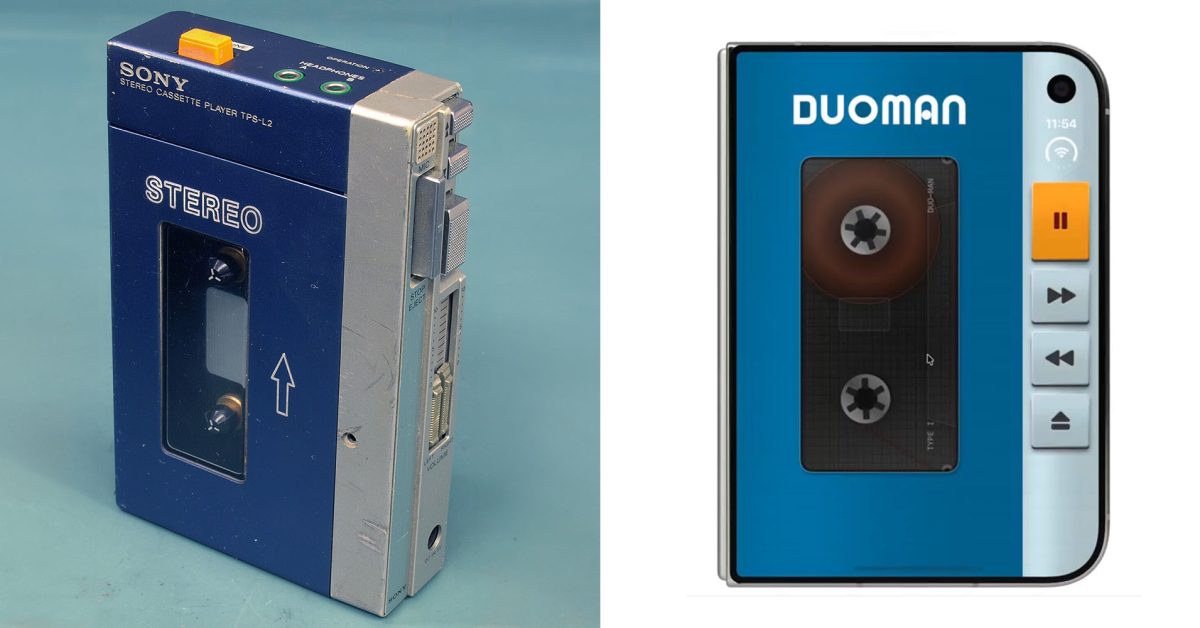
Long before the iPod arrived and changed how people carried music, the Sony Walkman was the device of choice for anyone who wanted to add a personal soundtrack to their day. That is the memory being mined by a new app called Duo-Man, which — according to a report published by 9to5Mac on September 29, 2026 — turns the 2026 iPhone Duo into a digital recreation of a 1980s Sony Walkman.
The concept is a familiar one in an era of software-driven nostalgia: take the flat glass slab in your pocket and dress it in the design language of a piece of hardware people once loved. Rather than asking users to forget the modern interface, Duo-Man leans into the contrast, inviting iPhone Duo owners to play with the idea of a cassette-era player living inside a 2026 device.
Why the Walkman Still Matters
The Walkman's cultural footprint is unusually deep for a piece of consumer electronics. It predated the iPod and became the gadget that taught a generation to treat music as something portable and personal rather than something anchored to a living-room stereo. In the framing used by 9to5Mac, it was long the device of choice for listeners who wanted to add a soundtrack to their life — a simple proposition that turned out to be transformative in practice.
Before the iPod, There Was the Walkman
The lineage matters. When people trace the ancestry of modern portable music, the story usually moves from the Walkman to the iPod and then to streaming, with each step trading physical controls for software flexibility. Duo-Man's premise — recreating the earliest of those steps on the newest hardware — works because the audience already understands that history. The app is aimed explicitly at users old enough to have owned the original device, people who remember pressing a physical button and hearing a tape begin to move.

What Duo-Man Sets Out to Do
- Recreate the experience of using a 1980s Sony Walkman inside a modern app.
- Use the 2026 iPhone Duo as the host device.
- Speak directly to users with firsthand memories of the original hardware.
Those three elements are the core of the pitch as reported. The framing is deliberately nostalgic rather than purely functional: the goal is not necessarily to replace a streaming service, but to offer a different, more tactile way to interact with music on hardware that never had physical controls to begin with.
Retro Tech as a Design Language
Retro revivals have become a dependable part of the technology landscape, and audio is one of the richest veins to mine. The reasons are not hard to see. Physical media imposed constraints: you chose an album, you committed to it, you turned it over when it ended. Those constraints produced a kind of attention that an infinite library can make difficult to reproduce.
An app such as Duo-Man can only simulate that experience rather than restore it. But simulation is often enough. Interface skins, tape hiss, and controls that mimic hardware all trade on the same idea — that the friction of older technology was also part of its pleasure. For listeners who remember the Walkman, the appeal is memory. For those who do not, the appeal is novelty: a chance to use a music player that behaves like an artifact rather than an app.

The iPhone Duo Factor
The device is the other half of the equation. Pairing a Walkman tribute with a phone named Duo suggests a play on form as much as function. A device with two distinct surfaces invites a two-part interface, and there are few better metaphors for that shape than a cassette deck, a hinged player, or a split transport layout.
That said, the report does not detail how far the recreation goes. Whether Duo-Man reproduces only the visual identity of a Walkman or attempts to echo the tactile rhythm of using one remains an open question. What is clear is the intent: to make a 2026 device feel, at least for a few minutes, like something from four decades earlier.
Context: A Busy Hardware Cycle
Software nostalgia is arriving alongside a period of hardware experimentation. The same feed that carried the Duo-Man story also included a September 27, 2026 report by Michael Burkhardt indicating that Apple is working on a new Vision Pro, with different form factors on the table. Read together, the two items point in a similar direction: device makers are exploring unusual shapes and new ways for users to interact with software, while developers look backward for interface ideas that already feel familiar.
That combination — forward-looking hardware, backward-looking software — is one of the more interesting tensions in consumer technology right now. New screens create room for old metaphors, and old metaphors give new screens something to do that a plain grid of icons cannot.
What Remains Unclear
- How closely the app recreates the Walkman experience beyond its appearance.
- Whether Duo-Man will be a standalone product or part of a larger suite.
- How the app handles modern music sources and libraries.
- What the release timeline and availability look like.
None of those questions have firm answers in the early coverage. For now, the headline is the concept itself: a piece of software that takes one of the most recognizable gadgets of the 1980s and gives it a home on a phone from 2026.
The Bottom Line
Duo-Man is a small story that touches a large theme. The devices we use keep changing shape, but the rituals we associate with them linger — the click of a button, the weight of a player in a pocket, the sense that listening to music was once a deliberate act rather than an infinite scroll. An app that turns a 2026 iPhone Duo into a 1980s Sony Walkman is not trying to bring back the past. It is trying to borrow its feel. Judging by how often that trick works, it is a bet worth watching.
This article is based on reporting by 9to5Mac. Read the original article.
Originally published on 9to5mac.com

![These are my favorite iPhone 18 Pro & Pro Max cases so far [Video] - 9to5Mac](https://9to5mac.com/wp-content/uploads/sites/6/2026/09/Cases.jpg?quality=82&strip=all&resize=1200,628)