A major moral intervention in the AI debate
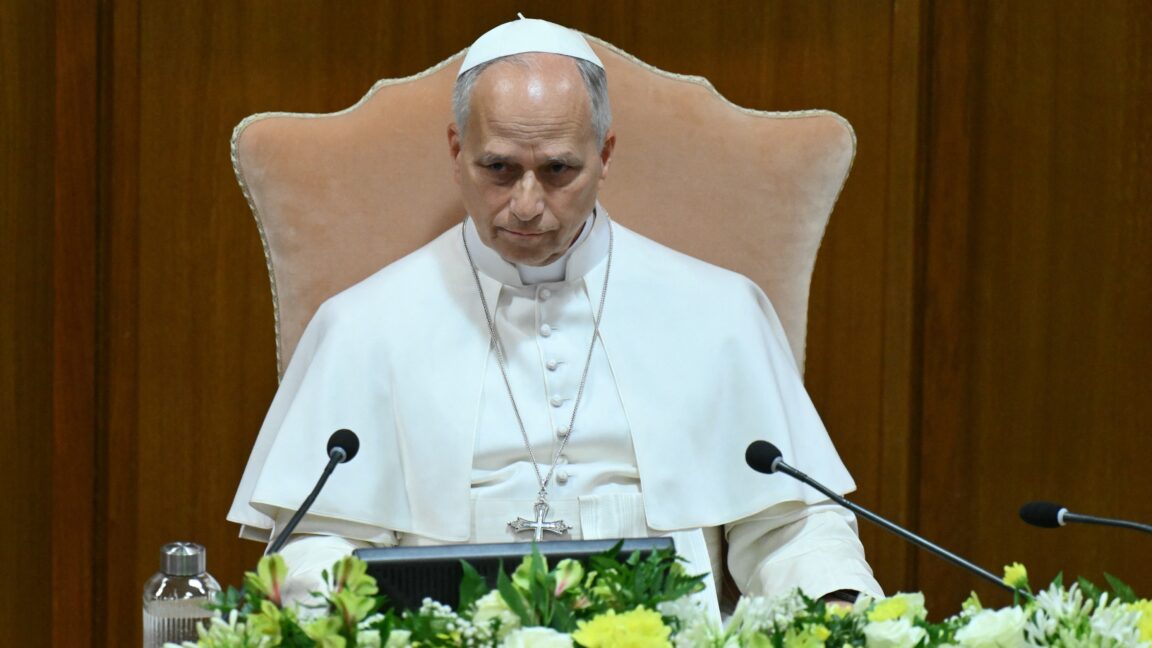
Pope Leo XIV has entered the global conversation on artificial intelligence with unusually direct language, calling for AI to be “disarmed” in his first encyclical, Magnifica Humanitas. The document, released in Rome, frames AI not as a narrow technical issue but as a civilizational test. Leo argues that the technology must be freed from systems that turn it into an instrument of domination, exclusion, and death, and instead be placed in service of the common good.
The force of the intervention lies partly in the vocabulary. Leo explicitly says he chose the language of disarmament because the moment requires words strong enough to attract attention, awaken consciences, and point humanity toward a different path. That makes the encyclical more than a general warning about ethics. It is a bid to define the stakes of the AI era in moral and political terms.
The Vatican’s framing also matters because this is not a marginal note in church teaching. Leo signed the encyclical on May 15, the anniversary of the 1891 encyclical Rerum Novarum, the foundational text of modern Catholic social teaching. In doing so, he places AI alongside the industrial disruptions that transformed labor, power, and social life more than a century ago. He presents artificial intelligence as the “new thing” of the current age, one powerful enough to require a fresh statement of principles.
From autonomous weapons to data extraction
The document’s critique is broad. According to the source text, Leo addresses AI-powered autonomous weapons, extractive approaches to health and genetic data, and the concentration of control in patents, algorithms, digital platforms, technical infrastructure, and data. This is a notable combination. Rather than treating AI as only a labor issue, only a military issue, or only a content issue, the encyclical connects them as parts of a common power structure.
That structure is described in stark terms. Leo compares today’s technological elites to colonial conquerors and warns against a new mindset of extraction, especially in regions with structural fragility and limited geopolitical influence. The argument is that data-intensive systems can reproduce older patterns of dominance under a digital label. In that framing, AI is not simply software. It is also an institutional arrangement that can deepen asymmetries between those who build and own systems and those who are measured, governed, or displaced by them.
This is where the encyclical departs from softer versions of AI ethics. Rather than centering transparency, bias mitigation, or voluntary guardrails alone, it appears to ask more basic questions about power, ownership, and purpose. Who benefits from AI systems? Who bears the risk? Who gets bypassed? Those questions place the Vatican’s intervention much closer to political economy than to corporate compliance language.

A competing vision of what it means to build
One of the more striking features in the source account is that Leo does not stop at critique. He also adopts the language of building, but redirects it. In his vision, building is not limited to code, startups, platforms, or factories. It is part of a broader call to create what he describes as a “civilization of love,” a social order in which technology serves and augments humanity rather than dominating it.
That distinction matters because the dominant public rhetoric around AI still tends to assume that acceleration is the main measure of seriousness. Build faster, deploy sooner, scale wider. Leo’s intervention suggests another test: whether systems preserve human dignity, social participation, and moral responsibility. If they do not, then technical sophistication is not a defense.
There is also an implicit warning here for institutions that want to outsource judgment. A machine can optimize, recommend, rank, target, or automate, but the encyclical appears to insist that none of those functions should be allowed to hollow out human agency. The demand is not anti-technology in a simple sense. It is anti-subordination. The problem is not that tools exist; it is that tools can be embedded in logics that exclude people from decisions that shape their lives.
Why this intervention lands now
The timing is significant. AI debates have become more concrete over the last two years, with growing concerns over labor disruption, military autonomy, concentrated infrastructure, and cross-border data extraction. Leo’s encyclical enters that moment with a vocabulary designed to raise the stakes. By tying AI to social teaching, he is effectively saying that this is no longer a specialist conversation reserved for engineers, executives, and regulators.
That may broaden the audience for AI governance arguments. Religious institutions do not write technical standards, but they can influence the public moral frame in which standards are debated. A call to “disarm” AI is memorable because it compresses a complex critique into a single demand: technology must not be allowed to accumulate power without accountability to human ends.
The presence of Anthropic co-founder Dario Amodei at the event, as noted in the source text, also underscored the overlap between moral authority and frontier-industry power. The Vatican clearly understands that it is addressing developers and executives as much as believers. The message is not that innovation should stop. It is that innovation without moral orientation becomes dangerous precisely when it appears most capable.

The long argument ahead
Whether Leo’s intervention changes policy directly is an open question. But it does add weight to a growing view that AI governance cannot be reduced to narrow risk management. The issues raised in the encyclical span warfare, labor, extraction, ownership, and the shape of social life itself.
That breadth may be the point. Industrial revolutions do not only change tools; they reorganize societies. By invoking the tradition of Rerum Novarum, Leo is arguing that AI belongs in that category. The central question is no longer whether the technology is impressive. It is whether the world being built around it leaves human beings more protected, more empowered, and more fully included than before.
In that sense, “disarm” is less a rejection of intelligence in machines than a rejection of the political and economic arrangements that can make those systems instruments of coercion. The encyclical is a reminder that AI’s future will not be determined by engineering alone. It will also be shaped by the values institutions are willing to defend.
This article is based on reporting by Ars Technica. Read the original article.
Originally published on arstechnica.com


