Launch growth meets an old spaceflight problem
China’s rise as a major launch power is colliding with one of the most persistent problems in orbital operations: what happens to spent upper stages after their job is done. According to reporting from Ars Technica based on analysis by space domain awareness expert Jim Shell, China is rapidly increasing the mass of rocket bodies left in long-lived orbits, even as other spacefaring nations have moved more decisively toward disposal practices meant to limit debris risk.
The raw launch numbers explain why the issue is becoming more urgent. China had never launched as many as 20 orbital rockets in a single year until about a decade ago. That changed dramatically in the 2020s. The country launched 64 rockets in 2022 and set a new record of 93 launches last year, making it the second-most active space power in the world. Further growth is expected from both state-backed entities and an expanding private launch sector.
Why upper stages matter so much
Upper stages are not small fragments. They are large rocket bodies, often weighing multiple tons, that can remain in orbit for years or decades if not actively deorbited or otherwise disposed of. Over time, those objects create collision hazards. A strike involving a large spent stage can generate large debris clouds that threaten satellites, crewed missions, and other space infrastructure.
The source report describes these rocket bodies as particularly dangerous because they are big, persistent, and often uncontrolled. That combination turns them into long-duration hazards in the most economically and strategically valuable orbital regions.

The numbers behind the warning
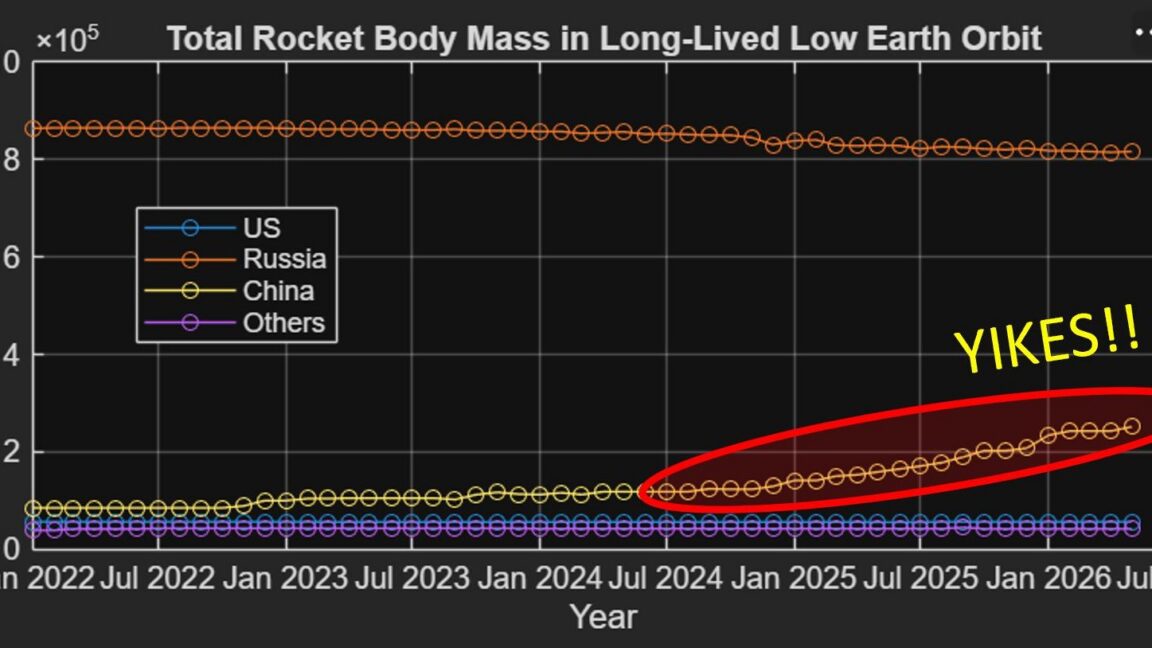
Most major space powers have gradually improved disposal behavior over the last two decades. Russia remains the largest historical offender, with about 800 metric tons of rocket bodies in long-lived orbits between 600 and 2,000 kilometers, according to data cited from the European Space Agency’s Space Debris Office and Jonathan McDowell’s catalog. The United States has about 57 metric tons in those same orbital bands.
What makes China stand out is not simply the current total, but the pace of growth. In the last five years, the mass of Chinese rocket bodies in long-lived orbits reportedly rose from less than 100 metric tons to 252 metric tons. That is a steep increase in a short period, and it tracks directly with the country’s fast-expanding launch activity.
The criticism here is not that China is launching more rockets. The article explicitly notes that rapid growth in launch is not inherently a problem and has also been seen in the United States, especially through SpaceX. The issue is that China appears to be neglecting long-established norms around upper-stage disposal while scaling up at speed.
A governance and safety challenge
Space sustainability debates often focus on satellites, mega-constellations, and anti-satellite tests. But spent upper stages remain a foundational part of the debris problem because they represent a preventable source of long-lived mass. Best practices are not mysterious: mission design can reserve propellant for deorbiting, use disposal orbits more responsibly, or otherwise reduce how much hardware is abandoned in congested regions.
If one major launch power does not follow those norms, the burden is shared by everyone operating in orbit. Collision cascades do not respect national boundaries. A debris event generated by one country’s hardware can affect commercial, civil, and military systems globally.

The next phase of the launch era
The broader significance of this issue is that the launch market is no longer small enough to tolerate legacy behavior at modern scale. When launch counts were low, bad practices accumulated slowly. At today’s rates, each policy gap compounds faster. That makes disposal behavior a front-line issue for the future of orbital access.
China’s space program is growing in capability and ambition. The question raised by this analysis is whether its debris practices will evolve quickly enough to match that growth. If not, one of the world’s most important technological competitions could leave behind a more crowded and more dangerous orbital environment for everyone else.
This article is based on reporting by Ars Technica. Read the original article.
Originally published on arstechnica.com


