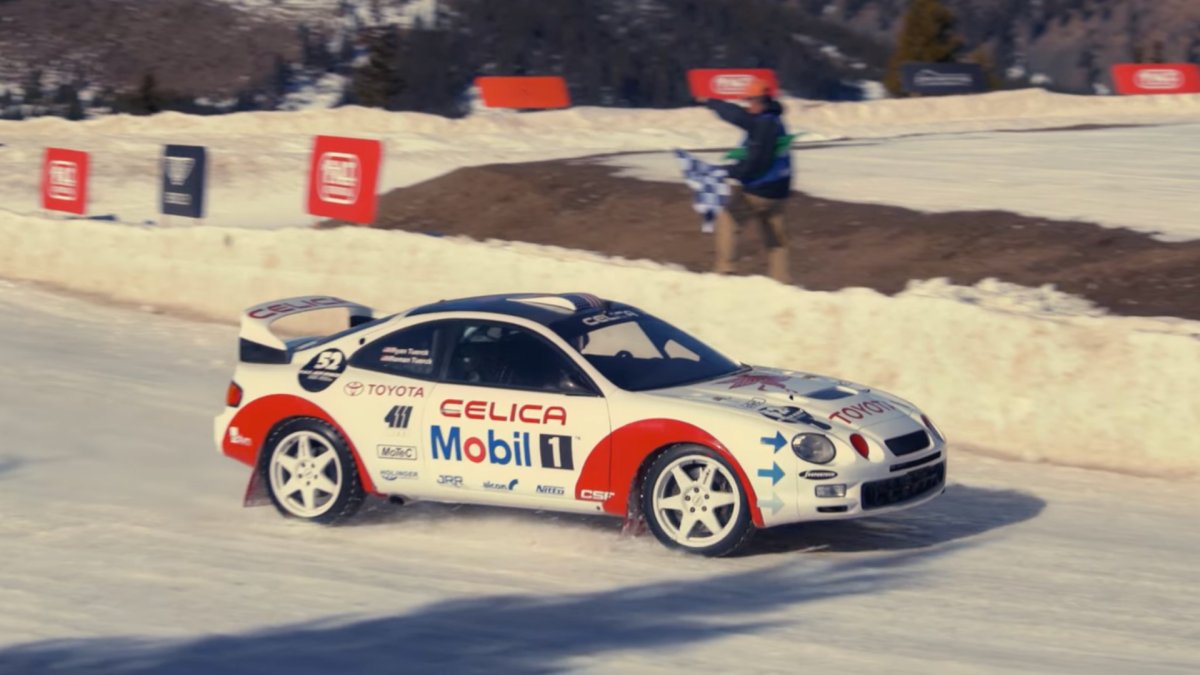
A Celica Rebuilt Around a Different Era of Toyota Performance
Ryan Tuerck’s latest project is not a restoration and not a simple engine swap. It is a ground-up reinterpretation of what a 1990s Celica might look like if it were rebuilt using modern Toyota rally-adjacent hardware and a willingness to cut deep into the chassis. The result, known as the GT411, pairs a 1994 Celica shell with the powertrain concept of today’s GR Corolla and enough structural change to turn a front-wheel-drive coupe into a purpose-built all-wheel-drive competition car.
According to the supplied report, the build began with a U.S.-market Celica GT stripped to a rusty shell. From there, the project moved well beyond cosmetic or bolt-on modifications. Converting the car for rally use required major floorpan work and the installation of a tubular rear subframe to accept an all-wheel-drive drivetrain. The report describes Wavetrac differentials and a Holinger sequential gearbox as part of that transformed driveline, underscoring how far the final machine sits from the road-going car it resembles.
That level of reinvention is what makes the GT411 notable. Many tuner projects are about extracting more power from an existing layout. This one changes the vehicle’s identity. A U.S.-spec sixth-generation Celica was never sold as an all-wheel-drive rally special. Tuerck’s team effectively built the version the platform never officially became.
Small Engine, Serious Output
The choice of engine is one of the project’s more interesting elements. Rather than installing a large displacement motor for shock value, the build uses Toyota’s turbocharged three-cylinder G16E engine from the GR Corolla. In stock form the GR Corolla is already a performance outlier, but the GT411 pushes far beyond factory output. The supplied report says the engine produces 500 horsepower in a low-boost setting and 600 horsepower at maximum boost.
Those figures come with substantial supporting work. The article cites a Garrett G30-770 turbo, a custom exhaust header from Teixeira Fabrication, forged pistons and rods from Nitto Performance Engineering, Kelford Stage 2 camshafts, and a Supertech valvetrain. Teixeira Fabrication reportedly carried out most of the build work. Together, those components make clear that the project is not trading on novelty alone. It is built around a serious performance target.
Other changes reinforce that intent. A roll cage and carbon-fiber body panels help convert the old Celica from neglected street car to competition machine. The goal, in Tuerck’s words, was a “psycho rally car” inspired by the Celica GT-Four lineage of the 1990s. That phrase sounds theatrical, but the hardware described in the report supports it.
Competition Debut Matters More Than the Spec Sheet
The strongest proof point for a build like this is not the dyno number. It is whether the car works in competition. On that front, the GT411 made an immediate impression. The supplied report says the car debuted at the FAT Ice Race in Big Sky, Montana, and finished second in its first event.
That result matters because freshly completed builds often spend their early outings exposing weak points. New drivetrains, revised suspension geometry, cooling systems, and electronics can all become liabilities under race conditions. A podium in the first event does not prove the development cycle is complete, but it suggests the core package is coherent.
The nostalgia factor is real, too. The Celica name remains deeply tied to World Rally Championship history, and the report explicitly invokes that heritage. The GT411 leans into the memory of the GT-Four era while updating nearly everything underneath. It is a modern competition concept wearing a familiar silhouette.
Projects like this also say something broader about where enthusiast performance culture is heading. Instead of chasing only authenticity or only excess, the GT411 combines historic form, current factory engineering, and custom fabrication into a hybrid kind of motorsport storytelling. It is recognizably a Celica. It is recognizably powered by GR Corolla DNA. And yet it is very much its own machine.
- The GT411 starts with a 1994 U.S.-market Celica shell and adds a full all-wheel-drive conversion.
- Its modified GR Corolla three-cylinder engine is reported to make 500 to 600 horsepower.
- The car finished second at the FAT Ice Race in its first competition outing.
This article is based on reporting by The Drive. Read the original article.
Originally published on thedrive.com