France’s solar push is exposing the storage gap
France’s latest debate over renewable energy is shifting from how fast solar can be built to how that power will be balanced once it reaches the grid. In a white paper submitted to the ministry, the Association Environnement Juste argues that France’s new Multi-Year Energy Plan, known as PPE 3, sets an ambitious target of 48 GW of solar capacity by 2030 but fails to set a corresponding target for energy storage.
For the group, that omission is not a technical footnote. It is a structural weakness. The association says that without flexibility, solar deployment risks running into a physical bottleneck, with consequences for grid stability and for the broader coherence of the energy transition. Its answer is to move flexibility closer to the source of generation rather than treating storage as an optional downstream add-on.
A proposed mandate would change project economics
The organization is calling for a minimum storage requirement on any new renewable energy installation larger than 10 kW. The idea is simple: if a producer adds variable generation to the system, that producer should also take some responsibility for smoothing the variability. In practice, that would push storage into a much wider share of distributed and small commercial renewable projects.
The proposal matters because it frames storage not as a premium feature, but as core infrastructure. That shift would affect project design, financing, and permitting. Developers would need to account for dispatchability earlier in the build cycle, while policymakers would need to decide whether the added cost is justified by greater system resilience and lower balancing pressure elsewhere on the network.

Why sodium-ion is part of the argument
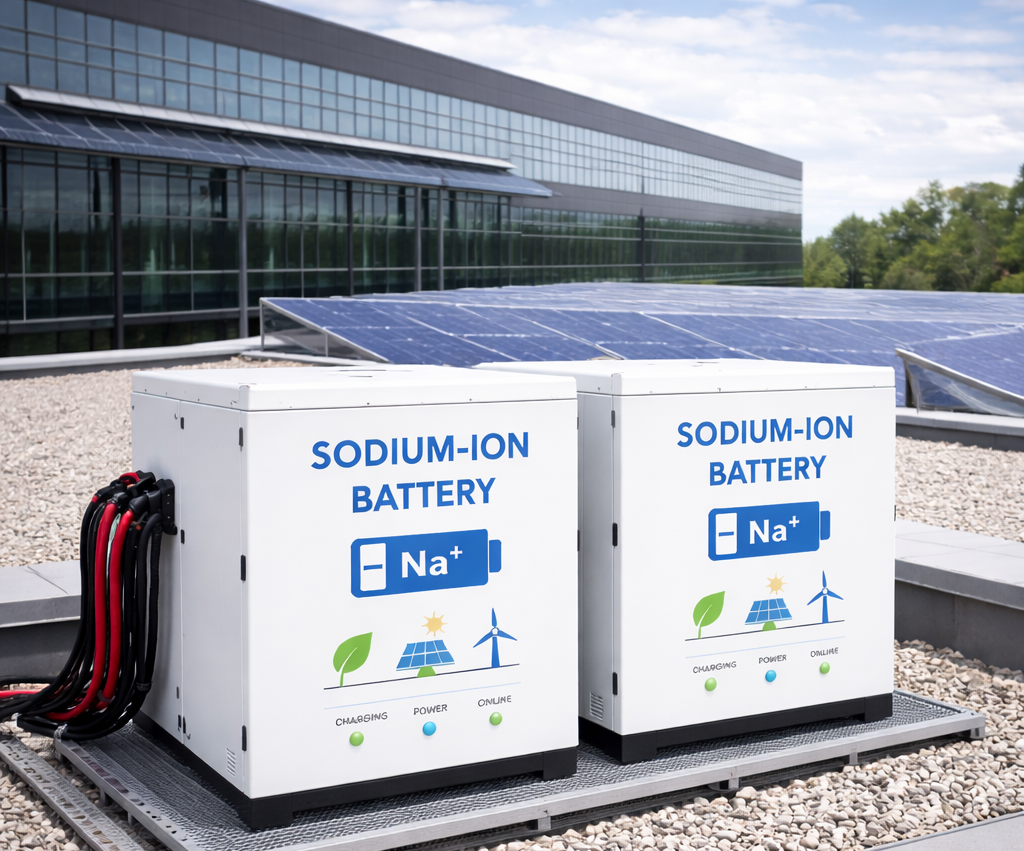
Association Environnement Juste says European sodium-ion batteries could offer an economically and environmentally viable way to meet that requirement. The case it makes is partly industrial and partly geopolitical. Sodium-ion chemistry avoids dependence on some imported metals, which gives it appeal at a time when supply-chain resilience has become part of energy policy.
The group’s position also suggests a specific model of clean-energy buildout: one in which Europe tries to pair renewable deployment with battery technologies that can be sourced and scaled with less exposure to strategic import risks. That does not mean sodium-ion replaces every other battery chemistry, but it does give the technology a defined role in the discussion around stationary storage and grid support.
What the proposal would mean for the grid
The central policy question is whether mandatory storage at project level would improve grid performance enough to justify a more prescriptive rule. The association argues that integrating flexibility at the source would help stabilize the grid and reduce the mismatch between variable production and real-time system needs. In that view, storage is not only about capturing excess solar generation. It is also about making deployment targets physically manageable.
The French debate is therefore becoming a test of planning philosophy. One option is to keep expanding renewable capacity first and rely on broader system upgrades later. The other is to require each new project to carry part of the balancing burden from the beginning. By explicitly tying storage to future renewable installations above 10 kW, the white paper backs the second path.
Why this story matters
- France’s official solar target is rising, but storage remains underdefined in current planning.
- The proposal would make flexibility a design requirement for a large set of new renewable projects.
- Sodium-ion is being positioned as a European-made alternative for stationary storage deployment.
Whether the ministry embraces the recommendation or not, the paper sharpens a question many power systems are now facing: renewable growth can be rapid, but flexibility cannot remain an afterthought indefinitely.
This article is based on reporting by PV Magazine. Read the original article.
Originally published on pv-magazine.com