The latest genetic evidence points to contamination, not clarity
The Shroud of Turin has spent centuries at the center of religious devotion, historical argument, and scientific controversy. A new DNA-focused study, reported by Gizmodo, does not settle the debate over the cloth’s origin, but it does make one thing clearer: the genetic record now present on the fabric appears too mixed to provide decisive evidence about who touched it or when it was made.
The paper, led by Gianni Barcaccia of the University of Padova and currently available as a preprint on bioRxiv, has not yet been peer-reviewed. Even so, its main finding is straightforward. Researchers identified an extremely diverse collection of medieval and modern DNA from humans, animals, and plants on the shroud. That breadth of material undermines the idea that metagenomic analysis can cleanly recover an original biological signature from the relic itself.
In the wording cited from the paper, the cloth “came into contact with multiple individuals,” making it difficult to identify any original DNA associated with the shroud. For a relic that has been handled, displayed, transported, and preserved across centuries, that conclusion is less surprising than it is consequential. It means that one of the more intriguing modern scientific routes into the debate may not yield the kind of answer advocates on either side want.
A relic with a long and disputed record
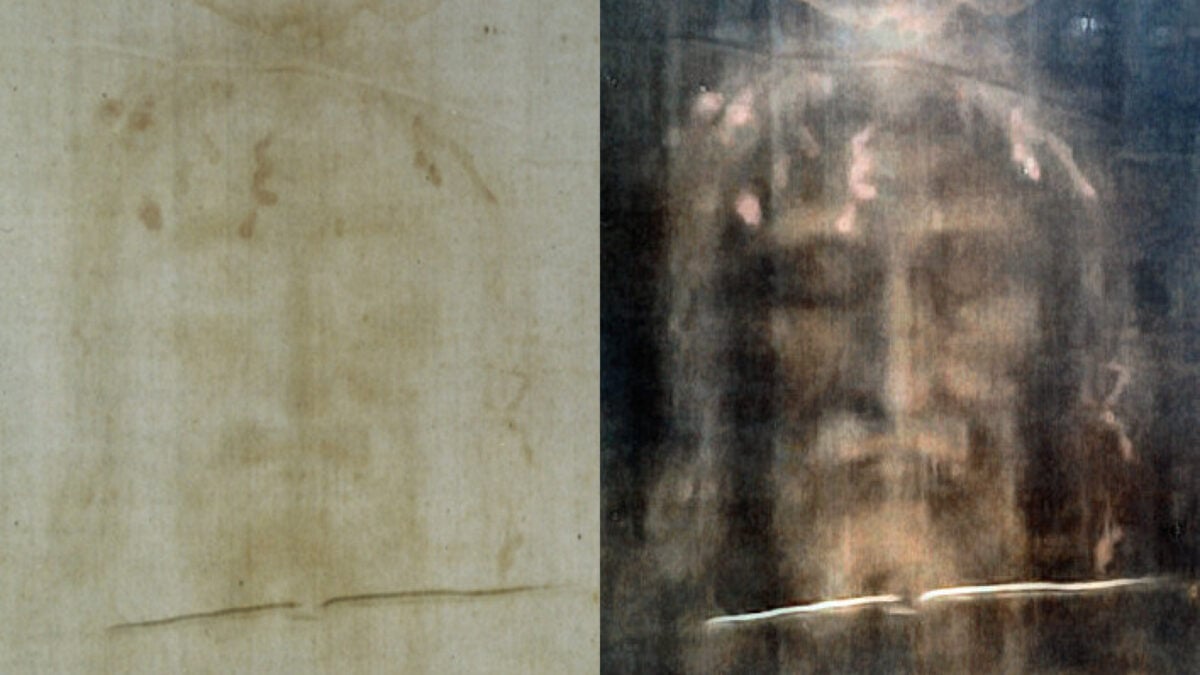
The Shroud of Turin is a linen cloth about 14.4 feet long and 3.6 feet wide, bearing the image of a crucified man. For believers, that image has fueled the claim that the cloth once wrapped Jesus of Nazareth. For historians and scientists, the more immediate question has been whether the relic can be securely dated and geographically placed using physical evidence.
According to the supplied account, the shroud’s first definite historical appearance comes from a 1389 document that described it as a forgery. The cloth later changed hands multiple times, survived a fire, and eventually became established in Turin, Italy, where it remains today in the Chapel of the Holy Shroud.
That historical timeline has long made scientific dating especially important. If the cloth could be shown to originate in the first century, its status would change dramatically. If it dates to the medieval period, the strongest authenticity claims become much harder to sustain.
Radiocarbon dating still matters
The major benchmark remains the radiocarbon testing published in 1989, when British, American, and Swiss researchers analyzed samples with Vatican permission. That work concluded the shroud most likely dated to between 1260 and 1390 CE. In other words, the cloth appeared to be medieval, not first-century.
The source text notes that this conclusion has been challenged by some scholars, but also cites paleogeneticist Anders Götherström saying most researchers consider the dating sufficiently robust. That does not mean debate has disappeared. It does mean the scientific burden for overturning the medieval dating remains high.
The new DNA work does not replace radiocarbon dating, and it does not independently prove a medieval origin. Its importance lies elsewhere. It weakens the hope that trace DNA on the cloth could provide a clean shortcut to the relic’s true age or its earliest handling history.
Why the DNA is not decisive
In theory, DNA recovered from an artifact might reveal something about where it has been, who touched it, or what biological materials it contacted. In practice, the shroud presents an extreme contamination problem. A relic that has moved through centuries of ritual, conservation, storage, public display, and environmental exposure is exactly the sort of object likely to accumulate layered biological traces from many eras.
The preprint’s broad mix of human, animal, and plant DNA fits that expectation. Instead of isolating a meaningful original signal, the analysis appears to show a record of repeated contact over time. That is scientifically interesting, but it is not the kind of evidence that can confidently identify a first owner, a first location, or a first-century timeline.
The study also follows a 2015 paper led by the same researcher that suggested the shroud was manufactured in India. The new findings, however, seem to move in a more cautious direction. Rather than clarifying a single origin, they emphasize how difficult it may be to extract definitive evidence from such a heavily handled object.
The result is not a final verdict, but it does sharpen the state of the argument. The shroud’s most cited scientific dating still places it in the medieval era. The latest DNA analysis does not overturn that conclusion. If anything, it suggests the relic’s accumulated biological history is so crowded that genetics may be less useful here than some had hoped.
This article is based on reporting by Gizmodo. Read the original article.
Originally published on gizmodo.com