A new surveillance problem defined by cost
NATO is rethinking how it watches the sky, and the catalyst is not a single breakthrough weapon so much as the economics of modern conflict. Adm. Pierre Vandier, NATO’s Supreme Allied Commander Transformation, said the alliance is adjusting its aerial surveillance approach after seeing the effectiveness of low-altitude drones and missiles in Ukraine and in the conflict involving Iran. His central point was blunt: today’s contest is a “cost-war,” where the relevant measure is not only whether a target can be hit, but whether it can be detected and defeated at a better cost than the attacker pays to field it.
That framing matters because it pushes NATO beyond the traditional model of relying on a small number of exquisite airborne surveillance platforms. Cheap drones, low-flying cruise missiles, and dense attack combinations force defenders to search wider areas, process more ambiguous tracks, and do so continuously. If every interception requires an expensive response, the defender can lose financially even while preventing damage.
Vandier’s remarks indicate that NATO increasingly sees surveillance as the foundation of this cost equation. Early warning, tracking, and identification determine not just whether an attack can be stopped, but whether the response can be rationally scaled. If the alliance cannot reliably detect low-altitude threats across a broad battlespace, everything downstream becomes more expensive and more fragile.
Why NATO is moving past the classic AWACS model
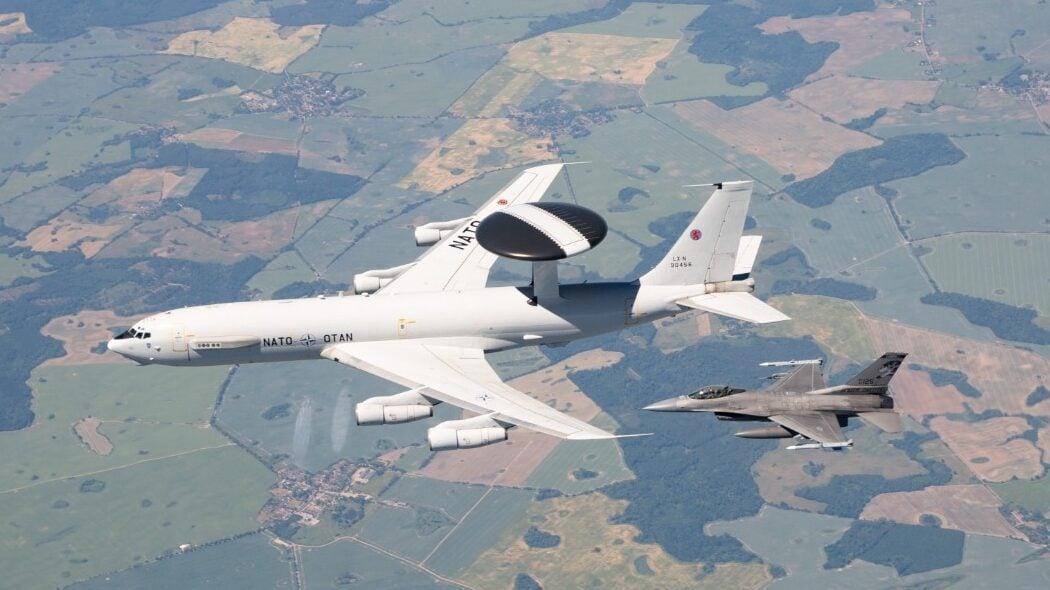
A key part of the rethink is the Allied Federated Surveillance & Control, or AFSC, program, which is intended to replace NATO’s aging Boeing E-3A AWACS aircraft. Those aircraft have served since the 1980s and remain easily recognizable by the large radar domes mounted on their fuselages. They have played a major role in patrol missions along the Baltic and Black Seas and in watching the skies over Ukraine, but the alliance now appears to view a one-platform answer as too vulnerable and too limited for the threat environment ahead.
Vandier said the next surveillance architecture will not be a single aircraft type. Instead, it will be a “system of systems” using space, airborne, and ground components together with enhanced radar capabilities. The logic is straightforward. A distributed network is harder to kill, can cover different altitudes and angles, and can be upgraded incrementally as new sensors and software mature.
This is also a strategic shift in how NATO defines resilience. An AWACS fleet concentrates capability in a small number of high-value assets. A federated architecture spreads that capability across multiple layers and domains. In practical terms, that could mean relying more on satellites, more on ground-based sensors, more on networking and command-and-control, and less on the assumption that a handful of airborne warning aircraft can anchor the entire picture.
The change comes after a major setback in NATO’s interim replacement plans. In November 2025, a multibillion-dollar deal to procure six Boeing E-7A Wedgetail aircraft collapsed after losing what was described as its “strategic and financial foundations.” That failure added urgency to the question of what comes next.
Lessons from recent wars are changing requirements
NATO’s updated priorities reflect how recent conflicts have compressed the distance between reconnaissance, strike, and attrition. Low-flying targets are difficult precisely because they exploit terrain, clutter, and radar limitations. Drones can be cheap, numerous, and adaptable. Missiles can approach below the coverage envelope of legacy systems optimized for other profiles. Together they create persistent pressure on defenders to detect earlier and classify faster.
To speed the search for answers, NATO Allied Command Transformation issued a request for information to industry last month. The request sought immediate and emerging technologies for detecting, tracking, and identifying aerial threats flying at altitudes up to 10,000 feet above ground level. That ceiling captures the operational band where many drones and low-altitude missiles become especially problematic.
The emphasis is notable because it suggests NATO is not treating this as a distant modernization exercise. The alliance is trying to close a current operational gap. Surveillance is being reconsidered alongside command-and-control and air defense, not as an isolated sensor procurement problem but as part of the architecture needed for sustained warfare.
The reference to space-based tracking also underscores how quickly alliance thinking is broadening. The United States is already investing in satellite tracking as part of its own multidomain surveillance picture. NATO’s movement toward a layered system suggests that future warning networks will be expected to fuse data from orbit, from aircraft, and from ground systems fast enough to support real-time defensive decisions.
What NATO’s comments make clear
- The alliance sees cheap drones and low-flying missiles as central drivers of a new air surveillance problem.
- NATO wants to replace its aging E-3A AWACS fleet with a broader, distributed surveillance network.
- The AFSC program is being framed as a multidomain “system of systems,” not a single-platform replacement.
- Industry has been asked for technologies that can detect and identify threats up to 10,000 feet above ground level.
The strategic implication is that the surveillance fight is becoming inseparable from the affordability fight. NATO is not only asking how to detect aerial threats. It is asking how to do so in a way that allows sustainable defense against mass, repetition, and cheap attack vectors. That is a different problem from the Cold War-era one that produced AWACS.
For the alliance, the real lesson from Ukraine and from the Iran-linked conflict may be that persistence now matters as much as peak capability. A network that can survive, adapt, and keep generating a usable picture under pressure is more valuable than a smaller number of exquisite platforms that are harder to replace and easier to target. NATO’s surveillance rethink reflects that shift. The sky is still the battlespace. But increasingly, the contest begins with who can make sense of the lowest part of it at acceptable cost.
This article is based on reporting by Breaking Defense. Read the original article.
Originally published on breakingdefense.com