A Small Vehicle Gains a Much Bigger Mission Set
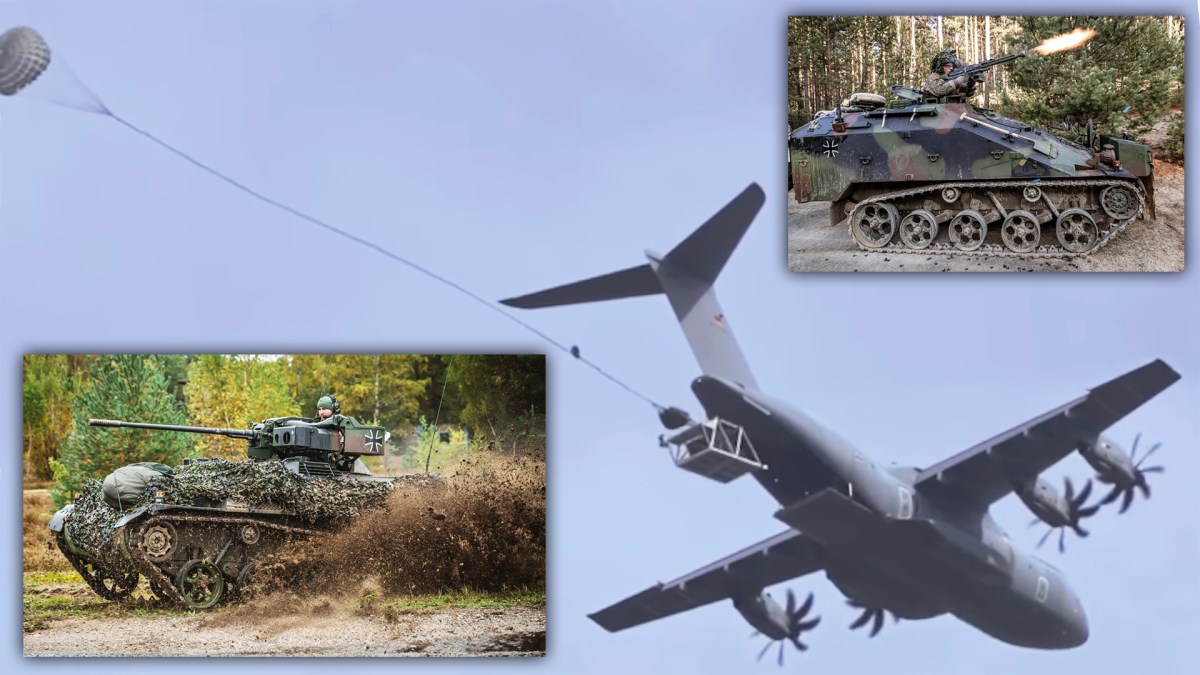
Germany’s armed forces have disclosed tests showing the Wiesel armored vehicle being airdropped from an A400M transport aircraft, a notable step for one of the smallest tracked combat vehicles in regular military use. The Wiesel has long been valued for its compact size, speed, and suitability for airborne units. The new trials suggest Germany now wants to push that utility further by making the vehicle deployable directly by parachute rather than only by air transport and ground unloading.
That change may sound incremental, but for airborne forces it is operationally significant. A force that can arrive with a lightweight armored vehicle close to its landing zone gains a different kind of immediacy. Instead of waiting for follow-on transport or heavier logistics, troops can potentially bring protected mobility and direct fire support into an austere environment much faster.
The Trial Points to Practical Battlefield Use
According to the supplied source text, the tests involved the German Armed Forces’ Technical and Airworthiness Center for Aircraft and the 1st Airborne Brigade. The vehicle was loaded into an A400M inside an ATAX parachute cage system made by IrvinGQ, rolled out of the rear ramp, and lowered under three parachutes. Reusable shock-attenuating airbags under the cage softened the landing. Soldiers were then able to drive the vehicle directly off the pallet with little preparation.
That last detail is especially important. The military value of an airdrop system is not just whether the equipment survives impact. It is whether the equipment becomes usable quickly enough to matter. If the Wiesel can land, be recovered, and move almost immediately, the concept becomes far more relevant for contested or time-sensitive missions.
The source says the German Army is aiming to place the vehicle within roughly 200 meters of the designated landing zone. That suggests an effort to make the system tactically precise enough to support dispersed airborne operations rather than simply proving that a drop is technically possible.

Why the Wiesel Fits the Role
The Wiesel was originally developed to give airborne units more firepower without burdening them with a full-sized armored platform. Germany became the only country to adopt the type, purchasing its first batch in 1985. More than 340 examples were built through 1993, and Germany later added about 180 of the lengthened Wiesel 2 variant in 2001. Its design philosophy has always been about trading heavy protection for portability and flexibility.
The vehicle’s characteristics help explain why it is now being adapted for this mission. It uses a standard four-cylinder Volkswagen diesel engine, can exceed 40 miles per hour, and has a range of about 120 miles according to the supplied source material. It is also compact enough to fit inside a CH-53 helicopter. Those traits already made it unusually deployable by military standards. The airdrop trials build on that logic by eliminating the need for a secure landing strip or helicopter insertion in every case.
For Germany, the move also reflects a broader European defense trend toward rebuilding readiness, mobility, and rapid-reaction capability. Airborne forces have symbolic value, but they become far more credible when they can bring meaningful combat systems with them at the opening stage of a deployment. Airdroppable vehicles do not replace heavier mechanized forces, but they can extend the combat relevance of paratroops in the gap before larger units arrive.
- Germany tested parachute airdrops of the Wiesel from an A400M using an ATAX cage system.
- The vehicle can reportedly be driven off the pallet shortly after landing.
- The goal is to place the Wiesel within about 200 meters of the target landing zone.
The Wiesel remains a niche platform by size and role, but that is precisely what makes this development interesting. Rather than trying to force a large vehicle into airborne service, Germany is refining a small one for faster deployment. In modern military planning, that kind of tailored mobility can matter more than raw mass.
This article is based on reporting by twz.com. Read the original article.
Originally published on twz.com