SuperCDMS hits a key milestone underground in Canada
The Super Cryogenic Dark Matter Search, or SuperCDMS, has reached its operating temperature at SNOLAB in Canada, marking a major transition for one of the most sensitive dark matter searches now underway. The experiment is designed to detect dark matter particles passing through Earth, and the temperature milestone means its installed detectors can now begin exploring a new region of parameter space where some of the lightest candidate particles may be hiding.
The result is significant because dark matter remains one of the biggest unsolved problems in modern physics. Scientists widely infer its existence from gravity’s effects on galaxies and large-scale cosmic structure, yet direct evidence of the particles themselves has remained elusive. SuperCDMS is part of the long-running effort to close that gap with exquisitely sensitive detectors placed in an environment built to suppress interference.
Why temperature matters so much
According to the project team, the experiment has been cooled to roughly one-thousandth of a degree above absolute zero. That is hundreds of times colder than outer space and close to the point where atomic and molecular motion effectively stops. For a dark matter detector, reaching that regime is not simply a technical flourish. It is essential to reducing noise and making extremely faint interactions detectable.
SuperCDMS is built around cryogenic solid-state detectors that must operate at these very low temperatures to achieve the sensitivity needed for the search. The colder the system, the better the chance of distinguishing a genuine rare signal from background disturbances. In practical terms, the milestone signals that the instrument has moved from years of construction and engineering toward the scientific phase it was designed for.
Project spokesperson Priscilla Cushman described reaching base temperature as a major milestone in the broader campaign to build a low-background facility capable of housing these detectors. The importance of that phrase, low-background facility, cannot be overstated. Dark matter searches often fail not because there is no signal, but because ordinary radiation and environmental noise can overwhelm the tiny effects researchers are trying to see.

Built to block the world out
SuperCDMS is located at SNOLAB, described as the world’s deepest underground laboratory. That location is part of the experiment’s strategy. By operating deep underground, the project reduces the impact of cosmic rays and other sources of interference that would make the search far harder near the surface.
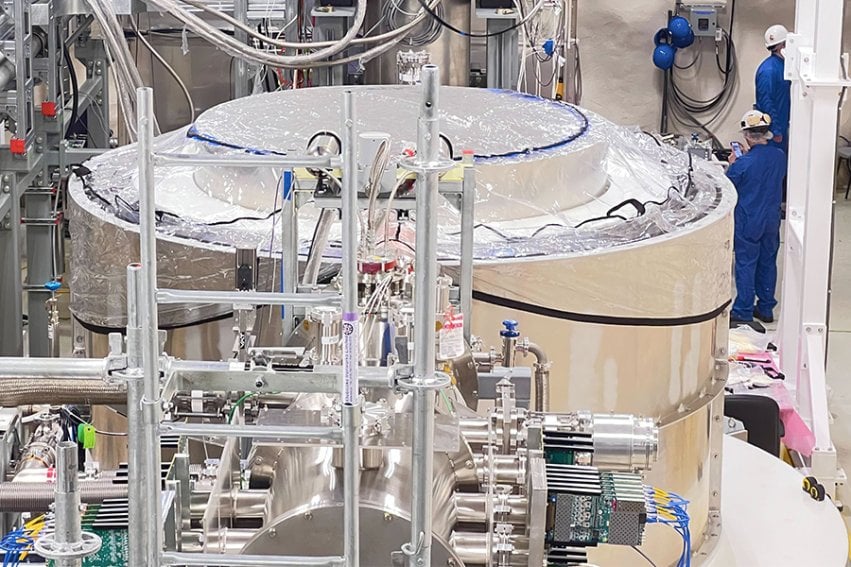
The apparatus itself adds another layer of protection. The experiment sits inside a cylindrical enclosure about four meters tall and four meters in diameter, built from layers of ultra-pure lead. This shielding is intended to protect the detectors from radiation, including neutrons and gamma rays created by high-energy cosmic rays interacting with Earth’s atmosphere. In dark matter work, shielding is not just a supporting system. It is part of the experiment’s scientific capability.
Researchers at the University of Minnesota played a major role in designing and assembling that low-background shield. The shield’s job is to create a zone as free as possible from trace radioactivity that could mimic or bury a true dark matter interaction. When the signal being hunted may be vanishingly small, every trace contaminant matters.
What SuperCDMS is trying to find
Dark matter is thought to account for about 85 percent of the mass in the known universe, yet scientists still do not know what it is made of. One widely accepted idea is that it consists of particles that interact with ordinary matter primarily through gravity. That broad picture has motivated many experimental efforts, but it also leaves a large range of possibilities for mass and behavior.
SuperCDMS is especially important because the team says the detectors can now scan a new region of parameter space where lighter dark matter particles may exist. That focus helps distinguish it from some earlier searches that emphasized heavier candidates. The field increasingly recognizes that dark matter, if particle-based, may not sit in the most conventionally expected mass range, and experiments must broaden their reach accordingly.
The scientific value of the milestone, then, is not only that the machine is cold enough to run. It is that reaching this temperature opens access to measurements that were previously impossible. The experiment can now test ideas about dark matter that theory alone cannot settle.

A milestone, not a discovery
It is important to separate the achievement from the outcome people may ultimately hope for. SuperCDMS has not detected dark matter. What it has done is cross a threshold that makes the search scientifically viable at the required sensitivity. In large physics experiments, that distinction matters. Major advances often begin with engineering milestones that quietly determine whether the science can happen at all.
This is one of those moments. Getting a large, shielded, cryogenic detector system to its base temperature deep underground is the kind of step that reflects years of coordination, design, and persistence. It turns a concept and construction project into an operating instrument.
If SuperCDMS succeeds later, this stage will likely be remembered as the point where the experiment became fully capable of testing its core ideas. If it does not find a signal, the data will still help narrow the possibilities and sharpen future searches. Either result is scientifically valuable, because dark matter research advances not only through detections but also through constraints.
The longer arc of the search
For decades, dark matter has remained a paradox at the center of cosmology: apparently dominant in the universe’s mass budget, but stubbornly absent from direct observation. Experiments like SuperCDMS exist because solving that paradox requires more than stronger theories. It requires instruments that can operate at extraordinary limits of quiet, isolation, and precision.
Reaching base temperature does not answer the dark matter question. It does something more immediate and necessary: it gives scientists the conditions needed to ask the question properly with hardware built for the task. That is why this milestone matters. It represents the beginning of a new observing phase in one of physics’ most difficult hunts.
For now, the headline is simple but important. SuperCDMS is cold enough to work as intended, shielded well enough to begin listening, and finally positioned to search for some of the faintest suspected matter in the universe.
This article is based on reporting by Universe Today. Read the original article.

Originally published on universetoday.com