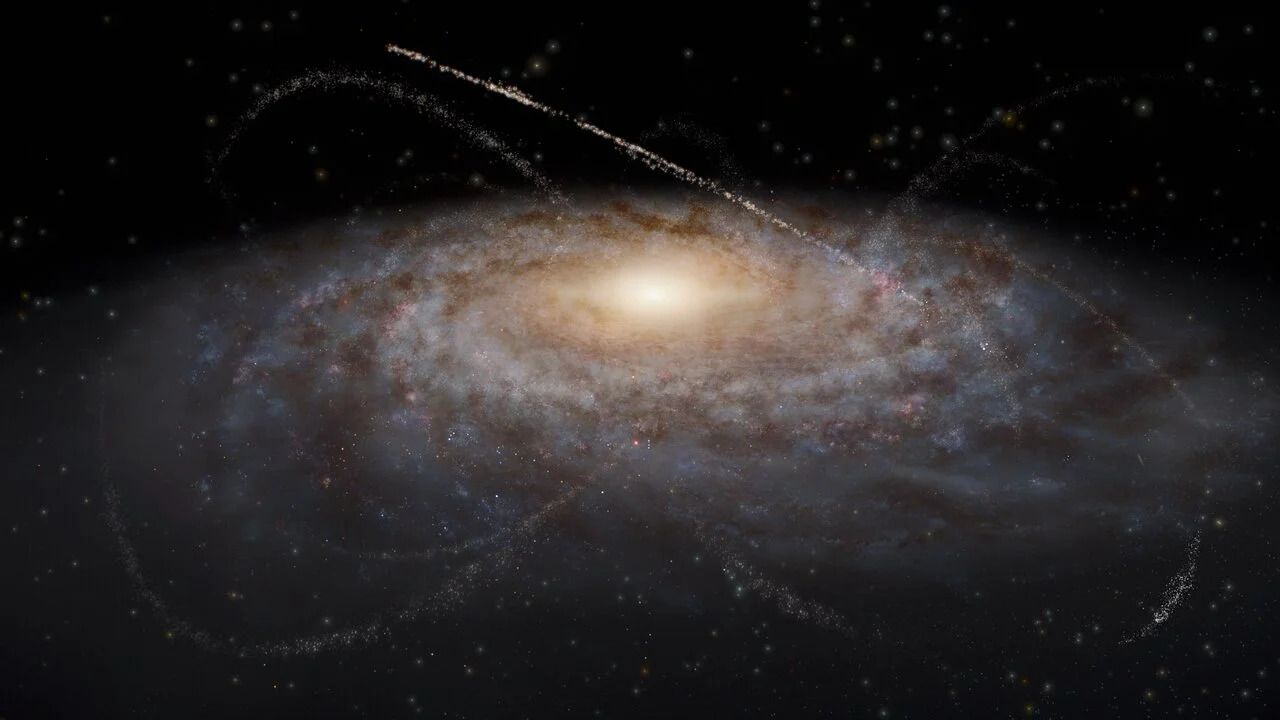
A wider map of the Milky Way’s faintest structures
Astronomers have identified dozens of previously hidden stellar streams in the outskirts of the Milky Way, using data from the European Space Agency’s Gaia mission and a new algorithm designed to detect these extremely faint structures. According to the reported findings, the method more than quadruples the number of known candidate streams, opening a larger window into how the galaxy assembled over time.
Stellar streams are long, arcing ribbons of stars left behind when compact star clusters move through the Milky Way’s gravitational field and gradually shed members. Over time, those stars are stretched into narrow trails that preserve a record of the interactions that shaped them. Because of that, every newly identified stream is more than a visual curiosity. It is also a trace of the galaxy’s past.
The newly reported candidates matter for two reasons at once. First, they expand the known population of these structures in the Milky Way’s outer regions, where the galaxy’s history is harder to read directly. Second, they may help researchers test ideas about how dark matter is distributed, because the shapes and disruptions of stellar streams are influenced by gravity on large scales.
Why stellar streams matter
Galaxies like the Milky Way were not built in a single event. They grew by accreting smaller systems over long periods, including dwarf galaxies and star clusters. Stellar streams are among the clearest surviving signatures of that process. In effect, they are the debris trails of earlier gravitational encounters.
That makes them unusually valuable to astronomers trying to reconstruct galactic evolution. A stream can reveal where a cluster once traveled, how strongly it was pulled apart, and whether something invisible may have disturbed it along the way. In that sense, these thin bands of stars act as historical records written in orbital motion.
The report describes the new search as a major step beyond earlier efforts because the algorithm was guided by a simpler theoretical picture of what to look for. That matters in modern astronomy. Vast surveys like Gaia produce enormous quantities of positional and motion data, but the challenge is not only collecting information. It is knowing how to recognize a subtle pattern inside it.
When theory and data line up well enough, previously buried structures can become visible. That appears to be what happened here. Instead of treating the Milky Way’s outskirts as a difficult background field, the new search framed those regions as a place where predicted stream-like signatures could be identified more efficiently.

Gaia’s continuing scientific reach
The discovery also underlines the continuing impact of Gaia, which has transformed astronomy by measuring the positions, distances, and motions of an enormous number of stars. That combination is especially powerful for stream hunting. A random grouping of stars may look meaningful in a static image, but a real stream should also show coherent motion.
With Gaia data, researchers can test for that coherence instead of relying only on appearance. The result is a more reliable way to distinguish genuine structures from chance alignments. In practical terms, that means the Milky Way can be mapped in greater detail and with more confidence than was possible a generation ago.
The outer galaxy is particularly important because it preserves some of the cleaner signatures of ancient interactions. Closer to the galactic center, repeated gravitational encounters can blur or scramble older structures. In the halo and outskirts, the evidence can remain visible for longer, even if it is faint and difficult to detect.
What the new candidates could reveal next
The discovery of many more candidate streams does not close the story. It starts a broader one. Each candidate will now need closer scrutiny, and the most promising ones can be followed up with additional observations and modeling. Researchers will want to know their origins, their orbits, and whether their shapes show signs of disturbances beyond the smooth pull of the Milky Way itself.
That is where the dark matter question becomes especially compelling. If stellar streams are perturbed in particular ways, they can provide indirect clues about unseen mass clumps moving through the halo. In other words, these newly found ribbons of stars may become tools not only for understanding visible galactic history, but also for probing the invisible architecture around it.
For now, the main result is already substantial. A better search method has revealed that the Milky Way may be threaded with far more faint stellar streams than previously cataloged. That shifts the scale of the map astronomers are working from and suggests that the galaxy’s outskirts still hold a large reserve of unrecognized structure.
In a field where major progress often comes from seeing old data in a new way, this is a consequential advance. The stars were already there. What changed was the ability to recognize the pattern they formed.
This article is based on reporting by Space.com. Read the original article.
Originally published on space.com