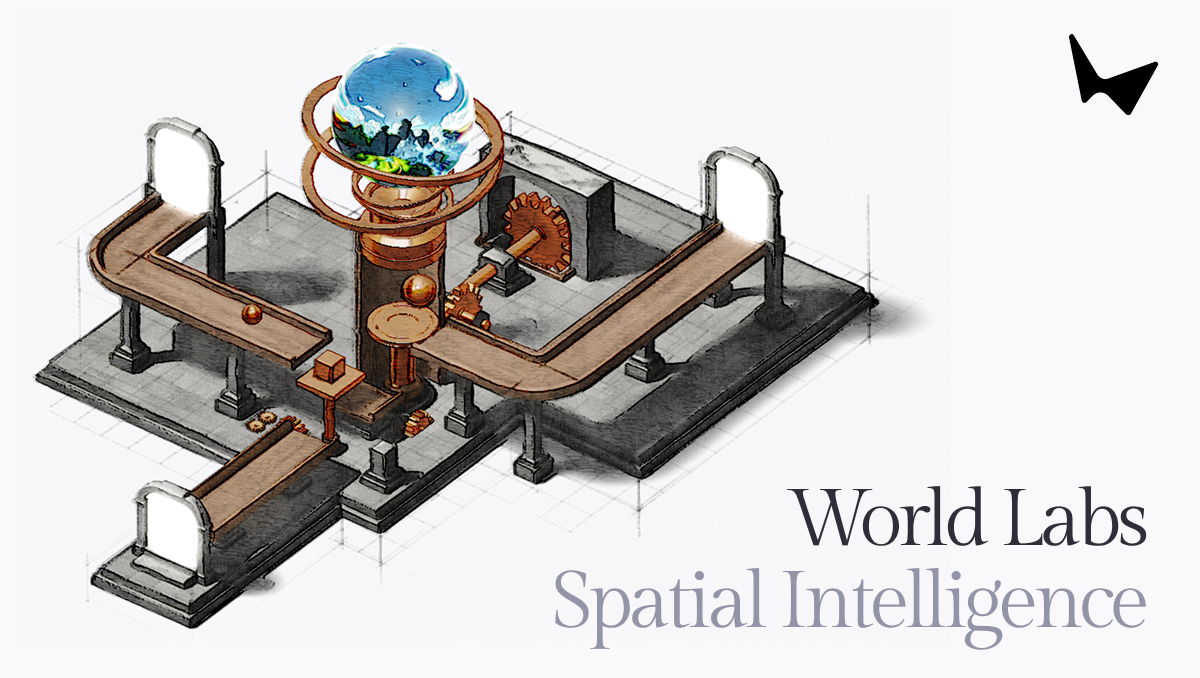
The next AI story may be about reality, not just text
Fast Company’s feature package on autonomy highlights one especially important development: Fei-Fei Li’s new company, World Labs, has reportedly reached a $1 billion valuation while positioning itself around a different AI frontier. According to the supplied source text, the company is betting on systems that understand the real world rather than only the digital one, and it is being framed as an early leader in the rise of world models.
That matters because it suggests a shift in where capital and ambition are flowing inside AI. Large language models defined the last wave of consumer and enterprise attention. The World Labs framing suggests investors and builders are now looking toward models that can represent space, objects, environments, and physical context more directly.
From language competence to world understanding
The source text presents a concise but consequential claim: world models are replacing large language models as the next wave of AI investment and hype. Even allowing for the promotional language that often accompanies frontier AI coverage, that sentence captures a real strategic transition. Language models are powerful at prediction over text and increasingly over images and code, but systems that must act in or reason about physical environments need something more grounded.
That is the promise World Labs appears to be pursuing. The company is described as working on “understanding the real world, not just the digital one.” In practical terms, that framing points toward AI that can model scenes, space, movement, and environment in ways that are useful for robotics, simulation, autonomy, and richer machine perception.
The source excerpt does not claim that World Labs has solved those challenges. What it does show is how the company is being positioned: not as another entrant in general chatbot competition, but as part of a broader race to build AI systems that can map and interpret reality more faithfully.
Why investors care
A reported $1 billion valuation is not just a financing milestone. It signals the level of conviction surrounding this thesis. Investors appear willing to assign substantial value to the idea that the next major AI platform shift will involve machine understanding of the physical world.
That is a logical direction for the market to explore. Many high-value applications of AI, from autonomous vehicles to industrial robots to simulation tools, depend on more than fluent text generation. They require systems that can represent the structure of environments and predict how those environments change. If language models provided a scalable interface to knowledge work, world models could be framed as a scalable interface to embodied or spatial reasoning.
The Fast Company excerpt also says World Labs has first-mover advantage. That phrase should be treated cautiously, but it is still revealing. In fast-moving technical markets, first-mover advantage often means a company has succeeded in defining the category before rivals have fully crystallized their positions. Even if the competitive landscape shifts quickly, being associated early with the core idea can shape recruitment, funding, and partnership opportunities.
A broader autonomy theme
The article appears inside a package titled “The Future of Autonomy,” which helps explain why World Labs stands out. Autonomy is increasingly less about isolated models and more about systems that can sense, interpret, decide, and act across real settings. Whether the application is robotics, transportation, commerce, or enterprise agents, the same question keeps returning: how much of the world can the model actually represent?
That question has become more urgent as AI moves from productivity software into operational domains. A model that writes well is not automatically a model that understands physical space. By emphasizing real-world understanding, World Labs is being cast as part of the effort to close that gap.
What to watch next
The available source text is limited, so it does not provide technical details about World Labs’ architecture, benchmarks, or products. It also does not establish timelines for deployment. But it does provide enough to identify why the company is attracting attention now. Its significance lies less in a disclosed product launch than in the direction of travel it represents.
If the next phase of AI competition centers on models that can build richer internal representations of the world, then research organizations and startups working on that problem may become increasingly central to the industry narrative. That would not mean language models disappear. More likely, it would mean they become one layer inside broader systems aimed at perception, simulation, and action.
For Developments Today readers, the key takeaway is simple: World Labs is emerging as a marker of where frontier AI may be heading next. The sector is not abandoning text-centric models, but it is increasingly looking beyond them. A company built around understanding reality itself is a clear sign that the industry’s ambitions are moving from conversation toward cognition in the physical world.
This article is based on reporting by Fast Company. Read the original article.
Originally published on fastcompany.com


